

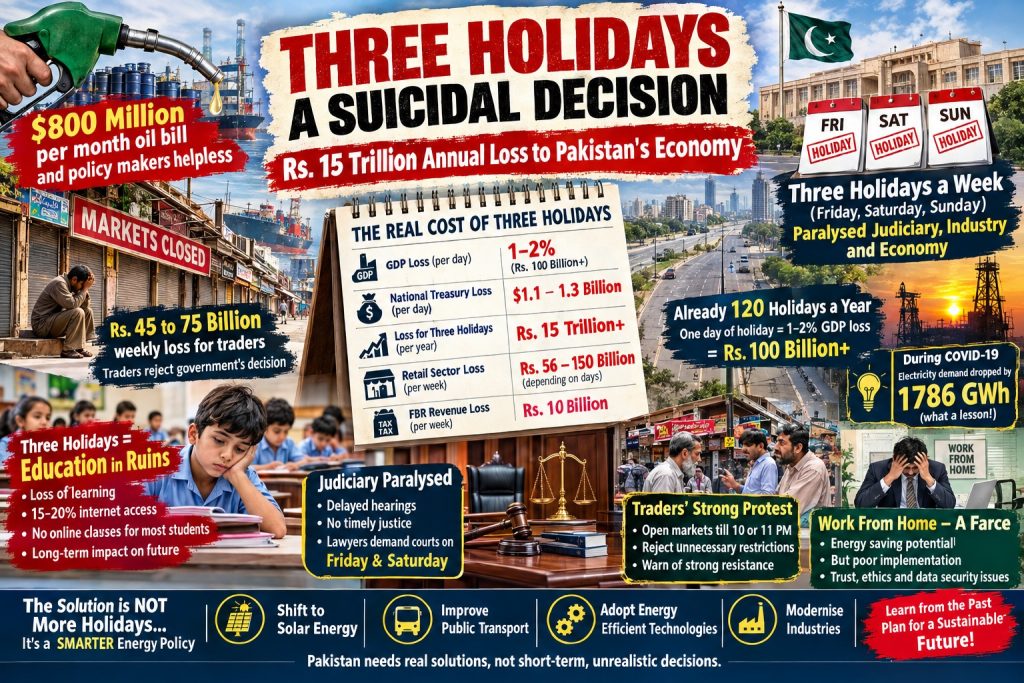

Self-Destructive Decision of Three Holidays: Pakistan’s Economy to Suffer an Annual Loss of 15 Trillion Rupees
By Mian Iftikhar Ahmad
When Pakistan’s policymakers have started considering the decision to make three holidays a week, the question arises whether these people have been unable to learn from past experiences or whether they are working under some agenda that will lead to the destruction of the country’s economy and the lives of the people. According to a news broadcast on City 41, consideration is being given to three holidays a week to save oil, which means that Friday, Saturday, and Sunday will be complete holidays, and government and private offices will work only four days a week. The argument being given behind this decision is that it will significantly reduce vehicular traffic on the roads and save fuel consumption. But the question is whether this will actually save oil or whether it is merely a decision that will push the economy further toward destruction. Sacrificing the public in the name of saving oil is the decline of the thinking of policymakers. This policy is equivalent to the massacre of education and the ruination of the future of the new generation. An 800 million dollar monthly oil bill and such policies are the best example of the helplessness of policymakers. According to a careful estimate, this will cause a weekly loss of 45 to 75 billion rupees. Three holidays a week will paralyze the judiciary, paralyze industry, and paralyze the economy. Why has the lesson of the Corona period been forgotten. Why are market timings not being reduced. The Government of Pakistan had also announced three holidays in March 2026 under similar circumstances, under which 50 percent of staff in government offices were given the facility of work from home, and the fuel quota of government vehicles was reduced by 50 percent, while 60 percent of vehicles were temporarily shut down. At that time, these measures were taken for two months, but later they were also extended. Now in September 2026, the same proposal is again under consideration, which shows that policymakers have no new solution available and are merely repeating old prescriptions. The problem is that Pakistan’s oil import bill has already gone out of control. During the five months from March to July 2026, Pakistan’s petroleum import bill reached approximately 7.7 to 7.9 billion dollars, which is about 20 percent higher than the 6.6 billion dollars of the same period last year. Due to the Iran war and shipping disruptions in the Strait of Hormuz, the petroleum import bill in June 2026 had reached approximately 1.91 billion dollars, which was a 46 percent increase in one month. Prime Minister Shehbaz Sharif himself had admitted that Pakistan’s weekly oil import bill had increased from 300 million dollars to 800 million dollars, which is a terrible increase of 167 percent.

If we examine the economic effects of this decision, Pakistan already has approximately 120 holidays annually, and due to one day’s holiday, the country’s GDP suffers a loss of 1 to 2 percent, which amounts to more than 100 billion rupees. One general holiday causes a loss of 1.1 to 1.3 billion dollars to the national treasury, and if this loss extends to three holidays, on an annual basis this amount could exceed 15 trillion rupees. According to a report by the Chain Store Association of Pakistan, due to the current restrictions on market timings, approximately 45 to 75 billion rupees of documented retail activity is being affected every week, while the FBR is suffering a tax revenue loss of up to 10 billion rupees every week. If three holidays are imposed, then in the retail sector alone, the loss of one day will be approximately 56 billion rupees, of two days 115 billion rupees, and with the addition of Friday, it could reach approximately 150 billion rupees per week. Due to markets closing at 8 pm, the retail sector suffered a loss of 200 billion rupees within just two weeks, and this policy is already facing severe opposition from traders.
Traders’ organizations have clearly rejected this decision. President of Central Anjuman Tajran Sherjeel Mir, President of Kiryana Merchants Association Saleem Parvez Butt, and other trader leaders have demanded that markets be allowed to remain open until 10 or 11 pm, and if the government tries to impose restrictions again, it will face strict resistance and protest. Traders say that regional tensions between Iran, America, and Israel have decreased, and due to increased business activities and reduced fuel pressure, this policy has become unnecessary. They warned that the early closure of markets has caused severe loss to traders, and if this step is taken again, it will face severe opposition. The effects of this decision on the education sector will be even more devastating. President of All Private Schools and Colleges Association Dr. Abrar Hussain Malik has clearly stated that three holidays a week will severely harm children’s education, and the long weekend will increase students’ educational loss. He said that 3 holidays will severely damage educational activities and demanded that the notification of private educational institutions be withdrawn immediately. In remote areas like Swat and Shangla, private school administrations have also rejected the decision of three holidays, saying that the number of educational days is already low, and additional holidays of Friday and Saturday will pose further threats to students’ educational future. In Shangla, education stakeholders expressed concern that keeping schools closed from Friday to Sunday will pose a severe threat to the already weak education system, especially in remote and mountainous districts. In Punjab, permission had to be given to hold summer camps to compensate for the educational loss so that students’ wasted educational days could be made up. It is noteworthy that only 15 to 20 percent of students in Pakistan have internet access, so the option of online classes is also not available to most students, and if educational institutions remain closed, they will have no alternative means of learning.
Negative effects of this decision have also appeared on the judiciary. President of High Court Bar Association Saeed Yousuf Khan, President of District Bar Association Tariq Mahmood, and other senior lawyers have demanded the abolition of Friday and Saturday court holidays because three consecutive weekly holidays have paralyzed the judicial system, delays are occurring in the hearing of important cases, and timely delivery of justice has become difficult. Lawyers demanded that all courts be directed to work as usual on Friday and Saturday. During the Corona period, when it was decided to close markets at 6 pm, a clear reduction occurred in oil consumption and electricity demand. At that time, due to business centers closing at 6 pm, electricity consumption in business centers came to an end, and those markets that opened at 12 noon began opening at 8 am. During the Corona lockdown, a significant reduction occurred in energy demand in Pakistan, and a decrease of approximately 1786 gigawatt hours was recorded in electricity generation. After the nationwide lockdown was imposed in March 2020, electricity consumption decreased by 9 percent year on year. This same experience shows that if market timings are regulated, fuel can be saved, but making three complete holidays is not its solution. Chairman of Peoples Democratic Party Altaf Shakoor had said that during the peak of Corona, the experiment of early closure of markets was successfully conducted, and despite traders and shopkeepers being angry, the public largely accepted it. He proposed that markets be closed at 8 pm and restaurants and marriage halls at 10 pm, while government and private offices be allowed to work five days and the culture of work from home be promoted.
According to a report by the Pakistan Institute of Development Economics, the Government of Pakistan had taken fuel-saving measures in March 2026 in view of global conflict, under which up to 50 percent of staff in government and private offices were required to adopt a work from home policy. In global literature, work from home has been declared an effective means of energy saving because it reduces the fuel consumption of office equipment, lighting, air conditioning, and generators. However, questions exist regarding the effective implementation of this policy in Pakistan because issues such as distrust in government offices, professional dishonesty, disproportionate burden on a few employees, and data security concerns have emerged. To make work from home successful in Pakistan’s government offices, an effective communication system, work ethics, and clear organizational rules are needed, which are currently not present.
Economic experts say that making three holidays a week is a short-term and ineffective solution that will have negative effects on the economy, education, and people’s lives. Pakistan needs to focus on reforms in energy policy, not on temporary and irrational decisions that further weaken the country’s economy. Transition to solar energy, improving public transport, adopting modern methods of energy conservation, and equipping industries with modern technology are the measures that can help deal with the energy crisis on a long-term basis. Altaf Shakoor had said that Pakistan should move toward solar energy and every residential unit, shop, factory, office, school, and hospital should be shifted to solar energy because if the government gives appropriate incentives, millions of units can run fully or partially on solar energy, and electricity savings can increase to an unimaginable extent.
The biggest stupidity of policymakers is that they do not benefit from past experiences. In March 2026, when this same proposal was implemented, private schools, traders, and industrialists had rejected it, and later the government had to back down. The savings that occurred during Corona due to reduced market timings were the result of a coordinated and temporary strategy, not of complete holidays. If the government really wants to save energy, it should regulate market timings, promote work from home, improve public transport, and invest in alternative energy sources. Making three holidays a week is a decision that is not only harmful to business and education but is also not an effective solution for energy saving.
Severe reaction against this proposal is also emerging on government reports, think tank reports, and social media. The public says that instead of focusing on real issues to deal with the energy crisis, the government is pushing the people into further difficulties. Traders’ organizations have clearly said that three holidays will cause irreparable loss to business, and the government should take the suggestions of industrialists and traders into consideration. On social media as well, users have criticized this decision, saying that the government is increasing people’s difficulties and that long-term planning is needed for energy saving. Pakistan’s policymakers must understand that making three holidays is not a solution but a decision that will push the country further toward economic decline and social problems. The need is for the government to learn from past experiences, give importance to experts’ opinions, and prepare a comprehensive and sustainable energy policy that proves helpful in improving the country’s economy, education, and people’s lives. Otherwise, this decision of three holidays will be remembered in history as another great stupidity that pushed a poor and backward nation further toward backwardness.