

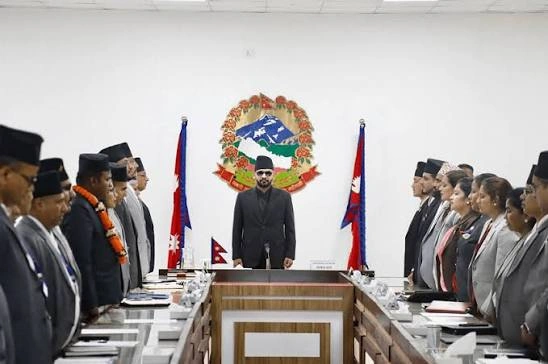

Nepal politics entered a new phase after last year’s unrest as the newly elected parliament held its first session, while the government pledged a formal apology to Dalit and historically marginalised communities.
Nepal’s political landscape has entered a period of significant change following last year’s unrest, with the newly elected House of Representatives holding its first session in April 2026 and the new government outlining a series of governance and social reform measures.
The opening of parliament marked an important stage in Nepal’s political transition after the elections. The first sitting of the House of Representatives took place on April 2, 2026, with senior-most member Arjun Narsingh KC chairing the session. Lawmakers endorsed interim rules to conduct parliamentary business until new rules are adopted.
The new government, led by Prime Minister Balendra Shah, has also placed social justice and institutional reform among its priorities. One of the most notable commitments is a plan to formally acknowledge historical discrimination against Dalit and historically marginalised communities.
Nepal Politics Enters New Parliamentary Phase
The first parliamentary session provided an early indication of the political debates likely to shape Nepal’s new government.
During the opening proceedings, lawmakers discussed the legacy of last year’s Gen Z protests and the need for investigations into incidents connected with the unrest. Opposition lawmakers also raised concerns about accountability and the treatment of protesters.
The session was briefly disrupted when CPN-UML lawmakers protested and demanded the release of former prime minister KP Sharma Oli and Nepali Congress leader Ramesh Lekhak. The incident reflected the political tensions surrounding the new parliament and the unresolved issues inherited from the previous political period.
Rastriya Swatantra Party chair Rabi Lamichhane also used his address to outline the government’s reform priorities. He said the new administration intended to focus on governance, transparency and institutional changes rather than relying on a traditional political transition period.
The Rastriya Swatantra Party emerged as the largest party following the elections, winning 182 seats, according to reporting on the first parliamentary session. The Nepali Congress won 38 seats, while CPN-UML secured 25 seats.
Government Announces Dalit Apology Plan
Another major development in Nepal politics has been the government’s decision to formally acknowledge historical discrimination against Dalit communities.
The government’s 100-point governance reform agenda included a commitment to recognise injustices, discrimination and deprivation of opportunities experienced by Dalits and other historically marginalised groups.
The plan called for a formal state apology within 15 days, alongside reform-oriented programmes intended to support social justice, inclusive rehabilitation and historical reconciliation.
The announcement has attracted attention because Dalits have historically faced caste-based discrimination and exclusion in Nepal despite constitutional protections and laws prohibiting caste discrimination.
The government’s proposal therefore goes beyond a general statement on equality by linking the planned apology with broader reform measures.
Rabi Lamichhane Apologises in Parliament
During the first sitting of the new House, Rabi Lamichhane publicly apologised to Nepal’s Dalit community on behalf of his party and government.
Lamichhane said discrimination based on caste should not be treated simply as a social mistake and described historical caste discrimination as organised injustice. He said the value of an apology would ultimately be measured through justice and action.
His remarks were significant because they came during the opening session of the newly elected parliament and placed caste discrimination directly within the government’s wider reform agenda.
However, reporting has distinguished Lamichhane’s parliamentary apology from the separate formal state apology promised in the government’s 100-point agenda. The government had committed to issuing the formal acknowledgement and announcing related reform measures within 15 days.
Dalit Groups Seek Concrete Action
The apology commitment has been welcomed by rights activists and organisations concerned with caste discrimination, but some have stressed that an official statement needs to be followed by practical reforms.
The Informal Sector Service Centre (INSEC), a human rights organisation, welcomed the government’s commitment to acknowledge historical discrimination while calling for concrete, time-bound and measurable implementation of the promised reforms.
The issue is particularly important because activists have argued that discrimination remains embedded in parts of Nepali society despite legal protections.
The Kathmandu Post reported that community representatives welcomed the government’s acknowledgement but also called for meaningful changes on the ground. The report highlighted concerns that legal provisions and government policies have not always been implemented effectively.
Political Reform and Social Justice
The developments surrounding the new parliament and the Dalit apology are part of a broader reform agenda being pursued by Nepal’s new administration.
The government has presented its programme as an effort to improve governance, strengthen transparency and address longstanding social and institutional problems.
For Nepal politics, the opening of the new parliament therefore represents more than the beginning of another legislative session. It provides the new political leadership with an opportunity to address issues raised during the country’s recent unrest while also responding to longstanding demands from marginalised communities.
At the same time, the debates in parliament show that the new administration will face scrutiny from opposition parties over its policies and its handling of the legacy of last year’s protests.
The government’s approach to caste discrimination will also be closely watched as it moves from a stated commitment toward possible policy and institutional changes.
What Comes Next for Nepal
Nepal’s new political period is now taking shape around several major issues, including governance reform, accountability for last year’s unrest, economic development and social inclusion.
The government’s planned apology to Dalit and historically marginalised communities has added another important element to that agenda.
While Rabi Lamichhane has already apologised publicly in parliament, the government’s broader commitment involves formal recognition and reform programmes aimed at addressing historical discrimination.
The effectiveness of the new administration’s reform programme will depend on how its commitments are translated into policy and implemented through government institutions.
As the new parliament continues its work, Nepal politics is likely to remain focused on balancing the demands for accountability following last year’s unrest with the government’s promises of institutional reform and greater social inclusion.