
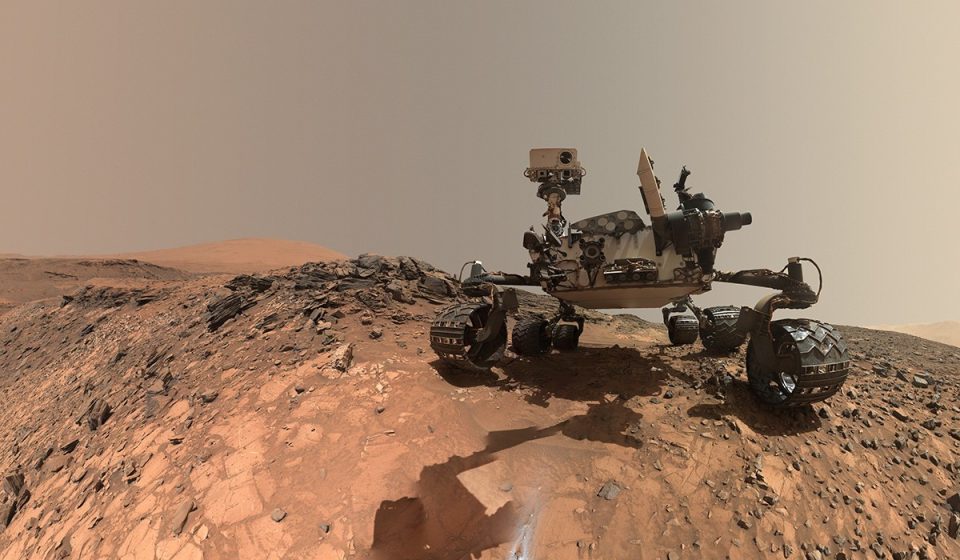

WASHINGTON: NASA has released a striking image of dawn on the Martian surface taken by its Curiosity rover, showing sunlight bathing jagged crags formed billions of years ago as the car-sized vehicle continues to explore Earth’s planetary neighbour. The photograph was taken on August 11, 2026, and released on October 6. It shows wind-carved cliffs in the distance, with bright morning light on the horizon and blue tones in the foreground. Scientists say the rocks are a layer they have been waiting to study up close for years.
Background: A Rover That Has Been Climbing Since 2014
Curiosity landed on Mars in 2012 in Gale Crater, a huge basin near the planet’s equator. Since 2014, it has been slowly climbing Mount Sharp, a mountain about 3 miles (5 km) tall that rises from the crater floor. The mission is designed to study the geology and climate of Mars and to find out whether the planet once had conditions that could have supported microbial life.
The rover has now climbed more than 1 kilometre above the crater floor, which NASA says is the highest elevation gain ever achieved on Mars. This milestone was marked in late August. Each layer of rock in the mountain records a different period in the planet’s history, so climbing upward is like moving through time.
Details: What the New Image Shows
The photograph is a zoomed-in crop of a larger panorama made from six shots taken by Curiosity’s Mastcam camera. It was captured about an hour after sunrise, in the early morning of Mars local time. NASA said that, unlike most Mastcam images, this one was processed without white balancing, which helps to keep the real colour of the morning light. That is why the foreground has blue tones, while the sunlit crags in the distance look warm and bright.
The jagged features are called yardangs, which are ridges formed when wind wears away rock over very long periods. According to the mission’s project scientist, Ashwin Vasavada of NASA’s Jet Propulsion Laboratory, this rock layer looks quite different from all the layers the rover has driven through so far. Scientists think it was once wind-blown sediment, maybe sand or even volcanic ash that blew into the crater, and then hardened into rock before the wind carved it.
The yardang layer covers about 10 miles (16 km) across the north-western part of Mount Sharp. NASA hopes that Curiosity will reach it in 2027 or 2028, and the rover will then use its instruments to study the rocks closely. The team expects the layer to offer clues about how the area changed over time.
Quotes: What the Mission Scientist Said
Vasavada said the scene has a wildness that reminds him of a road trip through Monument Valley in Arizona, with silence and endless open space under the sky. But he pointed out that the sky on Mars is orange and the sunrise has shades of blue. “It’s like Earth, but it’s definitely Mars,” he said.
Note for the writer: please add one more verified comment from NASA or another planetary scientist if you can find it. Do not publish invented quotes.
Impact: Why the Mission Still Matters
The image is a reminder that Curiosity is still producing important science more than a decade after landing. Every layer it studies helps scientists understand how Mars changed from a planet that once had lakes and rivers to the cold, dry world that we see today. That information is also important for future missions that may search for signs of ancient life.
The rover is one of two NASA rovers currently operating on Mars. The other, Perseverance, is exploring the margins of Jezero Crater in the northern hemisphere, where it is collecting rock samples that may one day be returned to Earth. Together, the two missions give scientists a view of two very different parts of the planet.
For the public, the picture also shows how space exploration can inspire people. Many readers search for NASA Mars rover images, live updates, the rover’s name or even a LEGO version of it. Raw pictures from the rovers are published on NASA’s official website, but they are not truly live, because signals take several minutes to travel between Mars and Earth.
Conclusion: What Comes Next
Curiosity will keep climbing Mount Sharp and sending back data and images. The next big goal is to reach the yardang layer, which scientists hope will happen in 2027 or 2028, after which the rover’s instruments will examine the rock in detail.
Meanwhile, Perseverance will continue its search for rocks that could preserve signs of ancient life. Further updates and new images from both rovers are expected, and will be released on NASA’s official channels.
Frequently Asked Questions (FAQs)
How many NASA rovers are on Mars?
NASA has two rovers working on Mars at the moment: Curiosity, which landed in 2012 and is climbing Mount Sharp in Gale Crater, and Perseverance, which landed in 2021 and is exploring Jezero Crater. In total, NASA has sent five rovers to the planet over the years. The earlier ones were Sojourner in 1997, and the twin rovers Spirit and Opportunity in 2004, which are no longer operating. Opportunity went silent in 2019 after a huge dust storm, and its final message was poetically described by a NASA engineer as “my battery is low and it’s getting dark.” Other countries have also sent rovers, including China’s Zhurong, but those are separate missions.
Did NASA confirm life on Mars?
No, NASA has not confirmed life on Mars. Both Curiosity and Perseverance have found evidence that Mars once had water and conditions that could have supported microbes, including ancient lakebeds and organic molecules, which are carbon-based compounds. Organic molecules do not prove life, since they can also be formed by non-living processes. In 2025, NASA announced that Perseverance had collected a rock sample with features that could be a “potential biosignature,” but scientists stressed that more study is needed and that non-biological explanations are still possible. A definite answer will probably require the samples to be brought back to Earth and studied in advanced laboratories.
Can gold be found on Mars?
There is no confirmed discovery of gold on Mars. The rovers have mostly found basalt rocks, clay minerals, sulphates and iron-rich dust, which gives the planet its red colour. Scientists believe that Mars may contain small amounts of metals such as gold, because it is a rocky planet that was once volcanically and hydrothermally active, and similar processes created gold deposits on Earth. However, no mission has found a gold deposit, and any talk of mining it is purely speculative, since the cost and technology needed for it are far beyond what is possible today. The main goal of the Mars rovers is to study geology and look for signs of past life, not to look for valuable minerals.