Netanyahu’s Final Political Battle: Power, War, Corruption, and Israel’s Future in the Grip of International Law
Mian Iftikhar Ahmed
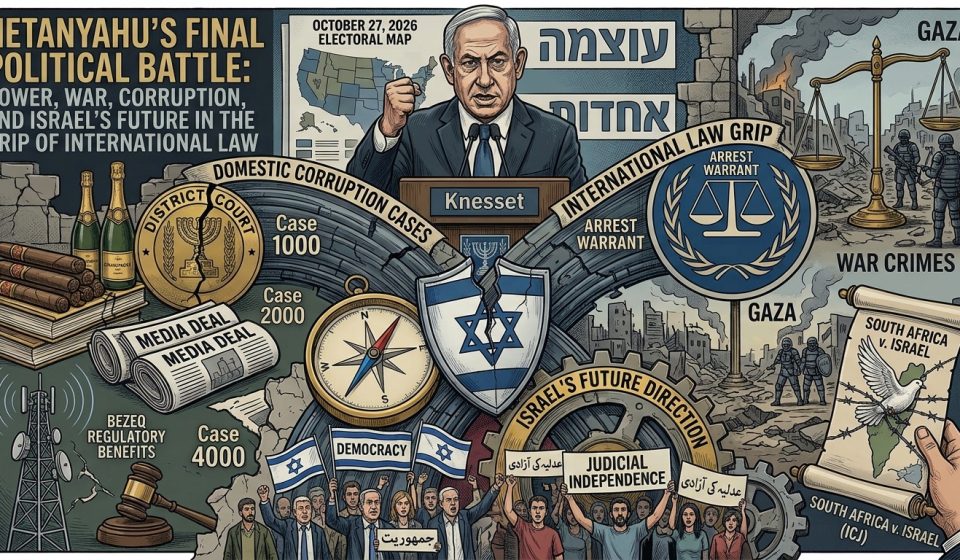
Benjamin Netanyahu’s political struggle is no longer merely a battle to save a prime minister’s seat. It has become a defining test of Israel’s democratic system, judicial independence, military strategy, the supremacy of international law, American foreign policy, and the future of the Middle East. Its consequences will be felt far beyond Israel’s borders. The Israeli parliamentary elections scheduled for October 27, 2026, are of extraordinary significance in this crisis because voters will not simply be choosing political parties and candidates.
They will also be indirectly answering a fundamental question: should Netanyahu remain in power despite the existing model of governance, continuing security crises, hardline policies toward the Palestinian issue, and ongoing legal proceedings against him, or should the country move in a new political direction? Electoral analyses by institutions such as the European Parliamentary Research Service and the Israel Democracy Institute have highlighted coalition formation, the balance between right-wing and religious parties, disputes over military service, judicial reform,
and government accountability following the October 7, 2023 attacks as important issues in Israeli political debate. However, neither the election outcome nor the subsequent process of forming a government can be regarded as predetermined. Israel’s parliamentary system depends on coalition governments and negotiations among different political parties. It would therefore be inaccurate to claim that Netanyahu’s defeat would automatically lead to his arrest or imprisonment,
or that an electoral victory would automatically free him from judicial proceedings. The issue is considerably more complex. The corruption cases being heard in Israeli courts and the proceedings before the International Criminal Court constitute two separate legal fronts, and understanding the distinction between them is essential to understanding the true nature of this political crisis.
Three prominent corruption cases against Netanyahu, commonly known as Cases 1000, 2000, and 4000, have influenced Israeli politics for years. Case 1000 involves allegations that Netanyahu and his family received expensive gifts from business figures Arnon Milchan and James Packer and that Netanyahu subsequently used his official influence to advance certain interests on their behalf. The alleged gifts included cigars, champagne,
and other valuable items. Case 2000 concerns alleged discussions between Netanyahu and Arnon Mozes, the publisher of the newspaper Yedioth Ahronoth, about the possibility of restricting the circulation of a rival newspaper in exchange for more favorable media coverage.
Case 4000 is widely regarded as the most serious of the three because it involves allegations that Netanyahu, while serving as communications minister, played a role in approving regulatory benefits for the Bezeq telecommunications company in exchange for favorable or more accommodating coverage of him by the Walla news outlet, which was associated with the company.
The cases involve allegations of bribery, fraud, and breach of trust. However, no allegation should be presented as a proven crime before a final judicial determination. Netanyahu has repeatedly denied the allegations, and his defense has maintained that the proceedings are politically motivated. Ultimately, the prosecution’s evidence, witness testimony, the defense’s arguments, and the judges’ assessment will determine the outcome.
As of 2026, the proceedings and questions surrounding witness testimony remain part of Israel’s political debate, but the election date should not be confused with a date for a judicial verdict. An election can change the balance of political power and influence government formation, while the criminal cases will continue according to their own legal procedures. If a crime is established in any case, the sentence will depend on the relevant law, the nature of the offense, and the court’s decision. Similarly, disqualification from public office is subject to separate legal requirements and does not automatically follow from every conviction.
Another important dimension of this legal crisis is the conflict between the Israeli government and the judiciary over the distribution of state powers. Judicial reforms proposed by the government in 2023 triggered large-scale protests, political polarization, and intense debate over the independence of democratic institutions. The Israel Democracy Institute has examined judicial independence, the balance among state institutions, civil rights, and the limits of executive authority as fundamental questions for Israel’s future. These debates are not limited to Netanyahu personally.
They concern the broader principle of whether an elected government can alter the judicial system in ways that weaken independent oversight. Supporters of the government have described certain reforms as an attempt to restore the authority of elected representatives, while critics argue that such changes could undermine judicial scrutiny and the constitutional balance of power. This is why Netanyahu’s legal cases are viewed not merely as proceedings against an individual political leader but also as a test of Israel’s institutional system.
Research by the Brookings Institution, the Center for Strategic and International Studies, the Council on Foreign Relations, and other international policy organizations helps explain this broader context, although not every analysis published by these institutions should be treated as confirmation of a specific allegation against Netanyahu. Think tanks generally examine political incentives, institutional weaknesses,
regional security, and the potential consequences of public policy. They do not replace criminal courts. Netanyahu’s second and considerably more complicated legal front is the International Criminal Court, which issued arrest warrants for him and former Israeli defense minister Yoav Gallant on November 21, 2024. The Court stated that the warrants concerned allegations of war crimes and crimes against humanity in connection with the situation in Gaza. These include allegations relating to the use of starvation as a method of warfare and conduct affecting the civilian population. An important legal distinction must be maintained here: an arrest warrant indicates that the Court has found a sufficient legal basis to proceed under the applicable standard, but it is not equivalent to a final criminal conviction or conclusive proof of guilt.
The International Criminal Court examines the potential criminal responsibility of individuals, whereas the International Court of Justice addresses disputes between states and questions of international law. Treating these two courts as interchangeable would be a serious legal and journalistic error. One important aspect of the International Criminal Court’s proceedings is that the practical effect of its warrants depends on cooperation by states that are parties to the Rome Statute, as well as applicable legal exceptions, judicial interpretations, and the obligations of individual states.
It is therefore too categorical to claim that Netanyahu cannot travel to any country in the world or that arrest would automatically follow in every member state under every circumstance. Nevertheless, the warrants create real diplomatic and travel difficulties because multiple countries may have to reconcile their international legal obligations with their political relationships. The Court’s official records contain the warrants and the allegations against Netanyahu, while Israel has challenged the Court’s jurisdiction and proceedings. This legal confrontation raises a broader question: to what extent can international law be enforced against powerful states and their leaders?
The case brought by South Africa against Israel before the International Court of Justice is another important dimension of the crisis. South Africa initiated proceedings alleging violations of the Genocide Convention. In 2024, the Court issued several provisional measures concerning the protection of relevant rights, the prevention of acts prohibited under the Convention, and the provision of humanitarian assistance.
The Court subsequently considered additional applications and developments. These provisional measures should not be confused with a final judgment because a conclusive determination of the genocide allegations and state responsibility requires separate judicial consideration. In July 2024, the Court also issued an advisory opinion addressing the legal aspects of Israel’s presence and occupation in the occupied Palestinian territories. These developments have transformed the Palestinian issue from what is often described merely as a regional conflict into a broader question involving international law,
the right to self-determination, human rights, and state responsibility. The fundamental distinction remains that the International Criminal Court proceedings concern the potential criminal responsibility of individuals, while the International Court of Justice proceedings concern state responsibility and the interpretation of international law. The political consequences of the two processes may overlap, but their legal jurisdictions are distinct. Chatham House, the Council on Foreign Relations, the International Crisis Group, and other research institutions have examined the relationship between international law, diplomacy, regional power interests,
and humanitarian crises in Middle Eastern conflicts. Their analyses help explain why international legal proceedings against a state or its leaders can have consequences extending well beyond the courtroom, potentially affecting arms supplies, diplomatic visits, trade relations, defense cooperation, and international public opinion. Nevertheless, a think tank’s general analysis should not be mistaken for a final judicial determination in a specific case. The next major question is how the United States will respond to the crisis. American support has long been a central pillar of Israel’s defense and diplomatic strategy.
U.S. military assistance, defense technology, intelligence cooperation, and diplomatic influence at the United Nations have strengthened Israel’s regional position. However, American policy is not entirely uniform. Different institutions, political parties, Congress, the administration, and public opinion often disagree over the appropriate relationship with Israel. The Washington Institute for Near East Policy, the Council on Foreign Relations, and the Center for Strategic and International Studies analyze how Israel’s domestic politics influence American interests, regional stability, strategy toward Iran, and diplomatic efforts to address the Palestinian conflict. A central challenge for Washington is how to balance support for Israel’s security with the requirements of human rights, international law,
and American credibility throughout the region. If Washington appears to provide Israel’s government with unconditional political protection, American credibility in the Arab world and other regions may suffer. Conversely, if the U.S. government increases pressure on Israel, it may face challenges involving defense relations with an ally, domestic political reactions, and regional security concerns. American policy should therefore not be attributed solely to Netanyahu’s personality.
It is shaped by U.S. strategic interests, domestic politics, Congress, regional threats, and relationships with allies. The position of President Donald Trump’s administration must also be considered within this broader context. Despite the political closeness between Netanyahu and American leadership, complete agreement on every issue cannot be assumed. Differences may emerge over ending the war in Gaza, the release of hostages and detainees,
Iran, Lebanon, Syria, regional diplomacy, and Israel’s long-term future. American sanctions against officials of the International Criminal Court and objections to the Court’s proceedings have also raised questions about the limits of cooperation with international judicial institutions. The fundamental issue is not merely the relationship between the United States and Israel. It is how the global system can maintain a balance between law and power.
If international law is supported only when it can be used against a rival state, while its enforcement is opposed when allies are concerned, the principles of international justice are called into question. At the same time, dismissing every aspect of a judicial proceeding simply because it has political consequences is equally inappropriate. Evidence, jurisdiction, fair proceedings, and the consistent application of legal standards must remain the principal criteria. The situation is particularly complicated for European countries because many are parties to the Rome Statute and have obligations to cooperate with the International Criminal Court.
If such countries face a possible visit by Netanyahu, they must consider their legal duties, diplomatic relationships, and security interests. The circumstances are not identical in every country, and legal interpretation and specific conditions may affect practical decisions concerning arrest. Arab countries, meanwhile, face both diplomatic opportunities and risks. Some Arab governments seek to preserve relations, trade, and regional security arrangements with Israel,
while also confronting political and humanitarian pressure following the devastation in Gaza and demands for Palestinian statehood. The future of relations established under the Abraham Accords cannot be separated from the Palestinian issue, regional security, and public opinion. If Israel’s leadership comes under greater international legal and diplomatic pressure, Arab countries may find greater opportunities to press for Palestinian statehood, the reconstruction of Gaza, and the political rights of the Palestinian people.
However, this outcome is not automatic because each Arab country formulates its foreign policy according to its national interests, relations with Iran, ties with the United States, and domestic circumstances. The most sensitive aspect of the crisis is the possible relationship between the Gaza war and Netanyahu’s political survival. Critics inside and outside Israel have argued that a prolonged war, continuing security emergencies, and a persistent state of crisis can push domestic criticism of the government into the background.
In their view, prolonging the war may align with Netanyahu’s political interests, particularly while criminal proceedings against him remain underway. However, claiming that the war is being continued solely to help him escape his legal cases would be a serious allegation that cannot be presented as established fact without supporting evidence. Understanding the situation requires separate consideration of Israel’s security policy, its conflict with Hamas, the fate of hostages, military objectives, pressure from coalition partners,
public opinion, and the government’s political interests. Research by the International Crisis Group is particularly relevant to understanding the political causes of conflict, the prospects for ceasefires, obstacles to negotiations, and the consequences for civilian populations. Similarly, research on the Middle East by Chatham House, CSIS, and the Council on Foreign Relations helps explain why military success and political settlement are not the same thing. Even when military objectives are achieved, lasting peace, an acceptable political arrangement, and the protection of civilian rights are not guaranteed.
The destruction in Gaza, displaced families, humanitarian needs, damaged infrastructure, and questions concerning future governance will remain challenges for any Israeli government. If political leaders fail to develop workable solutions to these problems, long-term security challenges may deepen regardless of the immediate military outcome. Iran and its regional partners, the situation in Lebanon, the balance of power in Syria, and the diplomatic role of Gulf countries must also be considered.
Netanyahu’s political weakening could create room for greater flexibility in Israeli policy. Conversely, right-wing parties might push the government toward more aggressive measures. If a new government emerges, its policies will depend not only on the identity of the prime minister but also on coalition partners, military leadership, security institutions, parliamentary support, and public pressure.
A change of leadership in Israel should therefore not be regarded as a guarantee that every conflict in the Middle East will be resolved. Nevertheless, a new government could have opportunities to pursue different approaches to a ceasefire, humanitarian assistance, the issue of hostages, relations with the Palestinian Authority, and regional diplomacy. Similarly, the return of the existing government would not necessarily mean that every policy would continue without change. Domestic pressure, coalition priorities, and international relationships could still force policy reconsideration.
Israel’s economy is another major front in this crisis. A prolonged war can increase defense expenditure, require repeated mobilization of reservists, disrupt business activity, put pressure on tourism, create investment uncertainty, and place additional burdens on the state budget. The technology sector, an important component of the Israeli economy, may be affected by political instability and declining investor confidence. However, it would be inappropriate to attribute every specific economic loss solely to Netanyahu’s legal cases or the elections.
The duration of the war, global economic conditions, fiscal policy, defense expenditure, and regional security risks also contribute to economic outcomes. Assessments by Moody’s, S&P Global, and other credit-rating agencies are important for evaluating a country’s debt-servicing capacity, financial risks, and economic prospects. Their assessments also consider political stability and security conditions. Israel’s long-term challenge is to balance defense requirements, social expenditure, investment, and economic growth.
If political instability prolongs government formation, delays budgetary decisions, or intensifies protests, economic confidence could deteriorate further. Conversely, if a stable government emerges after the elections and greater clarity develops in security and economic policy, investor confidence could improve. The outcome will depend not merely on the election result but on the new government’s practical decisions. At the societal level, Israel faces divisions between religious and secular communities, the political right and left,
supporters of the judiciary and advocates of government reforms, as well as disagreements over military service and exemptions granted to religious parties. If political leaders fail to address these divisions through dialogue and institutional reforms, social trust may weaken. However, describing Israel as inevitably moving toward civil war would go beyond what the evidence establishes.
A more accurate assessment is that deep political polarization, continuing warfare, and declining trust in institutions can make governance difficult in any democratic society. Reducing these risks requires transparency, accountability, and political dialogue. Netanyahu’s possible political exit routes include the normal judicial conclusion of his cases, attempts to negotiate a legal settlement, success or failure in forming a government, and an eventual change in political leadership.
Past cases involving senior Israeli officials demonstrate that political power does not guarantee permanent protection from legal accountability. However, a specific plea bargain, presidential pardon, or agreement to retire from politics cannot be presented as a certain possibility without confirmation. Similarly, electoral victory does not automatically exempt Netanyahu from all criminal proceedings. Any pardon, immunity, or legal settlement would depend on Israeli law, the relevant legal requirements,
and decisions by the competent authorities. If a final conviction is delivered against him, its political consequences will depend on the nature of the offense, the details of the judgment, and the applicable legal rules. Conversely, even if Netanyahu maintains his political position in the elections, the domestic cases, the International Criminal Court warrants, the situation in Gaza, American policy, and divisions within Israeli society will not simply disappear.
His real challenge will be to demonstrate whether he can face the legal proceedings while restoring confidence in institutions, reducing economic pressure, and presenting a long-term strategy for national security. The most important lesson from international think tank research is that a country’s security cannot be built solely on military strength, support from allies, or political stability at the top.
Credible institutions, clear laws, accountable government, economic sustainability, and the ability to pursue political solutions to conflicts are equally essential. Israel now faces several fundamental questions simultaneously: Can the balance of power between the judiciary and the government be maintained? Can humanitarian assistance and basic rights be protected for civilians in Gaza? Can a workable political path emerge for the Palestinian issue? Can Israel’s international allies support its security while maintaining consistency in their positions on international law? And can Israeli leadership rise above immediate political interests and prioritize the country’s long-term national interests?

The answers will not all emerge on a single election night. The October 27, 2026 elections will clarify the new balance of parliamentary power, but government formation, judicial proceedings, international legal actions, and the political consequences of the war may continue long afterward. The broader global message of this crisis is clear: powerful leaders may use political support to withstand pressure for a time, but lasting solutions to legal and political crises cannot be achieved merely through accusations,
attacks on institutions, or assistance from foreign allies. They require transparent accountability, fair judicial proceedings, respect for human rights, the protection of civilians, and serious efforts toward political settlement. Netanyahu’s future is not yet confined to a single predetermined outcome, but the legal,
political, economic, and diplomatic questions surrounding him could have a profound impact on Israel’s future direction. If Israel’s leadership responds to these crises by prioritizing institutional independence, the rule of law, and a workable solution to the Palestinian issue, the prospects for future stability may improve. If, on the other hand, political survival is placed above national interests,
humanitarian protection, and legal accountability, Israel could face a prolonged period of domestic division, international diplomatic pressure, and regional instability. This is the central point of the entire story: Netanyahu’s test is not simply whether he remains prime minister or leaves office.
The real test is whether the State of Israel can hold even its most powerful political leaders accountable under the law, confront the humanitarian consequences of war, and establish the foundations for a workable peace in the region.