At Least 69 People Killed in Deadly Collision as Investigators Examine Signalling Failure and Train Control Communications
MADRID: Newly published audio recordings of conversations between train drivers and railway controllers have raised questions about the events leading up to a deadly train collision in Spain that killed at least 69 people and injured dozens more.
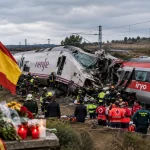
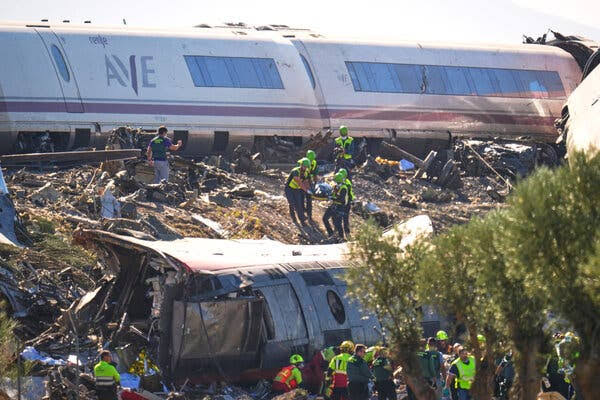
The crash occurred on Wednesday morning when a train travelling from Madrid to Seville collided with the rear of a stationary train. Authorities are investigating the circumstances surrounding the disaster, including a reported failure in the automatic signalling system and instructions given to the drivers before the collision.
Spanish media outlets, including El País and RTVE, published three audio recordings that capture exchanges between the drivers and the railway control centre in Madrid in the minutes before the crash.
Prime Minister Pedro Sánchez visited the crash area and said authorities were working “day and night” to establish every detail of the tragedy.
Spain has begun three days of national mourning following one of the country’s deadliest railway disasters in modern history.
Audio Recordings Reveal Communications Before the Crash
The recordings provide insight into communications between railway controllers and the drivers of the two trains involved in the collision.
One train, operated by state-owned Renfe, was carrying 397 passengers. The other, operated by private company Iryo, had 147 passengers on board and was travelling ahead on the same line.
According to the reported sequence of events, a technical problem involving the automatic signalling system had forced trains to stop on the affected stretch of railway.
In one recording, a controller in Madrid speaks to the Renfe driver, whose train was experiencing technical difficulties while travelling behind the Iryo service.
After several exchanges, the controller instructs the Renfe driver to continue the journey using an alternative signalling procedure.
“Continue your journey and then proceed under [Lateral Signalling Block], at normal speed with normal operation,” the controller says.
The driver asks, “At normal speed?”
The controller replies, “Yes.”
The exchange has drawn attention because the alternative procedure was reportedly being used after problems affected the automatic signalling or data transmission system.
Iryo Driver Reports Train Has Stopped
A separate recording captures the driver of the Iryo train reporting communication problems with the train-control system.
The driver tells the control centre that the train is unable to move and is stationary in front of the entry signal at Urda.
Following further exchanges, the driver receives instructions to resume the journey normally.
Spain’s transport minister reportedly said the Renfe train was subsequently authorised to proceed under an erroneous instruction. Investigators are examining the sequence of decisions, the signalling arrangements, and the communications between the trains and the control centre.
The recordings have become an important part of public scrutiny of the incident, although the precise cause of the collision remains under investigation.
Investigators are working to establish how the two trains came to occupy the same stretch of track and whether failures in signalling, communication, or operational procedures contributed to the disaster.
The investigation is also expected to examine the technical problems that reportedly brought trains to a halt, the instructions issued by railway controllers, and the circumstances under which the Renfe train continued its journey.
Authorities have not yet established a definitive explanation for the collision based on the information presented in the recordings.
The collision has prompted national mourning and renewed attention to railway safety. Emergency responders attended the scene, while officials began efforts to establish the full circumstances of the crash and identify any factors that may have contributed to the loss of life.
Prime Minister Pedro Sánchez pledged a thorough examination of the incident, emphasising the government’s commitment to uncovering the details of the tragedy.
As Spain mourns the victims, the investigation is expected to focus on establishing responsibility, understanding the role of the reported signalling failure, and determining whether changes to railway safety procedures are necessary to prevent similar disasters.