
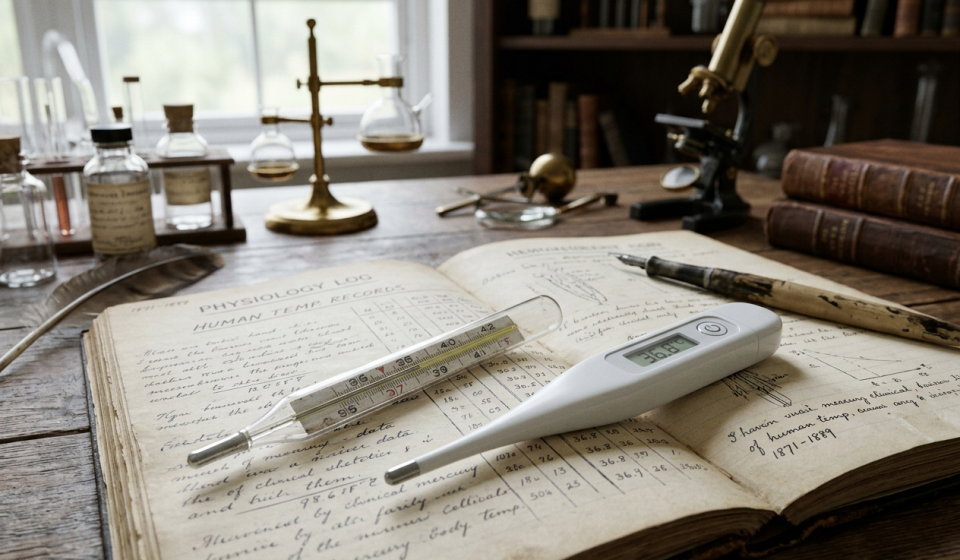

Why Was the Average Human Body Temperature Higher 150 Years Ago?
The average human body temperature appears to have declined over the past 150 years, raising questions among scientists about changes in human biology, healthcare and living conditions.
The traditional benchmark of 37°C (98.6°F) has long been used to describe normal body temperature. However, modern research suggests that this figure may not accurately represent the average temperature of people today.
How 37°C Became the Standard Body Temperature
In the 1860s, German physician Carl Wunderlich set out to understand the relationship between body temperature and illness. At the time, doctors were still debating whether fever was a disease itself or a symptom of an underlying medical condition.
Wunderlich conducted an extensive study over 15 years, recording the armpit temperatures of approximately 25,000 patients, including men, women and children. His research produced more than one million temperature readings.
After analysing the data, he established 37°C (98.6°F) as the average temperature of a healthy adult. He also identified temperatures above 38°C (100.4°F) as an indication of fever.
Although other researchers had reached similar conclusions, Wunderlich’s unusually large dataset helped establish his findings as a widely accepted medical reference.
Scientists Question the Traditional Temperature Benchmark
Research conducted in more recent decades suggests that average human body temperature has gradually changed since Wunderlich’s time.
This raises an important question: Was the historical benchmark inaccurate, or have changes in people’s health and living conditions influenced the body’s temperature over generations?
Medical historian and infectious disease specialist Philip Mackowiak of the University of Maryland has described the historical figure’s longstanding influence as unusually significant in medical practice.
What Could Explain the Decline?
Scientists are continuing to investigate why average body temperatures appear to have fallen over the past century and a half.
Potential explanations include improvements in healthcare, reduced exposure to certain infections, changes in living conditions and shifts in overall inflammation levels. However, the precise reasons remain under investigation.
The findings also highlight the importance of understanding body temperature as a biological measurement that can vary across individuals and populations rather than treating one historical figure as an absolute standard.
Is 37°C Still Normal Today?
The traditional 37°C benchmark remains an important reference in medicine, but normal body temperature can vary depending on factors such as age, time of day, individual biology and measurement method.
Modern research suggests that the average may be lower than the figure established in the 19th century. Scientists are still examining how much of this difference reflects changes in measurement, population health or human physiology.
Understanding these changes could help improve the way medical professionals interpret temperature readings and assess signs of illness.