
Not Just a Necklace: Rizwan Tanoli and the Value of Understanding Human Emotions
Sometimes, the real worth of something is not measured by its price, but by the memories, love and emotions attached to it.
A young girl named Maria in Mansehra recently experienced the distress of losing something that meant far more to her than its material value. It was a necklace gifted to her by her parents, a personal keepsake carrying sentiments that money could never replace.
During a visit to Beena’s Salon in Mansehra, she lost the necklace. What followed was not simply a search for a missing piece of jewellery; it was an emotional ordeal for a girl who feared losing something deeply connected to her family and memories.
Overwhelmed with distress, Maria approached the local police chowki, in tears, hoping someone would take her concern seriously. Instead of treating the matter as an insignificant complaint or asking the girl to move on, he understood the emotions behind her distress. He recognized that the necklace was not just an accessory but a gift from her parents, something she cherished and desperately wanted back.
According to the account of the incident, the necklace had been lost at the salon, where its presence was initially denied. The situation became increasingly emotional, with a woman even bringing the Holy Quran into the discussion and taking oaths that the necklace was not with with.
Amid this sensitive situation, Rizwan Tanoli handled the matter with composure and intelligence. Rather than allowing emotions to escalate or the situation to turn into an argument, he approached it thoughtfully and continued pursuing the matter.
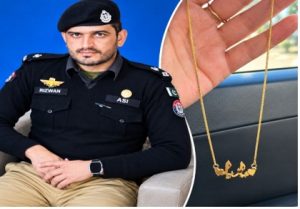
Within approximately ten minutes, the necklace was recovered from the salon.
What makes this incident worthy of appreciation is not merely the recovery of a necklace. It is the attitude of the officer who understood the human side of a seemingly ordinary complaint.
Policing is often discussed in terms of crime prevention, investigations, arrests and maintaining law and order. However, there is another dimension of public service that deserves equal recognition: the ability to listen, understand and respond to the concerns of ordinary citizens with compassion.
Not every complaint involves a major crime. Sometimes, a person simply needs someone in authority to listen without judgment. Sometimes, what appears insignificant to one person can carry immense emotional value for another.
Rizwan Tanoli demonstrated that being a police officer is not only about exercising authority; it is also about understanding responsibility towards the people one serves.
Such incidents remind us that the real impact of public servants is not always reflected in official records, statistics or headlines. Sometimes, it is reflected in the tears of a distressed citizen turning into relief, and in the gratitude of someone whose feelings were understood.
The officer deserves appreciation for recognising the sentiment behind a simple possession and responding with humanity, patience and presence of mind.
Because sometimes, a true hero is not the one who makes the biggest headlines, but the one who understands the smallest heartbreaks of ordinary people.