New Provinces—or Another Burden on the National Exchequer?
By Amir Muhammad Khan
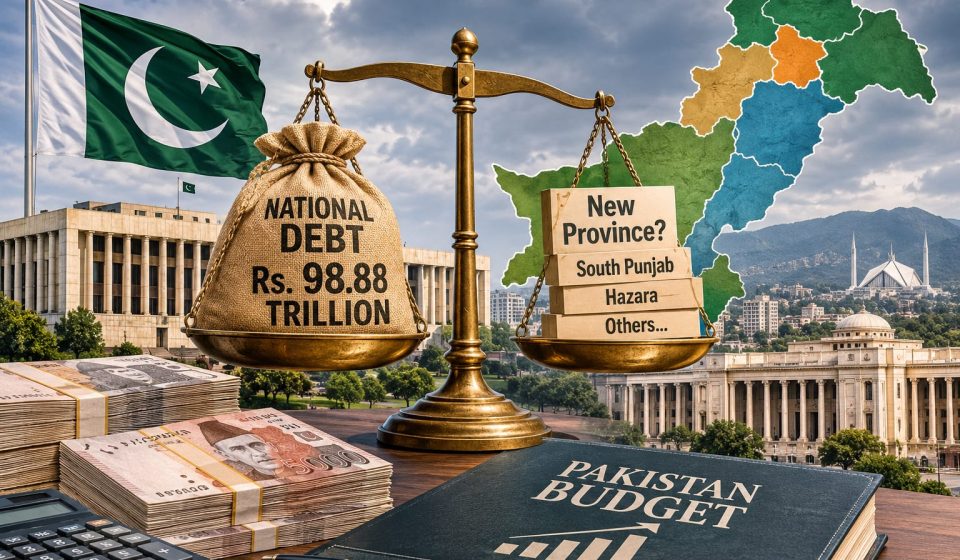
With Pakistan already reeling under a debt burden exceeding 98 trillion rupees, can it afford the expenses associated with additional provinces?
The current economic situation in Pakistan cannot be dismissed as a mere temporary financial crisis. The country’s economy is already facing a formidable challenge, compounded by the burden of domestic and external debt—along with the interest payments thereon—limited tax revenue, escalating government expenditures, inflation, unemployment, and crises within the energy sector.
Ordinary citizens are struggling with the soaring costs of electricity, gas, fuel, food items, and other daily necessities. Meanwhile, the government remains in a constant search for further loans and new financial resources to cover its expenditures.
Against this backdrop, the demand for the creation of new provinces in Pakistan has once again become a subject of political and national discourse. Calls for the establishment of new provinces have frequently emerged from regions such as Southern Punjab, Hazara, and others. Underlying these demands are genuine grievances, including administrative neglect, the inequitable distribution of development resources, regional imbalances within the larger provinces, and the complaints of the general public—issues that cannot simply be ignored.
However, the fundamental question remains: can Pakistan’s current economic condition sustain the additional costs involved in establishing new provinces? Will the creation of new provinces truly resolve the deprivations faced by the people, or will it merely impose a further, permanent financial burden on an already fragile economy?
This debate is not merely about increasing or reducing the number of provinces; rather, it concerns the national exchequer, public tax revenue, and the economic burdens that will fall upon future generations.
The state of Pakistan’s economy can be gauged from the fact that, according to State Bank data from September 2026, the country’s total debt and liabilities have reached approximately 98.88 trillion rupees—a figure amounting to roughly 98,881 billion rupees. There has been a significant increase in total debt and liabilities within just one year.
In the current budget, approximately 1,169 billion rupees have been allocated for pensions, 3,000 billion rupees for defense, and about 1,000 billion rupees for the federal development program. These figures highlight a fundamental reality: Pakistan’s financial resources are already under severe strain.
When interest payments on debt alone have reached the scale of trillions of rupees, the recurring expenditures resulting from the creation of new provinces cannot be dismissed as a trivial matter.
While these sobering details are documented in official records, the point here is that those advocating for new provinces are doing so to serve their own specific agendas. In Sindh, the PPP government opposes any such proposal, whereas in Punjab, they would prefer to see new provinces established immediately.
Those who support or demand new provinces fail to offer any proposals for improving the national economy.
A new province is not merely a new line drawn on a map. While the creation of a new province is often presented as a means to enhance administrative convenience and create new opportunities for development, one must consider the impact of the associated practical costs on our fragile economy.
Establishing a new province entails creating an entire governmental and administrative apparatus. This would require a new Governor House, Chief Minister’s House, Provincial Assembly, Speaker’s office, ministerial offices, a provincial secretariat, various government departments, a High Court, a police infrastructure, official residences, government vehicles, and other institutions.
Furthermore, this would necessitate salaries, perks, pensions, medical benefits, travel allowances, and other administrative obligations for assembly members, ministers, advisors, secretaries, officials, and thousands of government employees.
These expenses would not be limited to the first year alone; rather, they would become a permanent, recurring feature of both national and provincial budgets.
Constructing buildings requires a one-time capital investment; however, the costs associated with operating these facilities—such as staff salaries, fuel for vehicles, electricity, maintenance, and other amenities—will be ongoing.
Despite allocating funds for the Kalabagh Dam in the budget for several years, the project could not be realized due to a lack of provincial consensus, leaving Pakistan’s water and electricity challenges unresolved.
In the federal budget for the 2026-27 fiscal year, the provinces’ share has been set at approximately 8,848 billion rupees—a figure representing the transfer of the provinces’ portion of federal revenues.
To complicate matters further, there is the demand for new provinces—along with the associated costs!
This raises a fundamental question: will the creation of new provinces increase the national income, or will it merely result in the existing resources being divided into smaller portions?
If the national income remains stagnant while the number of provinces increases, the mere expansion of administrative units will not generate additional national wealth. Furthermore, allocating resources to new provinces could introduce further complexities into the existing fiscal system.
For instance, if South Punjab were to become a separate province, how would its resources, population, tax revenue, existing assets, and expenditures be determined? How would the share of the remaining Punjab be affected? What portion of federal resources would be allocated to the new province? And would the other provinces be willing to accept a reduction in their own current shares?
If the revenue of a new province falls short of its expenditures, who will cover the deficit?
Similar questions would arise regarding Hazara or any other proposed province.
Proponents of new provinces argue that the public would gain easier access to justice and public services through the administration of these new provinces.
But if the elected representatives—members of the Provincial and National Assemblies—who were voted in by the people of these remote areas (regardless of the circumstances of their election) are already in place, why are they unable to resolve the problems of their own constituents—especially when they are allocated development funds for each member?
Corruption is the “termite” eating away at our economy.
Will the creation of a new province automatically eradicate corruption? Will the performance of government departments improve in a new province? Will the cycle of political patronage, nepotism, unnecessary recruitment, and the misuse of development funds come to an end?
We are left with the same elite—the very same stock—that has failed to improve the country or resolve the problems of the common man for the past 80 years.
Given this, if we truly want the common man to have easy access to their representatives to address their grievances, why not implement a ‘Musharraf-plus’ style local government system—a model also advocated by Ijaz-ul-Haq?
The real need is for systemic reform, not merely a change in geographical boundaries.
If, as Mohsin Naqvi suggests, the current system is obsolete, is it the responsibility of the general public to modernize it?
Furthermore, in the interior of Sindh, will the feudal lords (wadera shahi) ever tolerate a robust local government system or the creation of a new province?
The formation of a new province in Sindh is virtually impossible; for the past eighteen years—and likely for an indefinite period into the future—the province has been effectively handed over to the PPP, largely due to the fear of separatist movements.