The prospect of a trilateral meeting involving US President Donald Trump, Russian President Vladimir Putin and Chinese President Xi Jinping has reignited international debate over the future of global politics.
As diplomatic discussions reportedly focus on a possible gathering in Shenzhen, comparisons with the historic Yalta Conference of 1945 are raising concerns about whether major powers could reshape the world order without giving smaller nations a meaningful voice.
The debate has particular significance for Ukraine and European nations, which fear that decisions concerning territorial sovereignty, security and the future of the war could be made without their full participation.
The central question is whether the proposed meeting could become a constructive diplomatic initiative or another example of powerful nations determining the destinies of others.
The Yalta Conference: A Historical Warning
In February 1945, as the Second World War approached its conclusion, the leaders of the United States, Britain and the Soviet Union gathered at Yalta on the Black Sea. Franklin D. Roosevelt, Winston Churchill and Joseph Stalin discussed the political arrangements that would shape the post-war international order.
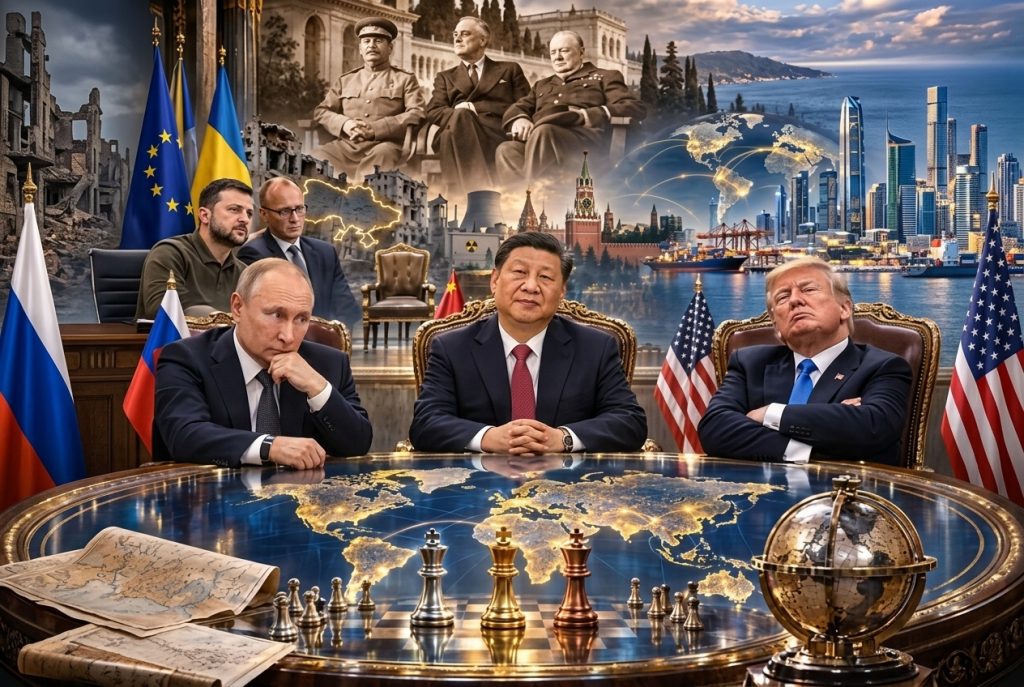
The negotiations included Soviet participation in the war against Japan and agreements concerning Eastern Europe and parts of East Asia. The Soviet Union secured significant strategic and economic advantages, including arrangements involving southern Sakhalin, the Kuril Islands and privileges in Manchuria.
For many Eastern European nations, Yalta became a symbol of great-power politics, in which national sovereignty and political independence could be subordinated to the interests of powerful states.
The lesson remains relevant today: having a seat at the negotiating table is fundamentally different from becoming the subject of negotiations conducted by others.
Ukraine and Europe Fear a New Yalta Agreement
The possibility of a new diplomatic arrangement has generated concern in Ukraine and European political circles.
Ukrainian President Volodymyr Zelensky has opposed any arrangement resembling what he describes as another Yalta, warning against decisions that could determine Ukraine’s future without its participation.
For Kyiv, the fundamental issues include territorial integrity, national sovereignty and long-term security guarantees.
German Chancellor Friedrich Merz has also stressed the importance of European participation in negotiations concerning the conclusion of the war in Ukraine. European governments maintain that sanctions, future security arrangements and peace terms cannot be determined without considering the interests of countries directly affected by the conflict.
The principle is straightforward: nations that bear the consequences of war must have a meaningful role in deciding the terms of peace.
Putin’s Diplomatic Strategy and Russia’s Global Ambitions
For Russian President Vladimir Putin, a meeting with the American and Chinese presidents could offer more than an opportunity to discuss Ukraine.
It could also demonstrate that Russia remains an influential global power despite international sanctions and diplomatic tensions.
According to reporting cited in the original analysis, Putin may seek support for a settlement of the Ukraine conflict on terms favourable to Moscow. However, the precise proposals and final negotiating agenda remain uncertain.
A meeting involving the leaders of three major powers could itself provide Russia with a significant diplomatic advantage, even if it produces no comprehensive agreement.
International recognition and diplomatic visibility are important elements of Russia’s wider strategy to maintain its position in the evolving global order.
Donald Trump: Peace Diplomacy or Global Prestige?
For US President Donald Trump, the proposed gathering could provide an opportunity to demonstrate his ability to bring major international powers together.
Trump has indicated that discussions could focus on nuclear weapons and arms reduction, although Russian officials have suggested that Ukraine could also feature in the discussions.
This difference highlights the uncertainty surrounding the meeting’s agenda.
An international summit can strengthen a leader’s political image, but its real importance must be measured by its results.
Reducing nuclear dangers, resolving international conflicts and restoring diplomatic confidence would represent more meaningful achievements than a high-profile photograph of three world leaders.
China’s Position: Strategic Caution and Economic Interests
China’s role could prove particularly significant.
President Xi Jinping must balance Beijing’s relationship with Moscow against its extensive economic and commercial ties with Europe and other international partners.
China has an interest in maintaining its position as a global power while avoiding the perception that it is directly supporting Russia’s war in Ukraine.
Its economic relationship with Europe makes political stability and continued commercial cooperation important considerations.
China also approaches nuclear negotiations cautiously. Its strategic interests do not necessarily align with the objectives of either Washington or Moscow.
Historically, China has its own reasons to approach the Yalta legacy carefully. In 1945, agreements involving Soviet privileges in Manchuria raised serious questions about Chinese sovereignty.
That experience offers an important historical lesson: even close political partners may have competing national interests.
Is the World Moving Towards New Spheres of Influence?
One of the most important questions surrounding the proposed trilateral meeting concerns the possibility of dividing the world into spheres of influence.
Russia has repeatedly sought recognition of its status as a major global power with interests extending across neighbouring regions.
The United States continues to pursue its strategic interests, including its support for Taiwan, while China’s economic and political presence continues to expand internationally.
However, dividing the world into clearly defined geographical zones of influence is far more complicated than it might appear.
Economic relationships, military alliances and national interests frequently overlap. Even powerful countries cannot always control developments within regions they consider strategically important.
The international system is therefore unlikely to be reorganised through a simple agreement among three capitals.
The Moral Question: Can Powerful Nations Decide the Future of Others?
Beyond strategic calculations lies a fundamental question of international justice: Does military or economic power give a nation the right to determine the future of another country without its consent?
The historical criticism of Yalta remains relevant to this debate.
During a visit to Lithuania in 2002, former US President George W. Bush criticised the political legacy of Yalta and declared: “There must be no new Yalta.”
Today, the same principle deserves renewed attention.
From an Islamic perspective, justice is a fundamental requirement of responsible governance. The Holy Quran states:
وَلَا يَجْرِمَنَّكُمْ شَنَآنُ قَوْمٍ عَلَىٰ أَلَّا تَعْدِلُوا ۚ اعْدِلُوا هُوَ أَقْرَبُ لِلتَّقْوَىٰ
“Let not your enmity towards a people induce you to depart from justice. Be just; that is nearer to righteousness.”
— Surah Al-Ma’idah (5:8)
This principle applies not only to individuals but also to relations between nations. Genuine peace requires justice, mutual respect and recognition of the rights of both powerful and weaker states.
Smaller countries are not merely pieces on the chessboard of international politics. They possess their own histories, identities, national interests and political rights.
Will History Repeat Itself?
The proposed meeting involving Trump, Putin and Xi Jinping raises important questions about the future of international relations.
Could it help reduce nuclear tensions, advance negotiations over Ukraine and create opportunities for lasting peace? Or could it strengthen an international system in which powerful nations negotiate arrangements at the expense of smaller states?
The answers remain uncertain.
Russia seeks recognition of its global standing. The United States may see an opportunity for diplomatic leadership. China must protect its economic and strategic interests, while Ukraine and Europe insist on meaningful participation in decisions affecting their security.
Although comparisons with the Yalta Conference of 1945 are understandable, the military, political and economic circumstances of today’s world are substantially different.
History does not predict the future with certainty. It provides lessons that can help political leaders avoid repeating the mistakes of the past.
The world does not need another Yalta. It needs a fairer international order in which power does not replace justice, national sovereignty is respected, and peace serves all nations rather than only the interests of the strongest.