
Pakistan and Nepal are sounding the alarm. As melting glaciers accelerate across the Hindu Kush, Karakoram, and Himalayan ranges, two nations each contributing almost nothing to global emissions are paying the highest price for a crisis they did not create.
Background: The Ice That Feeds a Civilization
High in Pakistan’s northern ranges, a silent catastrophe has been unfolding for decades. The Hindu Kush, Karakoram, and Himalayan mountain ranges together cradle more glaciers than anywhere else on Earth outside the polar regions. These frozen giants are not just scenic wonders they are the lifeblood of millions of people across South Asia.
Pakistan’s glaciers feed the Indus River system, which supports nearly 90 percent of the country’s agriculture and accounts for roughly 25 percent of its GDP. From rice paddies in Punjab to hydroelectric turbines in Gilgit-Baltistan, the ice of the north keeps the nation alive.
But that ice is disappearing faster than ever before.
How Many Glaciers Does Pakistan Have?
The numbers are staggering. A 2024 study by Italian nonprofit EvK2CNR confirmed that Pakistan is home to 13,032 glaciers, covering over 13,546 square kilometres across major river basins including the Indus, Gilgit, Jhelum, Kabul, and Tarim rivers. Earlier estimates often cited more than 7,000 glaciers still the highest count outside the polar regions.
These glaciers serve as natural reservoirs, storing water as ice through winter and slowly releasing it during the dry summer months. But global warming is disrupting that natural cycle at an alarming pace, with glaciers now beginning to melt in early spring rather than late spring or early summer leaving communities with unpredictable water supplies and heightened flood risk.
How Quickly Are Glaciers Melting?
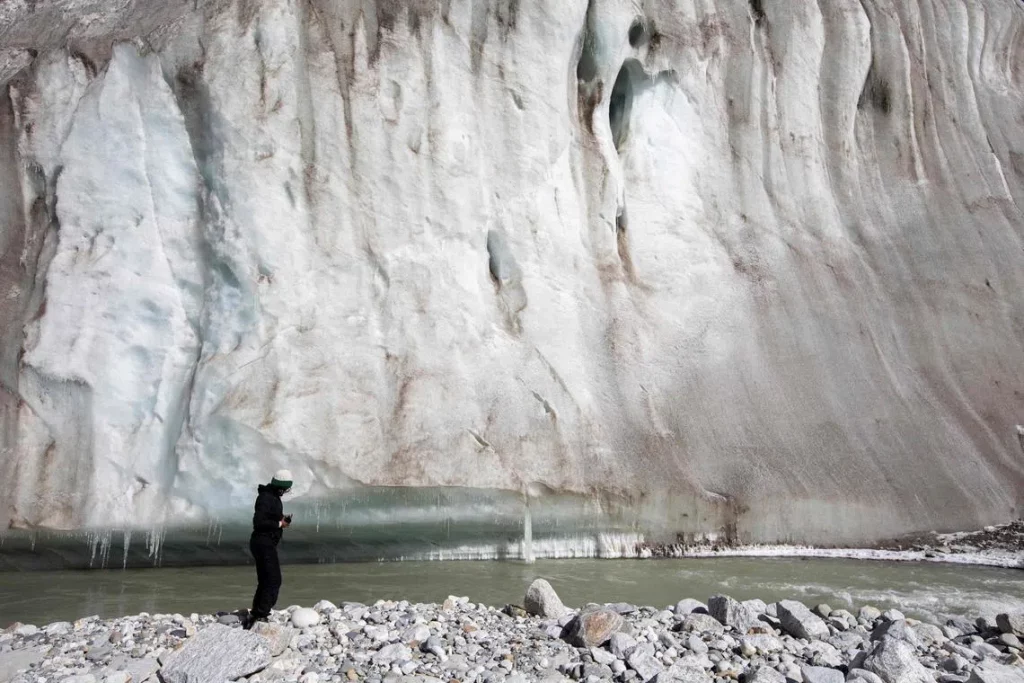
The pace of glacier melt in Pakistan is deeply concerning. The Passu Glacier in Gilgit-Baltistan, for instance, shrank by 10 percent over four decades from 1977 to 2014, and continues to retreat by roughly four metres every single month. The Hinarchi Glacier is now 12 percent shorter than it was just 30 years ago.
Scientific assessments by the International Centre for Integrated Mountain Development (ICIMOD) warn that glaciers across the Hindu Kush Himalaya region could lose as much as 80 percent of their volume by the end of this century if greenhouse gas emissions continue unchecked. The Intergovernmental Panel on Climate Change (IPCC) has similarly projected that Himalayan glaciers could shrink by two-thirds by 2100.
Pakistan’s own meteorological department has recorded steady glacial retreat in Gilgit-Baltistan and Chitral, alongside a rising number of glacial lake outburst floods (GLOFs). In 2022 alone, more than 20 such events were recorded and in that same year, Pakistan experienced triple the usual number of glacial lake outbursts.
What Problems Have Melting Glaciers Caused in Pakistan?
The consequences of Pakistan glaciers melting have been catastrophic and wide-ranging. As temperatures rise, melting glaciers leave behind large, unstable glacial lakes. Pakistan currently has over 3,044 such lakes identified in Gilgit-Baltistan and Khyber Pakhtunkhwa alone, with 33 considered at high risk of bursting.
When these lakes rupture, they unleash GLOFs sudden, violent floods that destroy villages, roads, farmland, and infrastructure within minutes. Over 7 million people in Pakistan live under the constant shadow of this threat. Around 2 million Pakistanis are directly exposed to glacial lake flooding, making the country one of the world’s highest-risk nations for this specific climate hazard.
The 2022 monsoon floods, which were amplified by accelerated glacier melt, were among the worst in Pakistan’s recorded history. The floods submerged one-third of the entire country, displaced over 30 million people, killed more than 1,700 individuals, and caused economic losses exceeding $30 billion. A World Weather Attribution study found that human-induced climate change likely increased rainfall intensity during those floods by up to 50 percent.
Beyond floods, glacier melt is also threatening Pakistan’s water security. The World Bank has warned that Pakistan’s water supply could fall below the minimum survival threshold of 1,000 cubic metres per person per year a crisis that would devastate agriculture and widen poverty at a massive scale.
Nepal Shares the Burden
Pakistan is not suffering alone. At the Breathe Pakistan International Climate Change Conference held in Islamabad in May 2026, Rita Dhital, the Ambassador of Nepal to Pakistan, called melting glaciers a “shared vulnerability” for both nations.
Dhital highlighted that glacial lake outburst floods have hampered tourism, agriculture, and hydropower generation across Nepal since the 1970s, when major GLOF events began occurring with increasing frequency. Nepal has since taken engineering measures to lower dangerous lake levels and identify high-risk glacial lakes before they burst.
Nepal’s mountains feed rivers that sustain hundreds of millions of people across South Asia. The melting of glaciers across the Hindu Kush Himalaya is therefore not just a bilateral issue between Pakistan and Nepal it is a regional and global emergency.
Why Are Extreme Weather Events Becoming More Frequent in Pakistan?
Pakistan’s extreme weather events are becoming more frequent and more severe for several interconnected reasons. Global warming is raising temperatures in the mountain regions, weakening glacier stability and destabilising fragile landscapes. Faster-melting glaciers produce more meltwater, which swells river systems already under pressure from heavier-than-normal monsoon rains.
Rampant deforestation has removed natural buffers that once absorbed rainfall and held soil in place. According to Global Forest Watch, Pakistan lost 95.3 square kilometres of forest cover between 2001 and 2024. Without trees to slow water runoff, communities are increasingly defenceless against flash floods and landslides.
Black carbon pollution largely originating from neighbouring countries such as India and China is also depositing soot on Pakistan’s glaciers, darkening the ice surface and accelerating heat absorption. Studies have found that up to 80 percent of black carbon on glaciers in the Karakoram originates from outside the region.
Pakistan emits less than 1 percent of global greenhouse gases, yet it consistently ranks among the top ten most climate-vulnerable nations in the world.
Voices from the Conference
The urgency of the climate crisis was front and centre at the Breathe Pakistan conference. Romina Khurshid Alam, the Prime Minister’s coordinator on climate change, delivered a blunt message to the world.
“This region is suffering. Our children are suffering. We are not in the state of crisis. We are in the state of war from climate change,” she said, stressing the need for a “regional solution” rather than vague global promises.
She also called out the international community’s failure to deliver on the Loss and Damage Fund — a financial mechanism meant to compensate climate-vulnerable countries. “What about the Loss and Damage Fund? Where is that fund? Nothing happened,” she said pointedly.
Mohamed Yahya, the UN Resident and Humanitarian Coordinator in Pakistan, underscored that Pakistan’s ordeal is not unique. “Pakistan’s reality is unmistakable from floods to prolonged droughts to glacial melts. This experience is not unique to Pakistan. It reflects a reality across South Asia,” he said, calling for the region to unite and help itself.
A Glacier Reveals a 28-Year-Old Secret
Perhaps the most haunting symbol of accelerating glacier melt came in the summer of 2025, when the body of a Pakistani man was found preserved in a melting glacier 28 years after he vanished. Nasiruddin, a father of two from the Kohistan region of Khyber Pakhtunkhwa, disappeared in 1997 after falling into a crevasse while crossing the Lady Meadows glacier. His body was discovered remarkably intact by a local shepherd, with his identity card still in his pocket. The glacier’s rapid retreat had finally brought him home. His story, widely reported by BBC and international media, became a vivid and deeply human reminder of what glacier melt actually means on the ground.
Regional and Global Impact
The melting glaciers of Pakistan and Nepal are not merely a local tragedy. Glaciers across the Hindu Kush Himalaya feed Asia’s most important river systems, including the Indus, Ganges, Brahmaputra, Mekong, and Yangtze. Hundreds of millions of people downstream from farmers in Pakistan’s Punjab to communities in Bangladesh and beyond depend on the steady flow of glacial meltwater.
As glaciers shrink, the Indus River is projected to reach “peak water” around 2050, after which river flows will progressively decline, potentially devastating agriculture that currently produces more than 90 percent of Pakistan’s food output.
Hydropower generation, which accounts for approximately 29 percent of Pakistan’s electricity, will also suffer. ICIMOD warns that reduced glacial meltwater will significantly cut hydropower capacity a major blow to a country already struggling with energy insecurity.
The Road Ahead
Pakistan has taken some steps to confront the climate risk posed by melting glaciers. The government, alongside the United Nations Development Programme and the Green Climate Fund, has been implementing early warning systems, building engineering structures like gabion walls and check dams, and empowering community-based disaster response committees across 24 high-risk valleys.
Yet experts and diplomats agree that engineering alone is not enough. Pakistan’s calls for climate justice including proper funding of the Loss and Damage mechanism, fair trade access rather than aid dependency, and binding emissions commitments from major polluters reflect the broader frustration of climate-vulnerable nations worldwide.
“No blame, no shame. Just take action,” Romina Alam told delegates at the Breathe Pakistan conference. It was a message addressed to the world and one the world can no longer afford to ignore.
Frequently Asked Questions (FAQs)
Q: Which countries are most affected by glacier melt?
Pakistan, Nepal, Bangladesh, India, and China are among the most affected countries in Asia, as they rely heavily on Himalayan and Karakoram glaciers for freshwater. Beyond Asia, nations in the Andes region of South America particularly Bolivia and Peru as well as island nations facing rising sea levels, are also severely impacted. Pakistan stands out as having the highest number of glaciers outside the polar regions, making it especially vulnerable.
Q: Which glacier is expected to disappear by 2040?
Several smaller glaciers in Pakistan and the Himalayas are at serious risk of complete disappearance within the coming decades. Some glaciers in the Tibetan Plateau and Central Asian ranges are projected to vanish by as early as 2040 if current warming trends continue. In Pakistan, smaller glaciers in Chitral, Swat, and parts of Gilgit-Baltistan are retreating at rates that could lead to their disappearance within a generation. ICIMOD warns that if global emissions are not reduced, two-thirds of all Hindu Kush Himalayan glaciers could be gone by 2100.
Q: Who was the Pakistani man found frozen in a glacier?
He was Nasiruddin (also spelled Naseeruddin), a man from the Kohistan district of Khyber Pakhtunkhwa who disappeared in 1997 at around 31–33 years of age. He had fallen into a crevasse while crossing the Lady Meadows glacier with his brother during a journey through the mountains. His remarkably well-preserved body was discovered in July 2025 by a local shepherd named Omar Khan, after the rapidly melting glacier exposed his remains. An identity card found in his pocket confirmed his identity. His family, who had searched for him for nearly three decades, were finally able to lay him to rest.