
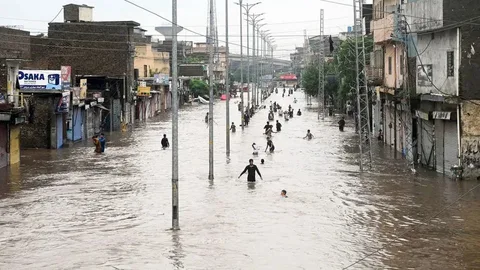
The flood in Pakistan 2025 has emerged as one of the most devastating natural disasters in the country’s recent history. According to figures compiled by the National Disaster Management Authority (NDMA), the 2025 floods claimed at least 1,000 lives and affected nearly seven million people across the country. The flood situation in Pakistan today continues to demand urgent attention from both authorities and the international community.
Background: How Did the Flood in Pakistan 2025 Begin?
Pakistan’s vulnerability to monsoon flooding is well-documented, but the 2025 season proved exceptionally brutal. The 2025 Pakistan floods were a series of devastating floods triggered by heavy pre-monsoon rains in June 2025 and continuing throughout the monsoon season into September. The disaster primarily affected Khyber Pakhtunkhwa, Punjab, Sindh, Balochistan and Azad Kashmir, causing widespread casualties, infrastructure damage, and mass displacement.
The Swat Valley and large parts of Punjab were among the worst-hit areas. As of 17 September 2025, over 1,000 people had been killed and over 1 million were affected nationwide.The flood alert in Pakistan was raised progressively as river levels crossed danger marks one after another across the country.
NDMA Pakistan: What the Authority Reported
The NDMA Pakistan the National Disaster Management Authority played a central role in coordinating rescue and relief throughout the crisis. The NDMA flood alert system tracked river levels around the clock, and the NDMA flood map live data was updated daily to guide evacuation decisions.
According to the National Disaster Management Authority (NDMA), since 26 June 2025 to mid-September 2025, the monsoon rains and floods claimed about 972 lives, injured 1,062 people, destroyed or damaged 8,481 houses, and damaged 239 bridges and 674.58 km of roads.
Since the onset of the monsoon, 814 relief camps supported 29,558 people, 312 medical camps provided care to 7,509 patients, and 1,494 rescue operations saved 255,676 people.The scale of NDMA’s response reflected the sheer enormity of the disaster across the country.
2025 Flood in Pakistan: Facts and Figures
The 2025 flood in Pakistan facts and figures paint a picture of extraordinary devastation. Here is a breakdown of what official data revealed by the end of the monsoon season:
By the end of September, over 6.9 million people had been affected, including 4.7 million people in Punjab Province, 1.6 million people in Khyber Pakhtunkhwa Province, 356,000 people in Gilgit-Baltistan, and 185,000 people in Sindh Province.
Rains and floods claimed the lives of over 1,000 people, including 275 children, with Punjab and Khyber Pakhtunkhwa provinces suffering the brunt of impact, with 304 and 504 fatalities respectively. Of the 6.9 million people affected, some 3 million people were forced to flee their homes in search of higher ground.
The flood also caused extensive damage to infrastructure, with over 229,700 houses, 790 bridges, and 2,811 kilometres of roads destroyed or damaged according to NDMA.
Over 2.2 million hectares of agricultural land were submerged in flood waters, wiping out harvests and increasing food prices across the country. A total of 8,400 villages were inundated and livestock swept away.
Flood Affected Areas in Pakistan 2025: Province by Province
Understanding the flood affected areas in Pakistan 2025 requires a province-by-province look at where the damage was concentrated.
Punjab bore the heaviest burden. Punjab remained at the epicenter of the emergency, with dangerously high water levels in the Chenab, Sutlej, and Ravi rivers. Fueled by heavy monsoon rains and upstream releases from India, the floods submerged thousands of villages in Muzaffargarh, Multan, Kasur, Okara, and Bahawalnagar.
According to NDMA, displacement exceeded 4.7 million people in Punjab. CM Maryam Nawaz Sharif ordered a major rescue operation, deploying army units across seven districts: Lahore, Narowal, Kasur, Sialkot, Okara, Faisalabad, and Sargodha.
Khyber Pakhtunkhwa suffered devastating flash floods in its northern districts. According to NDMA, at least 2,521 buildings were damaged, including 701 completely destroyed, across multiple districts in KP such as Swat, Abbottabad, Charsadda, Malakand, Shangla, Lower Dir, and Torghar. Over 437 kilometres of roads and 52 bridges were swept away.
Between Buner and the neighboring district of Shangla alone, nearly 500 deaths were reported, along with over 4,000 homes damaged and 674 schools affected.
Sindh also remained under serious risk. In District Dadu’s Kachha area, continuous rainfall caused flash floods up to 10 feet deep, cutting off road access to Johi and nearby villages. Rising Indus River levels, activation of the Nai Gaj hill torrent, and advancing waters toward Manchhar Lake created a dangerous multi-hazard scenario, with authorities estimating 178,000 people at high risk.
Balochistan was not spared either. Flash flood alerts remained in place particularly in districts bordering Punjab and Sindh. Low-lying areas in Nasirabad, Jhal Magsi, Lasbela, and Khuzdar remained highly vulnerable as rainfall continued across southern and western parts of the province.
Gilgit-Baltistan faced a different threat glacier lake outburst floods (GLOFs). A GLOF in Ghizer on 22 August damaged 211 houses and left nine people dead, while Diamer suffered 408 damaged houses and nine deaths. Water systems, bridges, powerhouses and irrigation channels were severely hit.
NDMA Flood Map Live: Tracking the Crisis in Real Time
The NDMA flood map live tracking system became a critical tool for authorities and citizens alike during the 2025 disaster. The National Emergency Operations Centre (NEOC) a pioneering initiative of NDMA tracked global oceanic and atmospheric oscillations to assess local hazards, remaining vigilant round the clock to ensure timely interventions.
The NDMA flood alert system issued daily situation reports referred to as SITREPs covering river flow data, dam and reservoir levels, rainfall recorded in the last 24 hours, and flood alert status for each province. These reports guided evacuation orders, relief camp placement, and military deployments on the ground.
A moderately active western disturbance was reported affecting upper and central parts of Pakistan, extending from northern Balochistan across Khyber Pakhtunkhwa, Punjab, Gilgit-Baltistan and AJK,highlighting that the flood situation Pakistan today remains dynamic and climate-sensitive throughout the year.
Quotes: Officials and Experts Speak
According to the NDMA, a total of 3,020,130 individuals were rescued in 5,768 operations carried out in flood-hit areas since June 26, as part of a coordinated response. The NDMA stated it actively monitored all ongoing flood relief activities being carried out by relevant institutions.
Dawn, citing APP, reported that these operations were the result of “coordinated efforts of NDMA, PDMAs, the Pakistan Army, and other rescue teams.
Experts have highlighted a deeper truth: floods do not create vulnerability they expose it. Researchers have pointed out for years that the same cities, same villages, and same houses are hit over and over again, raising serious questions about structural inequality in disaster resilience.
Health Impact: A Crisis Within a Crisis
Beyond the physical destruction, the flood in Pakistan 2025 triggered a serious public health emergency. Suspected malaria cases increased by 26.4% since June 2025, while other health concerns including skin diseases particularly scabies snake bites, and dog bites were reported at significantly higher levels, posing major public health concerns especially in Khyber Pakhtunkhwa.
A total of 104 damaged health facilities were reported across the country in Sindh, Khyber Pakhtunkhwa, Punjab, and Gilgit-Baltistan.Medical camps were set up as part of the NDMA Pakistan-coordinated response, but healthcare systems in many flood affected areas in Pakistan 2025 were stretched beyond capacity.
Impact: Regional and Global Dimensions
The flood in Pakistan 2025 was not just a national crisis it drew international concern. The United States, via CENTCOM, delivered life-saving supplies on C-17 aircraft and coordinated disaster response with the NDMA.
The NDMA and international organizations warned that communities need support both in the short- and long-term for food security, livelihoods, WASH, and healthcare. There is also the question of education, as Pakistan’s academic year begins in August, meaning many schools were forced to shut down just after reopening.
The agricultural devastation compounds the economic pain. Over 2.2 million hectares of agricultural land were submerged in flood waters, wiping out harvests and increasing food prices across the country.For a country already grappling with inflation and economic instability, this adds another layer of long-term hardship.
Conclusion: What Comes Next?
The flood situation Pakistan today as of early 2026 has shifted from emergency response to recovery and early reconstruction. Some 1,580 evacuation centers were established by provincial authorities, and international recovery planning is underway. OCHA’s support plan covering October 2025 to April 2026 outlines a roadmap for relief and early recovery across the most affected provinces.
The NDMA Pakistan continues to monitor weather patterns, issue NDMA flood alerts ahead of the next monsoon season, and push for structural investment in flood resilience. The lesson from 2025 is clear: Pakistan must move from reactive disaster response to proactive, long-term climate adaptation or face the same destruction again.
FAQs
Which areas in Pakistan are flooded?
The most severely flood affected areas in Pakistan 2025 included Punjab with 4.7 million people affected Khyber Pakhtunkhwa with 1.6 million affected, Gilgit-Baltistan, Sindh, Balochistan, and Azad Kashmir.Districts such as Muzaffargarh, Multan, Buner, Shangla, Swat, and Dadu were among the hardest hit.
What is causing flooding in Pakistan?
The 2025 floods were triggered by heavy pre-monsoon rains in June 2025 continuing throughout the monsoon season into September.Additional factors included upstream water releases from India, glacier lake outburst floods (GLOFs) in Gilgit-Baltistan, and poor drainage infrastructure in urban areas like Karachi.
When was the last major flood in Pakistan?
The 2022 Pakistan floods widely considered the worst in the country’s history submerged one-third of the country and affected over 33 million people. The flood in Pakistan 2025 is now ranked among the country’s worst disasters in terms of lives lost and displacement, rivaling and in some metrics surpassing previous major flood events. Pakistan experiences significant flooding nearly every monsoon season, making it one of the world’s most flood-vulnerable nations.