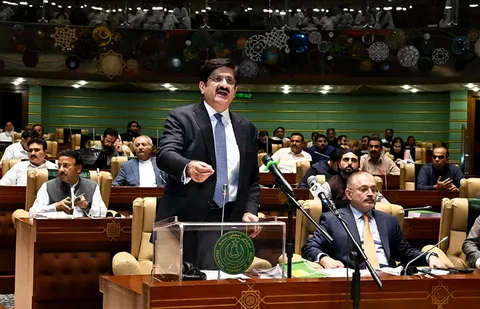
The Sindh Assembly ijlas today brought lawmakers together in Karachi to work through legislative business, governance matters, and public welfare concerns. Members questioned government departments, debated policy implementation, and reviewed issues affecting citizens across the province.
The session followed the standard pattern of parliamentary work: government ministers defending their record, opposition lawmakers pressing for accountability, and constituency representatives raising the specific concerns their voters sent them to Karachi to raise.
Sindh Assembly Holds Another Important Session
Assembly sessions like today’s are where provincial democracy actually operates, not just in principle but in practice. Elected representatives from across Sindh gathered to move through the agenda: governance items, financial oversight, administrative reforms, and constituency matters.
Members from different political parties took part in discussions, each bringing forward concerns from the districts they represent. The session gave the House an opportunity to exercise its constitutional oversight role over provincial government departments.
Background of the Provincial Assembly of Sindh
The Provincial Assembly of Sindh makes laws on provincial subjects under Pakistan’s Constitution, approves provincial budgets, scrutinizes government departments, and provides a forum for lawmakers to raise public concerns and question ministers.
The Assembly has shaped provincial policy across education, health, agriculture, local government, infrastructure, and economic development over the decades. Each session builds on that ongoing role, working through both new proposals and follow-up on existing policy commitments.
Legislative Business Dominates Proceedings
A significant portion of today’s session covered legislative business placed before the House: governance reform proposals, public administration measures, and implementation of existing provincial laws.
Members went through legislative clauses carefully. Government representatives defended ongoing policy initiatives while opposition members pushed for more detail on accountability and transparency. That back-and-forth is part of how legislation improves before it clears the House.
Public Welfare Issues Receive Attention
Public welfare issues came up repeatedly through the session, with lawmakers raising concerns about healthcare facilities, educational institutions, road infrastructure, water supply, sanitation, and employment.
Representatives pushed provincial departments to improve service delivery and respond faster to community-level issues. Constituency-specific problems also surfaced, which is exactly what Assembly sessions are designed to handle alongside broader provincial policy questions.
Ministers assured the House that relevant departments are monitoring development projects and implementing approved policies within available budgets.
Government and Opposition Exchange Views
Government and opposition members took different positions on policy matters, which is normal in parliamentary proceedings. Government lawmakers outlined what they see as administrative achievements and defended current policy directions. Opposition members questioned implementation timelines, project execution, financial management, and how available funds are actually being spent.
Both sides framed their arguments around the same underlying goal of better provincial governance, even where they disagreed sharply on how that’s being achieved.
Accountability Through Parliamentary Questions
Question Hour gave members a direct mechanism to seek official responses from government departments on specific matters: infrastructure projects, education policies, health services, municipal issues, and development schemes.
Ministers responded to parliamentary questions with departmental updates where they had them. This kind of structured accountability is one of the more concrete ways Assembly sessions translate into oversight of day-to-day government performance.
Role of Sindh Assembly Members
Sindh Assembly members carry a range of constitutional responsibilities beyond attending sessions. They represent public concerns, participate in lawmaking, review provincial policies, monitor government departments, debate budgets, raise constituency issues, introduce legislative proposals, and serve on parliamentary committees.
Most members also do substantial constituency-level work between sessions, engaging with residents to understand local issues before bringing them into the Assembly chamber.
Understanding the Sindh Assembly MPA List
The Sindh Assembly MPA List includes elected representatives from general constituencies as well as members on reserved seats for women and non-Muslims under constitutional provisions.
The composition reflects electoral outcomes across the province while ensuring broader representation within the legislature. The official list updates following general elections, by-elections, resignations, or other constitutional changes.
Sindh Assembly Seats Explained
Sindh Assembly seats follow constitutional provisions and electoral law. General seats are directly contested by voters; reserved seats are allocated to political parties based on proportional representation.
The system aims to strengthen democratic participation while ensuring women and minority communities have representation in provincial legislation. Seat allocation also determines how government is formed, what legislative priorities get pushed, and how parliamentary committees are constituted.
Current Deputy Speaker of Sindh Assembly
The Current Deputy Speaker of Sindh Assembly manages Assembly proceedings when the Speaker is unavailable, presides over sessions, ensures parliamentary rules are followed, and helps keep legislative business moving according to constitutional procedure.
Like the Speaker, the Deputy Speaker is elected by Assembly members and is considered an important part of the institution’s operational framework.
Digital Services Through the Sindh Government Website
The Sindh Government website gives citizens access to government departments, notifications, development initiatives, policy documents, and public services without needing to go through official channels in person.
Official announcements and provincial governance updates are also published there, improving public access to information that was previously harder to find or required direct contact with the Secretariat.
Public Access to Assembly Information
The Provincial Assembly continues publishing legislative information through official channels: committee reports, Assembly schedules, session records, and public announcements.
Citizens can track legislative developments through these materials. Greater public access to what the Assembly is actually doing strengthens democratic accountability and gives people a clearer picture of how provincial decisions get made.
Sindh Assembly Contact Number and Public Communication
People searching for the Sindh Assembly Contact number are typically looking for help with Assembly procedures, visitor arrangements, public records, or administrative inquiries. Official contact details are available through government communication channels, allowing citizens, researchers, journalists, and other stakeholders to reach the Secretariat directly.
Political Importance of Today’s Session
Regular sessions like today’s keep the Sindh Assembly ijlas functioning as a genuine accountability mechanism rather than a formality. Lawmakers who attend, ask questions, and push back on government responses make the institution more effective regardless of which party is in government.
Consistent parliamentary engagement matters for how provincial institutions actually perform, not just for how they appear to perform.
Regional Significance
Decisions made during Sindh Assembly sessions touch governance, development planning, public finance, education, healthcare, local government, agriculture, and infrastructure across the province.
Karachi’s status as Pakistan’s largest commercial center means the Assembly’s work also carries national weight. Policy decisions taken here directly affect millions of residents, businesses, and institutions, which is why Sindh Assembly proceedings attract attention beyond the province itself.
Looking Ahead
Future sessions are expected to continue working through governance reforms, public service delivery, development projects, and legislative priorities. Lawmakers will review additional bills, examine departmental performance, monitor policy implementation, and debate budgetary matters as they come up.
Parliamentary committees will keep examining proposals before they return to the full House. Today’s Sindh Assembly ijlas was another step in that ongoing democratic process.
Frequently Asked Questions (FAQs)
What is the protest in Sindh province?
Protests in Sindh happen for a wide range of reasons and can involve political parties, civil society organizations, public sector employees, traders, students, or local communities. Demonstrations may be over governance issues, public service failures, employment concerns, development project delays, or specific policy decisions affecting a district or sector. The trigger differs from one situation to the next, and from one part of the province to another, which is why verified news sources and official statements are the most reliable way to understand what’s actually driving any particular protest at a given time.
What is the current situation in Karachi?
Karachi continues to function as Pakistan’s largest commercial city and the country’s main financial and industrial center. Like any rapidly growing metropolitan area, it deals with a combination of active political life, business activity, major infrastructure projects, and urban management challenges. Provincial and city authorities are working on transport improvements, municipal services, urban development, and law enforcement, though the city’s scale and population growth mean these challenges don’t have quick fixes. For current developments, local news sources and official city administration channels are the most up to date.
Which city is called Paris of Sindh?
Shikarpur carries the title “Paris of Sindh,” reflecting its historical role as a major trading hub and its architectural and cultural legacy. During the nineteenth century, Shikarpur was genuinely significant as a commercial center connecting South Asia with Central Asia and the Middle East, and the wealth generated during that period left a mark on the city’s built environment and cultural traditions that’s still visible today. The city remains known for its historic bazaars, traditional buildings, and the kind of commercial heritage that earned it the comparison to a cultural capital in the first place.