

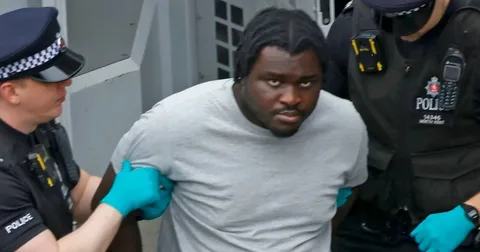
UK Metropolitan Police have charged a man with attempted murder following the stabbing of two Jewish men in Golders Green, north London.The case has drawn national attention and raised urgent questions about criminal offences in the UK, what being charged means, and how the law responds to serious crimes.
Background
Following the stabbings in a residential area of London, British officials raised the national terrorism threat to its second-highest level, indicating that an attack within the next six months is considered highly likely.
Prime Minister Keir Starmer pledged that stronger action would be taken to protect Jewish people in the UK. The incident has become a flashpoint in ongoing concerns about rising antisemitism and public safety across Britain.
Details of the Case
Police confirmed that Essa Suleiman, 45, has been charged with two counts of attempted murder and one count of possession of a bladed article in a public place in connection with the attack. He was also charged with attempted murder relating to a separate incident earlier on the same day in south London.
Suleiman has been remanded in custody and is due to appear at Westminster Magistrates’ Court.This is a direct example of how UK criminal law handles serious criminal offences from arrest, to charge, to court appearance.
Police said Suleiman resisted arrest and was detained with the use of a taser gun.The arrest itself sparked public debate after video footage was widely shared online.
What Are Criminal Offences in the UK?
Understanding criminal law UK is important for every citizen. Criminal offences in the UK are broadly divided into three categories under criminal law UK:
- Summary Offences — Minor crimes heard in Magistrates’ Court, such as traffic violations or minor assaults. Punishments are usually fines or short custodial sentences.
- Either-Way Offences — Crimes that can be tried in either Magistrates’ or Crown Court, such as theft or drug possession. Sentencing depends on severity.
- Indictable Offences — The most serious charges in the UK, including murder, rape, and terrorism-related crimes. These are always tried in Crown Court and carry the heaviest punishments.
List of Criminal Offences and Their Punishments UK
Here is a simplified list of criminal offences and their punishments UK to understand how the legal system works:
- Murder — Mandatory life sentence
- Attempted Murder — Up to life imprisonment
- Rape — Up to life imprisonment
- Terrorism offences — Up to life imprisonment
- Robbery — Up to life imprisonment
- GBH (Grievous Bodily Harm) — Up to life imprisonment (Section 18)
- ABH (Actual Bodily Harm) — Up to 5 years
- Theft — Up to 7 years
- Burglary — Up to 14 years
- Drug trafficking — Up to life imprisonment
- Fraud — Up to 10 years
- Sexual assault — Up to 10 years
- Arson — Up to life imprisonment
- Knife possession in public — Up to 4 years
- Hate crimes — Enhanced sentencing on top of base offence
- Cybercrime — Up to 10 years
- Money laundering — Up to 14 years
- Stalking — Up to 10 years
- Domestic abuse — Up to 5 years
- Manslaughter — Up to life imprisonment
This list of criminal offences and their punishments UK covers some of the most commonly prosecuted crimes under criminal law UK.
What Does “Charged” Mean Police Explanation
Many people ask: what does charged mean police? Being charged means the police and Crown Prosecution Service (CPS) have gathered enough evidence to formally accuse someone of a crime. A charge is an official criminal accusation it is not a conviction.
When police charge someone, they are saying: “We believe this person committed this specific criminal offence, and we are taking them before a court.” The charge begins the formal legal process.
What Happens After You’ve Been Charged With a Crime?
Knowing what happens after you’ve been charged with a crime helps citizens understand their rights. Here is a step-by-step overview:
- Step 1: You are formally charged and given a charge sheet.
- Step 2: You appear before a Magistrates’ Court, usually within 24 to 48 hours if held in custody.
- Step 3: The court decides on bail or remand (custody).
- Step 4: For serious offences, the case moves to Crown Court.
- Step 5: A trial is held, and a verdict is reached.
- Step 6: If found guilty, sentencing takes place.
Does Being Charged Mean Going to Jail?
A common concern is: does being charged mean going to jail? The answer is no not automatically. Being charged means you are accused of a crime. You are presumed innocent until proven guilty in court.
However, if remanded in custody (like Suleiman in this case), you may be held in jail while awaiting trial. For minor offences, you may be released on bail with conditions. Whether you go to jail ultimately depends on the verdict and the judge’s sentencing.
How Long After a Crime Can You Be Charged UK?
Another key question in criminal law UK is: how long after a crime can you be charged UK?
For summary offences, police generally have six months from the date of the offence to bring charges. For indictable offences such as murder, rape, or terrorism there is no time limit. Prosecutors can charge a person years or even decades after the crime occurred, as long as sufficient evidence exists.
10 Laws in the UK Everyone Should Know
Here are 10 laws in the UK that are relevant to everyday life and criminal responsibility:
- Offences Against the Person Act 1861 — Covers assault and GBH.
- Theft Act 1968 — Defines theft and robbery.
- Terrorism Act 2000 — Covers terrorism offences and police powers.
- Sexual Offences Act 2003 — Defines sexual crimes and consent.
- Misuse of Drugs Act 1971 — Governs drug possession and supply.
- Fraud Act 2006 — Covers fraud and false representation.
- Criminal Justice Act 2003 — Governs sentencing guidelines.
- Public Order Act 1986 — Covers riots, violent disorder, and harassment.
- Protection from Harassment Act 1997 — Addresses stalking and harassment.
- Domestic Abuse Act 2021 — Strengthens protections for domestic abuse victims.
Quotes
Metropolitan Police Commissioner Mark Rowley addressed the Golders Green arrest, saying officers faced an extremely dangerous and frightening situation. Rowley stated that officers were afraid because the suspect did not comply even after being brought down by a taser, and they were concerned he might be carrying an explosive device based on his behaviour.
Home Secretary Shabana Mahmood acknowledged that the UK has been experiencing a growing terrorist threat for some time, linked to security concerns connected to foreign states.4
Impact
The attack took place in an area home to a large Jewish community. One of the victims, a 34-year-old man, has since been released from hospital, while a 76-year-old victim remains in a stable condition.
The Home Secretary noted that several recent incidents including attacks on a synagogue in Finchley, the Kenton United Synagogue in Harrow, and a Jewish charity reflect a broader and growing threat against Jewish communities across Britain.
Several of these incidents have been claimed by a group called HAYI, whose name means the Islamic Movement of the People of the Right Hand.
British police have arrested 26 people for various attacks launched since the start of the US-Israel war on Iran in February 2026.
Conclusion
The London stabbing case is a stark reminder of how serious criminal offences under UK criminal law are handled from arrest to formal charge to court appearance. Understanding what does charged mean police, how long after a crime can you be charged UK, and what happens after you’ve been charged with a crime empowers citizens to navigate the legal system.
UK police have said they will assess planned pro-Palestinian protests in London in the coming weeks to determine whether further restrictions are necessary, with the Metropolitan Police chief pledging to do everything possible to maximise the sense of safety in the capital.
As antisemitism and terrorism-linked crimes remain a pressing concern, the enforcement of the list of criminal offences and their punishments UK will continue to be scrutinised by the public, policymakers, and legal experts alike.
FAQs
What are criminal offences in the UK?
Criminal offences in the UK are acts or omissions that violate criminal law and are punishable by the state. They range from minor summary offences (like petty theft) to the most serious indictable offences such as murder, terrorism, and rape. Criminal law UK sets out the definitions, procedures, and punishments for all recognised offences.
What are the 4 types of crime?
The four broad types of crime recognised in criminal law UK are: (1) violent crime such as assault, GBH, and murder; (2) property crime such as burglary, theft, and arson; (3) public order crime such as riots and harassment; and (4) white-collar crime such as fraud, money laundering, and cybercrime.
What are the most serious charges in the UK?
The most serious charges in the UK are indictable offences tried in Crown Court. These include murder, attempted murder, terrorism offences, rape, serious sexual assault, trafficking, and large-scale drug supply. Convictions for these crimes can result in life imprisonment under UK criminal law.