
Three words from the president “Cuba’s next” turned a geopolitical concern into a legislative emergency. On Tuesday, the Republican-led Senate voted to block a Democratic resolution that would have required congressional approval before any Trump military action Cuba could proceed.
The 51-47 vote was almost entirely along party lines and it leaves nothing legally standing between Trump and whatever he decides to do with the island nation 90 miles from Florida.
The Vote What Happened and Who Crossed Party Lines
The Democratic resolution was sponsored by Senators Ruben Gallego, Tim Kaine, and Adam Schiff, and sought to invoke the 1973 War Powers Act to block any Trump military action Cuba without a congressional green light. Republican Senator Rick Scott of Florida introduced a procedural point of order against it, arguing the measure was irrelevant because no troops had been deployed. The motion to kill the resolution passed 51-47. Two Republicans Susan Collins of Maine and Rand Paul of Kentucky broke with their party and sided with Democrats. One Democrat John Fetterman of Pennsylvania voted with Republicans to dismiss the resolution. The outcome mirrors a series of failed Democratic-led war powers efforts over the past several months on Iran and Venezuela.
Trump Said It Himself “Cuba’s Next”
The entire urgency behind the Trump military action Cuba debate traces to a single statement. Speaking at a Turning Points USA event, Trump said: “We have been very, very successful. You know, when I went into Venezuela. I built this great military, I said, you’ll never have to use it, but sometimes you have to use it. And Cuba’s next, by the way.” He pledged “a new dawn for Cuba” and has repeatedly told reporters he believes the Cuban government is on the verge of collapse. Trump has not specified whether any Trump Cuba executive order or military directive is imminent but Democrats argue that waiting for formal troop deployment before acting is exactly the mistake Congress made with Iran.
The Blockade Already in Place Is It Already War?
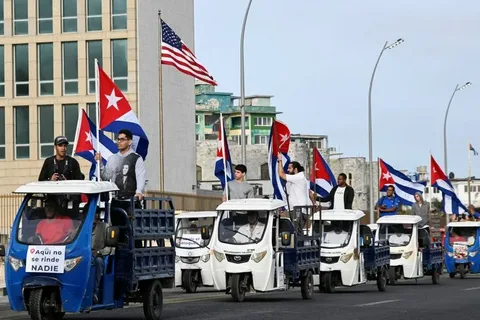
Democrats argue that Trump military action Cuba is not a future threat it is already happening. The US has used Coast Guard and naval assets to intercept and deter fuel shipments bound for Cuba, imposing what Senator Kaine called “a very devastating economic blockade.” The effects on Cuban society have been severe electricity blackouts lasting 20 hours a day, cancellation of medical procedures including for children, shutdown of municipal water supplies, and widespread food shortages. “If anyone were doing to the United States what we are doing to Cuba, we would definitely regard it as an act of war,” Kaine told the Senate floor. Republicans counter that blocking fuel shipments does not constitute military hostilities because no troops have been deployed and no shots have been fired.
Venezuela, Iran, Cuba A Pattern of Unilateral Action
Trump Cuba news today cannot be understood in isolation it is the third chapter in a pattern of unilateral military decision-making. Trump ordered a raid in Venezuela earlier this year. He launched Operation Epic Fury against Iran on February 28 without prior congressional authorisation. He has now imposed a de facto blockade on Cuba and publicly said it is next for regime change. Democrats have attempted to block each of these moves through the War Powers Act and failed every time defeated by a Republican majority that has consistently backed the president’s authority as commander-in-chief. Senator Jamie Raskin warned Tuesday that the pattern suggests Congress has effectively surrendered its constitutional war powers to the executive branch.
Why Is Trump After Cuba
The Trump Cuba executive order and blockade strategy is rooted in a combination of ideological, political, and strategic motivations. Trump has a long-standing view that communist governments in America’s hemisphere Cuba, Venezuela, and Nicaragua represent unacceptable threats to US interests. Florida’s large Cuban-American voting bloc, which overwhelmingly supported Trump in both 2020 and 2024, has long pushed for a hardline policy toward Havana. The Trump administration relisted Cuba as a state sponsor of terrorism on his first day back in office, reversing an Obama-era delisting. Cuba’s role in hosting Russian military assets and intelligence facilities has also been cited by hawkish officials as a national security justification for the pressure campaign. The why is the US blockading Cuba 2026 question has both a domestic political answer and a foreign policy one.
Democrats’ Argument And Why It Is Failing
The Democratic case for the Cuba war powers resolution was legally and morally coherent and politically powerless. Kaine argued that the Constitution gives Congress, not the president, the power to declare war and that economic warfare using military assets is functionally indistinguishable from armed hostilities. “What would the American public say about a war against Cuba?” he asked on the Senate floor. The problem Democrats face is arithmetic. Republicans hold slim majorities in both the Senate and the House, and have voted as a bloc to protect Trump’s commander-in-chief authority on every war powers challenge so far. Without five Republican defections as briefly occurred on Venezuela before two senators reversed course after Secretary of State Marco Rubio’s assurances Democratic war powers resolutions cannot advance.
What Comes Next Cuba on the Brink
The failure of Tuesday’s resolution leaves the path to Trump military action Cuba legally unobstructed from a congressional standpoint. Trump faces his Iran War Powers deadline of May 1 just days away which may consume his political attention in the short term. But once the Iran situation is resolved one way or another, Cuba is openly next on his stated agenda. The Cuban government has called the US blockade an act of economic warfare and has appealed to international institutions including the UN. Russia has warned Washington against any military intervention. Whether Trump moves next toward a naval escalation, a regime-change operation, or a negotiated arrangement remains unclear but after Tuesday’s Senate vote, Congress has placed no legal barrier in his way.
Frequently Asked Questions
Did Trump put an embargo on Cuba?
Trump relisted Cuba as a state sponsor of terrorism on his first day back in office reversing an Obama-era delisting and imposed a de facto maritime blockade using US Coast Guard and naval assets to intercept fuel shipments bound for Cuba. Democrats argue this energy blockade already constitutes Trump military action Cuba under the terms of the War Powers Act. Republicans maintain it does not qualify as military hostilities because no troops have been formally deployed to Cuban territory.
Does the US still pay Cuba for Guantánamo Bay?
The US has a lease agreement for the Guantánamo Bay Naval Base dating to 1903, which requires an annual payment of approximately $4,085. Cuba has refused to cash these cheques since the 1960s, viewing the US presence as an illegal occupation. The lease technically requires mutual consent to terminate, meaning the US can legally remain at Guantánamo indefinitely. The base has been a persistent source of diplomatic friction and plays no role in the current Trump Cuba news today blockade situation.
What is the deal with the USA and Cuba a brief history?
The US and Cuba have been in a state of political hostility since Fidel Castro’s 1959 revolution overthrew the US-backed Batista government. The US imposed a comprehensive trade embargo in 1962 still largely in place today and severed diplomatic relations. The 1961 Bay of Pigs invasion, a failed CIA-backed attempt to overthrow Castro, remains one of the most embarrassing episodes in US foreign policy history. President Obama restored diplomatic relations and eased some restrictions between 2014 and 2016, but Trump reversed many of those measures in his first term and has gone significantly further in his second, imposing the current blockade and openly discussing regime change as the goal of Trump military action Cuba policy.