
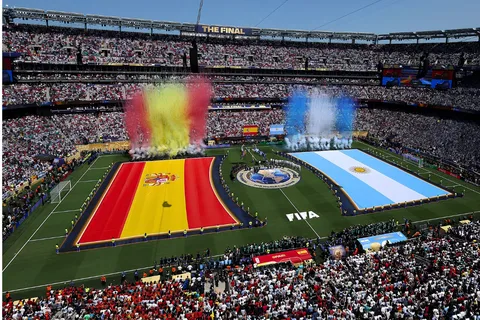
Spain’s national football team etched their names into history on Sunday, July 20, 2026, winning the FIFA World Cup 2026 final at MetLife Stadium in New Jersey, United States. It was a night filled with raw emotion, world-class football, and a closing ceremony that gave fans far more than they expected. Spain’s players celebrated wildly on the pitch as confetti rained down and the golden trophy glittered under the stadium floodlights.
The victory made Spain one of the most decorated international teams in football history. Their triumph was met with euphoria back home in Spain and among Spanish-speaking communities across the world. Social media exploded within seconds of the final whistle, and the YouTube World Cup closing ceremony 2026 footage began circulating almost instantly across platforms.
The Closing Ceremony Everyone Is Talking About
The FIFA World Cup 2026 closing ceremony was a grand production featuring music, light shows, and speeches designed to cap off a tournament that was hosted across the United States, Canada, and Mexico. Stadiums across three nations had welcomed millions of fans over the course of the competition, and the final ceremony was meant to be a dignified and celebratory send-off for the greatest football event on the planet.
Everything was going according to plan until a moment unfolded on the trophy presentation stage that stopped the world. United States President Donald Trump, who had been a visible presence throughout the tournament hosted on American soil, appeared onstage during the ceremony. What followed became the defining image of the entire event and sent the internet into overdrive.
Trump and Infantino: The Moment That Went Viral
Video footage broadcast live and quickly uploaded to YouTube showed FIFA President Gianni Infantino appearing to physically guide President Trump away from the trophy presentation stage as Spain prepared to lift the World Cup. The clip, which spread across social media within minutes, showed Infantino placing a hand on Trump’s arm and appearing to steer him in a different direction as the Spanish players approached the moment they had been waiting their entire careers for.
The video drew massive attention globally. Millions of viewers searched for the YouTube World Cup closing ceremony 2026 clip within hours of the event ending, making it one of the most-watched sports ceremony moments in recent memory. Reactions ranged from amusement and disbelief to sharp political commentary, and the footage was shared widely across X, Instagram, TikTok, and Facebook alongside countless reaction videos and news reports.
Al Jazeera was among the international outlets that aired the footage, with their coverage clearly showing Infantino’s attempt to manage the situation on stage as the ceremony moved toward its climax. The visuals were unambiguous and the moment was impossible to ignore for anyone watching the broadcast.
The Trophy Presentation
Despite the commotion surrounding Trump’s presence onstage, the trophy presentation itself proceeded and Spain’s captain raised the FIFA World Cup trophy to a roaring crowd. The image of Spanish players holding the golden trophy aloft, surrounded by fireworks and stadium lights, will remain one of the defining sports photographs of 2026.
Spain’s players, coaching staff, and supporters inside MetLife Stadium celebrated long into the night. The win was not just a football result — it was a statement of sustained excellence from a nation that has consistently produced some of the world’s finest football talent across generations.
Trump’s Involvement in FIFA World Cup 2026
President Trump had positioned himself prominently throughout the FIFA World Cup 2026 tournament. As the competition was held across American cities for the first time in decades, Trump made appearances at multiple stages of the event and treated the tournament as something of a national moment tied to his administration’s identity. His presence at the final and at the closing ceremony reflected a desire to be associated with what was the largest sporting event ever held on United States soil.
However, the moment with Infantino suggested that FIFA officials were mindful of maintaining protocol during the actual trophy ceremony, which is traditionally reserved for players, football officials, and tournament organisers. Whether the interaction was a result of misunderstanding, tight scheduling, or deliberate management of the stage, it became the most talked-about non-football moment of the entire tournament.
FIFA’s Record-Breaking 2026 Tournament
The FIFA World Cup 2026 was the first edition of the expanded 48-team tournament, a change that FIFA had announced years earlier to bring more nations into the competition. The expansion meant more matches, more countries represented, and a longer competition window spread across three host nations. It was also, by almost every measure, a commercial and broadcast success for FIFA.
The YouTube World Cup closing ceremony 2026 content, including the full ceremony broadcast and the viral Trump-Infantino clip, together accumulated tens of millions of views within the first 24 hours of being available. The tournament had already broken records for streaming numbers, stadium attendance across North America, and global broadcast viewership, and the closing ceremony extended that story well beyond the football itself.
Global Reaction to the Ceremony
Reaction to the closing ceremony was divided along predictable lines. Football fans around the world largely focused on celebrating Spain’s achievement and discussing the quality of the final match. Political commentators and media figures focused heavily on the Trump-Infantino moment and what it represented about the intersection of sports, politics, and American public life.
International media from Europe, Latin America, the Middle East, and Asia all picked up the footage. In Spain, coverage was overwhelmingly focused on the players and the trophy. In the United States, the political angle dominated. Social media users across the world landed somewhere in between — watching and rewatching the clip with equal parts fascination and disbelief.
The FIFA World Cup closing ceremony 2026 became a trending topic in dozens of countries simultaneously, which is extraordinarily rare even for events of this scale. The combination of football history, a viral political moment, and the spectacle of a 48-team tournament all coming together in one final evening gave the story an unusually wide reach.
What Spain’s Win Means for Football
Spain’s World Cup victory in 2026 adds another chapter to one of international football’s greatest stories. Spanish football has been shaped over decades by world-class clubs, elite academies, and a playing philosophy centred on technical ability and intelligent movement. This squad carried that tradition forward onto the world stage and delivered when it mattered most.
For the players who lifted that trophy, many of whom represent a new generation of Spanish talent, this victory will define their careers. For Spanish football as a whole, it reinforces a culture of winning at the highest level and will inspire the next generation of young players growing up watching their heroes celebrate on the world’s biggest stage.
Impact on YouTube and Digital Sports Media
The YouTube World Cup closing ceremony 2026 moment illustrated once again how quickly sports events are consumed, shared, and discussed on digital platforms. FIFA’s official YouTube channel, alongside clips shared by broadcasters and individual users, drove enormous traffic on the night of the final and in the days that followed.
Sports events have become increasingly inseparable from their digital afterlife. The most talked-about moments from the 2026 World Cup final and ceremony will continue to be viewed, analysed, and referenced for years. FIFA has invested significantly in its digital presence over recent years, and the 2026 tournament demonstrated how powerful that investment can be when a single viral moment captures the attention of audiences who may not have been watching the original broadcast.
Quotes from Key Figures
Gianni Infantino, speaking after the ceremony, praised the tournament as the greatest in FIFA’s history and highlighted the contribution of the three host nations in delivering a competition of this scale. He did not address the viral moment directly in his initial public remarks following the event.
Spain’s manager expressed overwhelming pride in his players following the final whistle, describing the team’s journey through the tournament as one built on unity, hard work, and belief. Several Spanish players spoke in post-match interviews about what the victory meant to them personally and to everyone back home in Spain.
Donald Trump, through a post on his social media platform, congratulated Spain and described the World Cup as a tremendous success for the United States, pointing to the organisational achievement of hosting such a large-scale event across multiple American cities.
Looking Ahead
With the FIFA World Cup 2026 now concluded, attention in the football world will quickly shift to the qualification campaign for the 2030 edition and to the domestic club seasons resuming across Europe and South America. For FIFA, the 2026 tournament sets a commercial and organisational benchmark that will shape how future tournaments are planned and delivered.
For viewers and fans, the YouTube World Cup closing ceremony 2026 content the performances, the trophy lift, and that unforgettable moment between Infantino and Trump will remain some of the most replayed sports footage of the year. It was a night that had everything: sporting greatness, political theatre, and the kind of spontaneous human moment that no amount of planning could have scripted.
FAQs
Does the World Cup have a closing ceremony?
Yes, the FIFA World Cup always features a closing ceremony held immediately after the final match concludes. The ceremony takes place on the pitch of the host stadium and typically includes a formal trophy presentation to the winning team, a musical or entertainment segment, and speeches from FIFA officials. The 2026 edition was held at MetLife Stadium in New Jersey and featured an elaborate production involving light displays, live performances, and the presentation of the FIFA World Cup trophy to Spain. The closing ceremony is one of the most-watched moments of the entire tournament and is broadcast live to billions of viewers around the world. The 2026 ceremony drew particular attention due to President Trump’s appearance onstage and the widely circulated footage of Infantino appearing to redirect him during the proceedings.
What time is the closing ceremony for the World Cup?
The FIFA World Cup closing ceremony traditionally takes place immediately after the final match ends, which means the start time depends on when the game concludes. The 2026 World Cup final kicked off in the early evening local time in New Jersey, and with the match running its full duration plus any additional time, the closing ceremony began in the late evening local time. For international viewers, this translated to late-night coverage in Europe, early morning in parts of Asia, and varied broadcast windows depending on time zone. Fans watching on television or via YouTube were able to follow the ceremony live, and full recordings were made available on YouTube and official FIFA digital channels within hours of the event ending, making the YouTube World Cup closing ceremony 2026 footage accessible to global audiences regardless of their time zone.
What time is the closing ceremony of FIFA 2026?
The FIFA 2026 closing ceremony on July 20, 2026 started following the conclusion of the World Cup final at MetLife Stadium in East Rutherford, New Jersey. Given that the final was scheduled for an evening kickoff in the Eastern Time zone, the closing ceremony is estimated to have begun between approximately 10 PM and 11 PM Eastern Time, depending on how long the match ran. For viewers in the United Kingdom, this would have placed the ceremony in the early hours of July 21. Viewers across Europe, the Middle East, South Asia, and the Asia-Pacific region would have been watching in the early morning hours of July 21, 2026. FIFA and its broadcast partners ensured that the ceremony was streamed live on multiple platforms including YouTube, where it remained available for on-demand viewing shortly after the live broadcast concluded.