
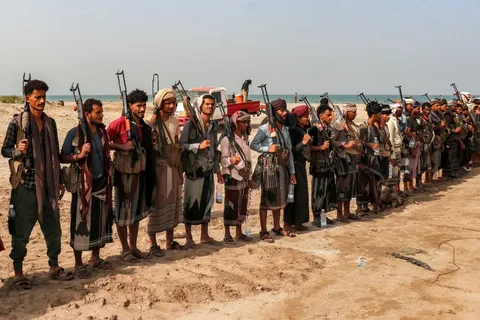
The Red Sea crisis has escalated sharply after Yemen’s Houthi rebels announced a full naval blockade against Saudi Arabia, threatening one of the world’s busiest shipping corridors. The move comes just weeks after Houthi forces resumed attacks on commercial vessels for the first time since 2024, reviving fears of a wider disruption to global trade.
Background
The Red Sea sits between northeast Africa and the Arabian Peninsula, connecting the Mediterranean to the Indian Ocean through the Suez Canal in the north and the Bab el-Mandeb Strait in the south. Roughly $1 trillion worth of goods passed through this corridor each year before the current crisis began.
Many people ask why is Red Sea called Red Sea, and the answer ties directly to the region’s geography. Historians generally trace the name to seasonal algae blooms that turn the water reddish-brown, though some scholars link it instead to the reddish mountains along its shores or an old translation referring to the “south” rather than the color itself.
The current Red Sea crisis began in November 2023, when Houthi forces started targeting vessels they linked to Israel in solidarity with Palestinians during the Gaza war. Attacks continued for months, forcing major shipping companies to reroute around Africa’s Cape of Good Hope instead of using the Red Sea and Suez Canal route.
Details
On July 20, the Houthis announced they were imposing what they called a complete maritime embargo on Saudi Arabia, retaliating against a Saudi-led blockade on Yemen and a recent strike on Sanaa’s international airport. The group’s statement warned that Saudi oil facilities were now considered targets for missiles and drones.
This is a shift from previous Houthi attacks, which mainly focused on vessels linked to Israel, the US, or the UK. A direct blockade against Saudi Arabia opens an entirely new front, one tied closely to the broader US-Iran conflict now playing out across the region.
Earlier in July, Houthi forces attacked the Liberian-flagged bulk carrier Magic Seas near Al-Hudaydah, Yemen, firing on it with gunfire, rocket-propelled grenades, and unmanned surface vessels before the crew abandoned ship. That attack marked the group’s first strike on commercial shipping since 2024, breaking a period of relative calm that followed the Gaza ceasefire.
Analysts have started comparing the situation to tensions in the Strait of Hormuz, another critical chokepoint where Iran has threatened shipping amid its ongoing conflict with the US and Israel. Both waterways now sit at the center of overlapping regional crises, raising the possibility that global shipping could face disruption on two major fronts simultaneously.
The Suez Canal, which links the Red Sea to the Mediterranean, has already suffered financially. Egypt’s government reported billions of dollars in lost revenue as shipping companies avoided the route, a serious blow to a country that relies heavily on canal fees for foreign currency.
Not every body of water in the region is affected. The Dead Sea, located far to the north between Jordan and Israel, remains untouched by the shipping crisis since it isn’t a trade route at all, but the confusion between regional seas has become common in public discussion as tensions spread.
Quotes
The UN Security Council’s resolution on the crisis, first adopted in response to the initial wave of attacks, demanded that the Houthis “immediately cease all attacks on merchant and commercial vessels,” while affirming the right of states to defend their ships under international law.
The European Union condemned earlier attacks in similarly firm language, with its foreign affairs spokesperson stating that such strikes “directly threaten regional peace and stability, global commerce and freedom of navigation as a global public good.”
Maritime security analysts tracking the latest blockade announcement have described it as a serious escalation. According to the Council on Foreign Relations, the declared blockade “threatens to choke off the Red Sea’s Bab el-Mandeb Strait, with potentially major consequences for the global economy.”
Impact
The economic stakes of the Red Sea crisis are enormous. Global shipping firms that once relied on the Suez Canal route now face a difficult choice between the longer, costlier Cape of Good Hope diversion or the mounting risk of sailing through contested waters.
For Saudi Arabia specifically, a Houthi blockade threatens direct access to Red Sea ports that support both commercial trade and oil exports. This is part of why many analysts now ask why is Saudi Arabia not using Red Sea routes as freely as before, since threats to tankers and cargo vessels have made insurers and shipping companies increasingly cautious about the region.
Seafarers themselves have borne some of the heaviest costs. Multiple crew members have been killed, injured, or taken captive since the crisis began, and vessels have been sunk outright. This explains why do seafarers avoid the Red Sea whenever alternative routes are available, despite the added time and fuel costs of sailing around Africa.
The countries that lie on the Red Sea, including Saudi Arabia, Egypt, Sudan, Eritrea, Djibouti, Yemen, Israel, and Jordan, are all affected in different ways, from lost trade revenue to direct military exposure. The crisis has turned a shared economic resource into a contested strategic battleground.
Conclusion
With the Houthis now threatening Saudi Arabia directly, the Red Sea crisis appears set to deepen rather than ease in the coming weeks. Diplomatic efforts in the wider Horn of Africa region continue, but they have yet to produce a breakthrough capable of restoring normal shipping traffic.
Whether global shipping lines return to the Red Sea and Suez Canal route will likely depend on developments in the broader US-Iran conflict, since Tehran’s backing of the Houthis remains central to the group’s ability to sustain its campaign. Until that wider conflict cools, the Red Sea will stay one of the most closely watched maritime flashpoints in the world.
Frequently Asked Questions
Why is Saudi Arabia not using Red Sea routes as before?
Saudi Arabia has not stopped using the Red Sea entirely, but its access has become far riskier following the Houthis’ July 2026 declaration of a naval blockade against the kingdom. The blockade came in direct retaliation for a Saudi-led blockade on Yemen and a strike on Sanaa’s airport, with Houthi forces explicitly naming Saudi oil facilities as targets for missiles and drones. As a result, shipping companies and insurers handling Saudi-bound cargo now treat Red Sea routes near Yemen as high-risk zones, pushing some traffic toward alternative arrangements even though the kingdom has not voluntarily abandoned the waterway.
Why do seafarers avoid the Red Sea?
Seafarers avoid the Red Sea because of the real and repeated danger posed by Houthi attacks since late 2023, which have included missile strikes, drone attacks, gunfire, rocket-propelled grenades, and assaults using unmanned surface vessels. These attacks have sunk multiple ships, killed at least nine mariners, and led to crew members being injured, rescued at sea, or taken captive. Maritime unions and shipping companies have responded by rerouting vessels around the Cape of Good Hope in South Africa whenever possible, accepting longer voyage times and higher fuel costs in exchange for avoiding a route where crew safety cannot be guaranteed.
What countries lie on the Red Sea?
The Red Sea is bordered by eight countries: Saudi Arabia, Egypt, Sudan, Eritrea, Djibouti, and Yemen along its main coastline, along with Israel and Jordan, which have narrow access points at its northern tip near the Gulf of Aqaba. Each of these nations has been affected differently by the ongoing Red Sea crisis, from Egypt’s steep losses in Suez Canal revenue to Saudi Arabia’s newly declared exposure to Houthi threats, making the waterway a shared economic lifeline that has increasingly become a shared source of regional risk.