
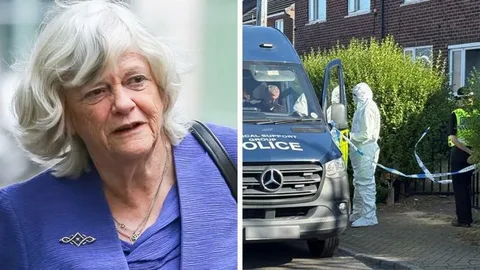
British counterterrorism police have taken charge of the investigation into the murder of Ann Widdecombe, a former Conservative MP and recent Reform UK spokesperson. She was found dead at her Dartmoor home with serious injuries. A 26-year-old man has been arrested, and the case has reopened painful questions about the safety of politicians inside the UK political system.
Background
Ann Widdecombe, 78, spent two decades as a Conservative member of Parliament before stepping away from frontline politics. <cite index=”32-1″>She later became known to the public as a reality television contestant, appearing on Strictly Come Dancing and Celebrity Big Brother.</cite>
In recent years, she re-entered the political arena as justice and immigration spokesperson for Reform UK, the hard-right party led by Nigel Farage. Her journey from the Conservative benches to Reform UK reflects a broader shift happening across the political parties of the United Kingdom, where voter loyalty has become increasingly fluid.
Understanding this case also requires a basic grasp of the UK political system itself. The country operates as a parliamentary democracy, with the House of Commons made up of 650 elected MPs and an unelected House of Lords. Power typically alternates between the Labour Party and the Conservative Party, though Reform UK has surged in recent polling, reshaping the traditional two-party balance that has long defined British politics.
This backdrop matters because Widdecombe was not a private citizen. She was a public figure operating inside a political system already under strain, and her death has forced many to reconsider how well that system protects the people who serve in it.
Details
Widdecombe was found dead at her home near Haytor, on the edge of Dartmoor National Park in southwest England, on Thursday, July 9. Police described her injuries as serious, and Devon and Cornwall Police opened a murder inquiry soon after.
<cite index=”32-1″>A 26-year-old man was arrested on suspicion of her murder</cite>, with the arrest taking place in Rotherham, northern England, late on Saturday. His identity has not been made public.
By Monday, July 13, the case had escalated. <cite index=”29-1″>Counterterrorism officers formally took over leadership of the investigation</cite>, following new information that emerged over the weekend. Investigators say they are examining several possible lines of inquiry to determine a motive.
Concern was first raised days earlier when Widdecombe failed to appear for a scheduled remote television interview. A Channel 5 presenter later said she had stopped responding to messages before the show, prompting her agent and eventually the police to be alerted.
Quotes
Home Secretary Shabana Mahmood confirmed the shift to a terrorism-focused inquiry, saying investigators were <cite index=”29-1″>”pursuing multiple lines of inquiry to establish the motivation.”</cite>
Devon and Cornwall Police’s Assistant Chief Constable, Matt Longman, said the murder enquiry was <cite index=”31-1″>”in its early stages but moving at a significant pace.”</cite>
Reactions came quickly from across the political spectrum. Outgoing Prime Minister Keir Starmer called it shocking news, while Conservative leader Kemi Badenoch said she was left struggling to find words. Reform UK leader Nigel Farage warned that public life in Britain has become increasingly dangerous for anyone in politics.
Brendan Cox, whose wife, Labour MP Jo Cox, was murdered in 2016, wrote that the news brought back painful memories, while stressing that nothing could justify such an attack.
Impact
Widdecombe’s death has reignited a difficult conversation about violence against elected officials in the UK political system. She becomes the third British parliamentarian in a decade to be killed, following Jo Cox in 2016 and David Amess in 2021.
For Reform UK, a party that has been gaining ground in national polling, the loss of a prominent spokesperson adds an emotional and political weight to an already turbulent period in British politics. Farage’s comments suggest the party views this as part of a wider pattern of risk facing public figures.
More broadly, the case is likely to renew scrutiny of security arrangements for MPs, former MPs and party spokespeople, many of whom maintain a visible public profile with limited personal protection. Analysts expect calls in Parliament for a review of protective measures once the investigation progresses.
Conclusion
With counterterrorism police now leading the case, further updates are expected as investigators work to establish a motive and build a fuller picture of what happened at Widdecombe’s Dartmoor home. Parliament is set to receive updates directly from the Home Secretary as the inquiry continues.
For now, the case stands as one of the most serious incidents involving a British political figure in years, and one that is likely to influence debate around political safety within the UK political system for some time to come.
FAQs
What is politics like in the UK?
UK politics operates through a parliamentary democracy where voters elect Members of Parliament to represent local constituencies in the House of Commons. Power has traditionally shifted between the Conservative and Labour parties, though smaller parties such as Reform UK, the Liberal Democrats, the Greens and various nationalist parties in Scotland and Wales also play significant roles. In recent years, British politics has become notably more volatile, with rapid shifts in public opinion, frequent leadership changes and rising support for parties outside the traditional two-party system.
What is the political system of the UK?
The United Kingdom is a constitutional monarchy combined with a parliamentary democracy. The monarch serves as head of state in a largely ceremonial capacity, while the Prime Minister, who is typically the leader of the party with the most seats in the House of Commons, holds executive power. Parliament is made up of two chambers, the elected House of Commons and the unelected House of Lords, and together they debate and pass legislation that governs the country.
Why did the UK prime minister resign?
Keir Starmer announced his resignation as Labour leader and Prime Minister after months of mounting pressure from within his own party. The pressure followed heavy losses for Labour in the May 2026 local elections, a string of high-profile ministerial resignations, and declining public approval ratings. Starmer agreed to remain in a caretaker capacity until his party completes its leadership contest and a successor is formally chosen.