
China and North Korea have reaffirmed their decades-old military alliance as the two nations marked the 65th anniversary of their friendship treaty this week. Chinese President Xi Jinping and North Korean leader Kim Jong Un exchanged messages pledging closer strategic cooperation. The renewed alignment comes amid rising global tensions involving the United States, Russia, and Iran.
The China North Korea relationship remains one of the most closely watched alliances in modern geopolitics. It is rooted in a formal defense pact, a shared communist history, and mutual suspicion of Washington. Analysts say the bond is entering a new phase as regional rivalries intensify.
Background
The China North Korea alliance traces back to the Korean War, when Chinese troops crossed into the peninsula in October 1950 to support North Korean forces against South Korea and United Nations troops. That intervention cemented a bond that has lasted more than seven decades.
The two countries formalized their partnership on July 11, 1961, when they signed the Treaty of Friendship, Cooperation, and Mutual Assistance, which remains Beijing’s only formal defense pact with any nation. The agreement was renewed multiple times over the decades, most recently extending its relevance into the present era.diate military and other assistance if either country came under armed attack, while also pledging not to join any alliance directed against the other. This clause is central to why China vs North Korea war scenarios are rarely discussed as realistic; the two are legally bound partners, not rivals.
Understanding why China supported North Korea in the Korean War helps explain the alliance today. Beijing viewed a hostile, US-aligned government on its border as an unacceptable security risk. That strategic logic continues to shape China’s calculations regarding the Korean Peninsula.
Details
This year marks the 65th anniversary of the treaty, and North Korean Premier Pak Thae-song traveled to Beijing for a three-day visit to commemorate the occasion, arriving just weeks after Chinese President Xi Jinping’s own visit to Pyongyang. The exchange of high-level visits signals a deliberate effort by both governments to project unity.
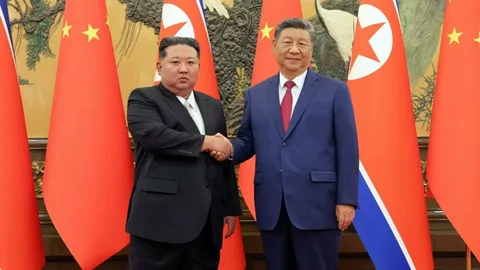
In messages marking the anniversary, Kim Jong-un and Xi Jinping reiterated their shared commitment to strengthening strategic cooperation as regional rivalries intensify, according to North Korean state media. The timing reflects growing unease in Beijing and Pyongyang over shifting alliances across Asia.
Xi’s trip to Pyongyang in June 2026 was his first in nearly seven years, and it came shortly after his own summit with US President Trump in Beijing. Notably, Xi avoided public discussion of North Korea’s nuclear weapons program during the visit, even though Washington claimed both countries had agreed on denuclearization as a shared goal.
This silence on the nuclear issue is significant for anyone asking does China support North Korea unconditionally. Beijing appears reluctant to publicly pressure Pyongyang on weapons development, even as it avoids openly endorsing an expanding nuclear arsenal.
China and North Korea share a 1,416-kilometer border that runs almost entirely along the Yalu and Tumen rivers, a geographic reality that keeps the two nations deeply intertwined. While China remains North Korea’s principal trading partner, Russia’s growing assistance has somewhat reduced Pyongyang’s dependence on Beijing.
That shift toward Moscow raises fresh questions about China North Korea vs South Korea dynamics and whether Beijing risks losing influence. Analysts note the trip was widely seen as China’s effort to regain influence after North Korea grew closer to Russia by supplying troops and weapons for the war in Ukraine in exchange for economic and military support.
Quotes
Chinese foreign ministry spokeswoman Mao Ning described the countries as “traditional friendly neighbouring countries,” stating that developing bilateral ties “has always been a steadfast strategic policy of the Communist Party and government.” This framing highlights how central the alliance remains to China’s foreign policy identity.
In his anniversary message, Xi Jinping said he was ready to pursue closer strategic communication with Kim to navigate a rapidly changing world, adding that China would continue attaching great importance to the relationship regardless of shifting international circumstances. He also referenced the treaty as a legal basis for ties often described as “sealed in blood.”
Kim Jong-un, in turn, expressed his desire to elevate the relationship into a model of the most powerful and strategic partnership between socialist states, describing bilateral cooperation as central to protecting sovereignty and regional stability. Analysts describe the relationship using the Chinese proverb about lips and teeth, meaning that if one side falls, the other becomes vulnerable.
Tong Zhao, a senior fellow at the Carnegie Endowment for International Peace, has suggested China’s current approach reflects a broader shift in its regional priorities. Meanwhile, Seong-hyon Lee of Harvard University’s Asia Center has argued that the wider bloc involving China, Russia, Iran, and North Korea functions more on transactional cooperation than formal institutional structure.
Impact
The renewed alliance carries implications well beyond the Korean Peninsula. As tensions grow between Washington and both Beijing and Moscow, the China North Korea partnership is increasingly viewed as part of a wider strategic bloc. This has fueled speculation over whether China and North Korea will support Iran amid ongoing Middle East tensions.
Some observers argue there is a strong strategic imperative for close cooperation among Russia, North Korea, and China to counterbalance what they view as a US-centric world order. Whether this translates into direct military coordination beyond Korea remains uncertain, but the rhetoric suggests deepening alignment.
South Korea and the United States are separately discussing what they call “alliance modernization,” under which Seoul’s military would take a greater lead in deterring the North while American forces increasingly focus on countering China. This restructuring reflects how the China North Korea relationship is reshaping broader regional security planning.
For countries watching Asia-Pacific stability, the central concern is less about a direct China vs North Korea who would win scenario, since the two remain allies, and more about how a unified China-North Korea-Russia posture might respond to crises involving Taiwan, the Korean Peninsula, or global flashpoints like Iran.
Conclusion
The China North Korea alliance, formalized 65 years ago, shows no sign of weakening despite shifting global alliances. Recent high-level visits, anniversary messages, and diplomatic exchanges all point toward a relationship both governments are actively working to reinforce.
Going forward, observers will be watching whether Beijing addresses Pyongyang’s expanding nuclear program more directly, and how the broader China-Russia-North Korea dynamic evolves alongside tensions with Washington. Future summits and treaty commemorations are likely to offer further signals about where this long-standing alliance is headed next.
FAQs
Who are North Korea’s biggest allies?
North Korea’s most significant allies are China and Russia, both of which maintain formal cooperation agreements with Pyongyang. China remains North Korea’s largest trading partner and its only formal treaty ally, while Russia has deepened military and economic ties in recent years, particularly through cooperation linked to the war in Ukraine. Together, these relationships form the backbone of North Korea’s international support network, especially as Pyongyang faces continued isolation from Western nations and strict international sanctions over its nuclear and missile programs.
Why does China keep supporting North Korea?
China’s continued support for North Korea stems from a mix of historical loyalty, geographic necessity, and strategic calculation. Beijing views a stable, allied North Korea as a buffer against direct US and South Korean military presence along its border. The two nations also share a long history of ideological alignment dating back to the Korean War. Additionally, China is wary of a unified Korean Peninsula that could shift toward Washington’s sphere of influence, which would significantly alter the regional balance of power in Northeast Asia.
What is China’s view on North Korea?
China officially describes North Korea as a close and traditional friendly neighbor, emphasizing cooperation, mutual respect, and shared strategic interests. However, Beijing has generally avoided publicly endorsing Pyongyang’s nuclear weapons expansion, choosing instead to focus statements on diplomatic friendship and economic cooperation. Chinese officials have repeatedly stated that maintaining and developing ties with North Korea remains a steadfast policy priority, even as global dynamics shift and North Korea grows closer to Russia through expanded military and economic cooperation.