
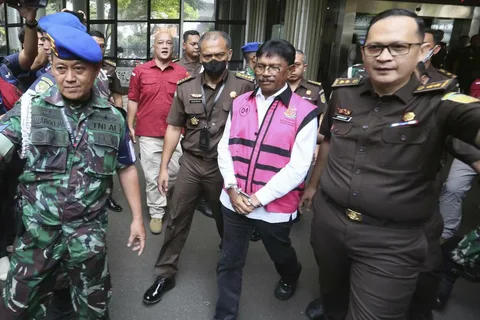
Indonesia’s top anti-corruption prosecutor has resigned after police raided his properties and seized gold bars and millions of dollars in cash. The dramatic fall of a man once celebrated as a graft-buster has put Indonesia back into global headlines about the most corrupt countries 2025 rankings.
The resignation of Febrie Adriansyah, once one of Indonesia’s most trusted anti-corruption prosecutors, has stunned observers. His case shows how deeply corruption can penetrate even the institutions built to fight it.
Background: A Prosecutor Turned Suspect
Febrie Adriansyah served as Indonesia’s Deputy Attorney General for Special Crimes. He built his reputation prosecuting major graft cases involving state miner Timah, energy giant Pertamina, national carrier Garuda Indonesia, and former education minister Nadiem Makarim, according to local coverage that described him as one of Indonesia’s highest-profile corruption prosecutors.
He was also tied to President Prabowo Subianto’s forestry task force and had overseen scrutiny of the president’s flagship free-meal scheme. His portfolio made him a central figure in Indonesia’s anti-corruption apparatus, which is why his sudden fall shocked the public.
Discussions of the most corrupt countries 2025 list often focus on failed states or dictatorships. Indonesia’s case is different — it shows corruption reaching into the very agency meant to stop it.
Details: Raids, Gold Bars, and Millions in Cash
Indonesian police conducted raids on Friday across at least 12 locations, including properties linked to Febrie in and around Jakarta. The searches formed part of a widening investigation into corruption and money laundering.
The biggest haul came from a house in Sentul, Bogor, which Febrie later acknowledged belonged to him, where investigators seized 74 kilograms of gold bars, nearly 4.77 million US dollars, and roughly 14.08 million Singapore dollars in cash.
Police also recovered additional cash from a safe at De’Clan Signature Cafe in South Jakarta, along with billions of rupiah from a money changer. Total estimates of the seized assets range between 476 billion and 540 billion rupiah, depending on the source.
Investigators found a two-meter steel safe concealed behind a display case and embedded inside a wall at the cafe location. The scale and secrecy of the hidden safe raised further suspicion among investigators.
The raids relate to a broader probe into alleged corruption in coal supply that investigators believe contributed to recent widespread power outages across Sumatra, Kalimantan, and Java. Separate investigations are also examining state insurers Asabri and Jiwasraya, and steelmaker Krakatau Steel.
Police estimate the alleged coal procurement scheme may have caused state losses of around 5 trillion rupiah, roughly 278 million US dollars. Investigators believe manipulated documents disguised the true quality and quantity of coal delivered to state power plants.
Quotes: Officials Respond
Attorney General’s Office spokesman Anang Supriatna confirmed the resignation was accepted to protect institutional integrity. “The decision was a form of commitment to maintain the integrity, objectivity, and neutrality of law enforcement,” Anang said.
Febrie himself denied any wrongdoing before stepping down. He confirmed the raided house in Sentul belonged to him but denied it was linked to any corruption cases, insisting the ownership of the cash and other assets could be fully documented.
Jakarta police spokesperson Budi Hermanto confirmed the scale of the investigation. He said detectives interviewed 15 witnesses during the week and seized gold bars along with cash worth more than 20 million US dollars in multiple currencies, including rupiah, US dollars, Singapore dollars, and Saudi riyals.
Charges have not yet been filed against Febrie. Police say suspects in the case will be named soon, though the investigation remains at an early stage.
Impact: Regional and Global Corruption Concerns
Indonesia’s scandal arrives as Transparency International’s 2025 Corruption Perceptions Index shows global corruption remains stubbornly high. The global average CPI score fell to a new low of 42, with more than two-thirds of countries scoring below 50.
For readers researching the most corrupt countries 2025, the index remains the most cited global benchmark. Top scorers in 2025 included Denmark at 89, Finland at 88, and Singapore at 84, representing some of the least corrupt nations on earth.
At the other end of the scale, countries perceived as the most corrupt included South Sudan and Somalia, both scoring 9, along with Venezuela at 10. These nations consistently rank near the bottom due to weak institutions and armed conflict.
Western European nations make up nine of the top ten countries globally on the index, though anti-corruption efforts have stalled in the region even as its average score drops faster than any other. This shows even wealthy democracies are not immune to declining transparency.
The United States has fallen to its lowest-ever ranking, placing 29th out of 182 countries with a score of 64. Analysts point to politicized prosecutions and pressure on independent institutions as contributing factors.
Indonesia’s case fits a broader regional pattern. Analysts note that in the Asia Pacific region, well-connected elites often buy political influence while many anti-corruption laws go unenforced, a dynamic now visible in Jakarta’s unfolding scandal.
The fall of a senior anti-corruption prosecutor also damages public trust. When the very officials tasked with fighting graft become suspects themselves, citizens lose confidence that any institution is free from influence.
Conclusion: What Comes Next
Indonesian police say the investigation is ongoing, with formal suspects expected to be named soon. The case is likely to test President Prabowo Subianto’s broader anti-corruption commitments at a politically sensitive moment.
Analysts expect the scandal to fuel further public debate over transparency in Southeast Asia’s largest economy. As global rankings on the most corrupt countries 2025 continue to shape international perception, Indonesia’s outcome could influence investor confidence and diplomatic standing in the region.
Future developments will depend on whether prosecutors can pursue the case independently, given that it touches the agency’s own leadership. The world will be watching closely to see if Indonesia’s institutions can hold themselves accountable.
Frequently Asked Questions
What is the corruption level in Indonesia?
Indonesia has struggled with persistent corruption across state institutions, including its energy, insurance, and steel sectors. The country ranks below the global CPI average, and recent scandals including the coal procurement probe that led to the resignation of a top prosecutor highlight ongoing weaknesses in oversight and enforcement, despite years of anti-graft reform efforts by government agencies.
Which country has the highest corruption rate?
According to Transparency International’s 2025 Corruption Perceptions Index, South Sudan and Somalia are tied as the most corrupt countries in the world, both scoring just 9 out of 100. Venezuela follows closely with a score of 10. These nations face conflict, weak governance, and institutional collapse, which experts say are major drivers behind their persistently low rankings on the global corruption index.
Why are Indonesians protesting?
Public frustration has grown over corruption scandals affecting state-owned enterprises, including coal procurement for power plants, insurance firms, and steel companies. Recent power outages linked to alleged coal supply manipulation, combined with the resignation of a senior anti-corruption prosecutor under investigation himself, have deepened public anger over accountability and transparency within Indonesia’s government institutions.