

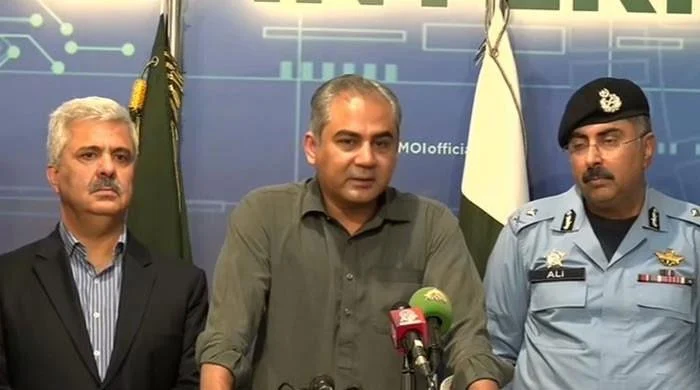

PTI’s call for a nationwide protest on September 27 has pushed the federal government into a visible state of preparation, with Interior Minister Mohsin Naqvi confirming that security agencies across Islamabad have been placed on high alert.
The protest call, aimed at pressing for the release of PTI founder Imran Khan, has set off a fresh round of tension between the party and the federal administration, one that now carries the weight of a recent court ruling on protest conduct.
Background
PTI announced weeks ago that it would organize a long march toward Islamabad on September 27. Party leaders have said convoys would set out from multiple provinces, with a central caravan originating in Khyber Pakhtunkhwa, before converging on the capital.
The timing places the protest shortly after the Islamabad High Court issued a ruling stating that political parties do not have a lawful right to occupy public roads, highways, or buildings while demonstrating. That ruling now sits at the center of how the government is framing its response.
Details
Speaking at the Jinnah Convention Centre in Islamabad, Naqvi said the government had completed coordination with provincial authorities to stop protest convoys from entering the capital. He said law enforcement agencies had reviewed contingency plans covering everything from traffic diversions to possible Section 144 enforcement, depending on how PTI proceeds.
Naqvi said the state holds the primary responsibility of protecting citizens’ lives and property, and that this responsibility shapes how the government intends to respond if the march goes ahead. He added that authorities are prepared to seal off Islamabad entirely if organizers attempt to push through the restrictions.
He also addressed the Khyber Pakhtunkhwa provincial leadership directly, urging the chief minister to focus on the province’s own security challenges rather than organizing a march toward the capital.
Quotes
Naqvi said organizers of the march would bear full legal and moral responsibility for any loss of life connected to the protest. He said political parties remain free to hold demonstrations within their own cities and provinces, but stressed that no city would be allowed to shut down and no province would be allowed to send crowds to attack another.
He further warned that violating the Islamabad High Court’s ruling could expose organizers to contempt proceedings, adding that provincial governments have already been instructed to prevent protesters from reaching the capital.
Impact
The standoff carries real consequences for both sides. For the government, enforcing the court ruling at scale means committing significant security resources to the capital, alongside possible disruptions to daily life, commerce, and diplomatic movement in Islamabad’s high-security zones.
For PTI, the government’s posture raises the practical cost of proceeding with the march as planned. Contempt proceedings, arrests, and forceful containment are now openly on the table, which could affect how many of the party’s supporters choose to join the convoys on the day.
Conclusion
As September 27 approaches, the gap between PTI’s stated plans and the government’s security posture shows no sign of narrowing. How the coming days play out, whether through negotiation, a scaled-back protest, or direct confrontation, will likely depend on decisions made by both sides in the final stretch before the march.
Frequently Asked Questions
Who is Mohsin Naqvi?
Mohsin Naqvi is a Pakistani politician who previously held the role of caretaker Chief Minister of Punjab before his appointment as federal Interior Minister. In his current role, he has taken charge of the government’s response to PTI’s planned demonstrations, including recent warnings issued from Islamabad.
What is Section 144 and why is it relevant to the PTI protest?
Section 144 refers to a legal provision that allows authorities to restrict public gatherings, movement, or assembly in a given area to maintain order. Reports indicate the government may apply it in parts of Islamabad depending on how PTI’s September 27 march develops.
What happens if PTI proceeds with the march despite the warnings?
Based on statements from Interior Minister Naqvi, organizers who proceed despite the Islamabad High Court’s ruling could face contempt proceedings, along with active efforts by law enforcement to prevent protest convoys from entering the capital.