
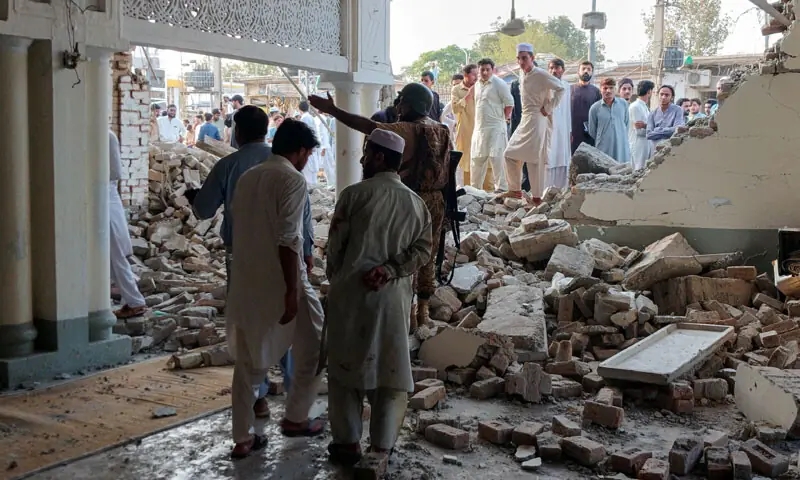

A Quick Summary of the Terrorist Attack in Kohat
A suicide bombing followed by an armed assault struck the Old Police Lines complex in Kohat on September 18, killing dozens of worshippers and police officers. Days later, the UN Security Council issued a formal statement condemning the violence and demanding that the people responsible be held accountable.
This explainer breaks down what happened, why the UN Security Council chose to respond so firmly, and what the statement could mean for counter-terrorism cooperation involving Pakistan going forward.
How the Kohat Terror Attack Unfolded
The complex targeted in Kohat was not an ordinary neighborhood mosque. It sat inside the Old Police Lines, a facility that also housed the Counter Terrorism Department and Special Branch offices long involved in operations against militant groups active in Khyber Pakhtunkhwa.
A bomber rammed a vehicle packed with explosives through the compound gate at around 1:15 pm, just as Friday prayers were underway. The blast tore through the mosque entrance, and armed attackers pushed further into the complex afterward, triggering an exchange of fire with police stationed there.
Casualties and the Security Response
Official figures released through UN channels put the death toll at a minimum of 24, including seven civilians and seventeen law enforcement personnel, with at least 88 people wounded. Several of the critically injured were shifted to Peshawar for advanced treatment, and hospital officials said the toll could shift as recovery efforts continued.
Elite Force commandos and Counter Terrorism Department teams moved in quickly, and police confirmed eight attackers were killed during the operation. By the following weekend, Khyber Pakhtunkhwa police announced that the clearance operation had concluded and the compound was fully secured.
Why the UNSC Statement Carries Weight
Security Council press statements are typically negotiated and agreed to by all fifteen member states, which gives them a degree of diplomatic weight even though they are not legally binding resolutions. Council President Jérôme Bonnafont read out language describing the bombing as heinous and cowardly, language the Council has used sparingly for attacks it considers especially severe.
More significantly, the statement went beyond condemnation. It specifically called on member states to cooperate with Pakistan’s government in identifying and prosecuting the perpetrators, organizers, financiers, and sponsors of the attack, a phrase that signals interest in the broader financial and logistical network behind the plot rather than just the attackers on the ground.
International Reaction Beyond the Security Council
The UN Secretary-General, the UN Alliance of Civilizations, and several governments including Qatar and Iran issued their own statements condemning the bombing. Officials repeatedly stressed that places of worship must remain protected spaces, a point that has become a recurring theme in Council statements following attacks on mosques, churches, and other religious sites worldwide.
A group linked to the Tehrik-e-Taliban Pakistan claimed responsibility for the bombing, consistent with a pattern of attacks the group and its affiliates have carried out against Pakistani security installations in recent months.
What This Means Going Forward
For Pakistan, the UNSC statement adds diplomatic backing to its ongoing counter-terrorism efforts and may encourage greater international information-sharing on the networks financing such attacks. For the Council, it continues a pattern of rapid, unified condemnation whenever mosques or other religious sites are targeted.
The real test, analysts note, will be whether the call for accountability for perpetrators and sponsors translates into concrete cross-border action, rather than remaining a diplomatic gesture.
Conclusion
The Kohat terrorist attack has already prompted a strong, unified response from the UN Security Council, but the harder work of tracing and prosecuting the people who planned and funded it is only beginning. Pakistani authorities say the investigation remains active, and further security reviews are expected at facilities that combine police and religious functions.
FAQs
What happened in the Kohat terrorist attack?
A suicide bomber detonated an explosives-laden vehicle at the gate of the Old Police Lines complex in Kohat on September 18, striking the mosque there during Friday prayers. Armed attackers then engaged security forces inside parts of the compound before police and Counter Terrorism Department teams brought the situation under control, killing eight attackers in the process. The complex also housed offices linked to past counter-militancy operations, which investigators believe made it a deliberate target rather than a random attack.
Why did the UNSC condemn the Kohat terrorist attack?
The Security Council condemned the attack because it targeted a mosque full of worshippers alongside police officers on duty, an act the Council described as heinous and cowardly. Council members reaffirmed that terrorism in any form threatens international peace and security and stressed that such violence is criminal and unjustifiable no matter the motivation behind it. The statement reflects a broader pattern of the Council responding firmly whenever religious sites are attacked.
Who will be held accountable for the Kohat terrorist attack?
The Council’s statement specifically named perpetrators, organizers, financiers, and sponsors as the parties that should face accountability, not only the individuals who carried out the bombing. It called on all UN member states to cooperate with Pakistan under international law to trace and prosecute this wider network. A group linked to the Tehrik-e-Taliban Pakistan has already claimed responsibility, giving investigators a starting point as they work to identify who financed and directed the plot.