
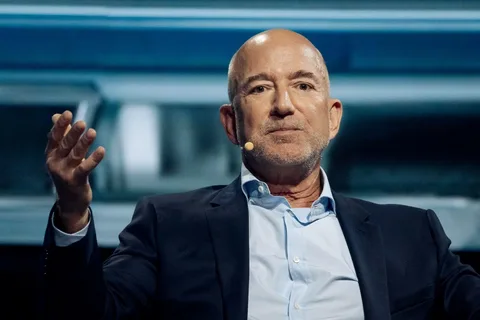

WEB DESK: Jeff Bezos’ vision for the average American worker involves a lot less work, and netizens aren’t buying it. The Amazon founder recently claimed that artificial intelligence (AI) could generate enough productivity gains to allow people to support a family on a three-day workweek, or let a household live comfortably on a single income. He made the remarks in an interview with Fox News on Wednesday. The comments have since drawn sharp reactions online, with many users questioning how realistic the idea is.
Background: Bezos’ Long Argument That AI Will Not Cause Mass Job Loss
This is not the first time Bezos has spoken on the subject. In May, he told CNBC’s “Squawk Box” that AI should be seen as a tool and not as a threat. He compared it to digging a basement with a shovel and then being handed a bulldozer, and said people “should be so happy.”
In June, he went further in another CNBC interview, saying that many smart people who fear mass unemployment are missing the bigger picture. Bezos is now co-CEO of an AI start-up called Prometheus, which he runs with Vik Bajaj, and he has described the company as building an “artificial general engineer,” a design tool for physical objects such as jet engines and medicines. His argument has remained consistent: as productivity rises, goods become cheaper, and people need less income to live well.
Details: What He Said This Week
Speaking at Blue Origin’s facility in Cape Canaveral, Florida, Bezos told Fox News that rapid advances in AI could raise productivity so much that some people might not need to work full-time. He said that some families may decide to live on one income, while others could choose to work just three days a week.
He also suggested that this could create a different problem for employers. According to Bezos, it may become hard to hire people because they will not need to take a second job or work overtime to make ends meet. In his view, this means AI will lead to a labour shortage and not to widespread unemployment.
The remarks came at a time of strong public anxiety about AI. Many workers fear that automation could replace their jobs, and companies, including Amazon, have also cut staff while investing heavily in AI. This is the context in which the new comments were received.
Quotes: What Bezos and His Critics Said
Bezos has repeated the same message in several interviews. “AI is going to create a labor shortage,” he said at an event in conversation with Blue Origin CEO David Limp. In his May CNBC interview, he said that if you have been digging with a shovel, “somebody is about to hand you a bulldozer.”
Online, the response has been less friendly. Social media users argued that people who struggle with rent and bills will not benefit from an AI-driven shorter week, and others noted that Amazon’s own warehouse and delivery staff have long fought for fair wages and humane conditions. Writers at Gizmodo also argued that the optimism comes from someone who is raising money for his own AI business while his former company cuts jobs.
Note for the writer: if you can find a verified response from an economist or a labour group, add it here. Do not publish invented quotes.
Impact: Work, Wages and the AI Debate
The debate touches on a basic question about who gets the gains from AI. Supporters say that productivity growth has historically raised living standards and created new kinds of work. Critics respond that the benefits often go to company owners first, while workers face lower bargaining power or job losses, and they say that a shorter week is meaningful only if wages and prices allow it.
For many readers, the practical issue is simple. Most households cannot choose to work less unless their income and costs stay stable. Whether AI will make goods cheap enough, and whether employers will share the gains, is still uncertain, and economists are divided on the answer.
The story also shows how closely the public watches billionaire tech leaders. Searches about Jeff Bezos’ CNBC full interview, his net worth, his wife and his age show strong interest in him as a person as well as in his views. That interest often makes his AI comments travel faster and be judged more harshly.
Conclusion: What to Watch Next
Bezos is likely to keep promoting his view as Prometheus grows and as AI tools spread through workplaces. Policymakers and economists will also be watching job data, wages and company hiring for evidence of whether AI creates shortages or layoffs.
For workers, the debate is far from settled. Further updates will follow as more data and reactions come in.
Frequently Asked Questions (FAQs)
What is the IQ level of Jeff Bezos?
Jeff Bezos has never publicly released an IQ score, and any number that appears online is an unverified claim or a guess, so it should not be treated as fact. What can be said is that he was a very strong student, as he graduated from Princeton University in 1986 with a degree in electrical engineering and computer science. He then worked on Wall Street before founding Amazon in 1994, and the company grew into one of the world’s largest. IQ is also only one measure and does not explain business success on its own. Readers who see claims of a specific IQ for Bezos or other celebrities should look for a primary source such as a published test result.
What AI company did Jeff Bezos invest in?
The AI company most clearly linked to Bezos in recent reports is Prometheus, an AI start-up where he is co-founder and co-CEO together with Vik Bajaj. Prometheus is described as building an “artificial general engineer,” a tool that can model and predict how physical objects such as jet engines and pharmaceuticals are designed. Bezos has also been reported to back other AI and robotics start-ups through his personal investment firm, Bezos Expeditions, and Amazon, which he founded, makes its own AI investments, but these details change often. For a verified and current list, readers should check company filings, funding announcements and reports from trusted business news outlets.
What is Jeff Bezos’ 70% rule?
The “70% rule” is a decision-making principle that Bezos explained in a letter to Amazon shareholders in 2016. It says that most decisions should be made with around 70% of the information that you wish you had. If you wait for 90%, he argued, you are probably moving too slowly, and speed is important in business. He added that leaders should be good at spotting and fixing wrong decisions quickly, since the cost of being slow is often higher than the cost of being wrong. He also described choices as “one-way doors” and “two-way doors,” meaning that some decisions are hard to reverse and need more care, while others can be changed easily and should be made quickly.