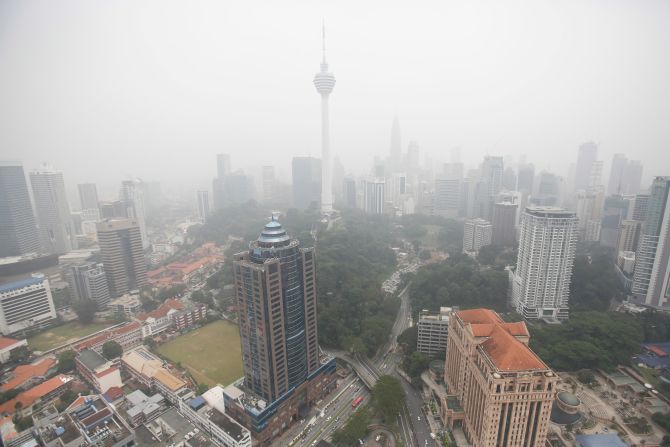

KUALA LUMPUR: Malaysia closed schools in Kuala Lumpur and other parts of the country on Friday, as haze from fires in neighbouring Indonesia again plunged local air quality to among the world’s worst. Toxic smoke from peatland and forest fires has covered towns and cities in the region for more than a month, sending respiratory complaints sharply higher. The school closures came as Prime Minister Anwar Ibrahim discussed the smoke with Indonesian President Prabowo Subianto and called for an urgent regional meeting. Kuala Lumpur’s Air Pollutant Index (API) stood at around 170 on Friday, which is classed as unhealthy.
Background: A Haze Problem That Keeps Returning
The haze in Southeast Asia is a seasonal problem that often returns in the dry months, when fires on peatland and forests burn out of control in Indonesia’s Sumatra and Kalimantan regions. The smoke is then carried by the wind across borders to Malaysia and Singapore. Reuters has described this year’s fires as Indonesia’s most intense in more than a decade.
The region has seen similar crises before. In 2019, nearly 2,500 schools were closed in Malaysia in a single day, and earlier crises in 2005 and 1997-98 also covered large parts of Malaysia and Singapore in smoke. This year, Singapore has also had very poor air, and organisers of the Singapore Grand Prix said earlier this week that the haze was not a threat to the race.
Details: Which Schools Closed and How Bad the Air Is
Education Minister Fadhlina Sidek said the closures covered Johor, Malacca, Negeri Sembilan and Selangor on the peninsula, as well as Kuala Lumpur and Putrajaya, and a partial closure in the Rompin district of Pahang state. Schools in three districts of Perak state were also closed, according to AFP. Reports differ slightly on the exact number of affected states, so parents should follow the ministry’s official notices.
On Thursday, Malaysian King Sultan Ibrahim said that schools should be closed when readings reach 150 or higher on the API. Government data showed that 37 areas recorded unhealthy levels on Friday morning. Malaysia’s API classes 101 to 200 as unhealthy, 201 to 300 as very unhealthy and anything above 300 as hazardous.
On the IQAir monitor, Kuala Lumpur’s reading rose to about 224 on Friday and put the capital past Singapore as the most polluted major city in the world at that time. Singapore’s air quality was at 205, which is classed as very unhealthy. Different monitors use different scales, so the numbers are not directly comparable.
Quotes: What Leaders Said
Anwar said on Thursday that he had discussed the fires with Prabowo, and that “the haze issue is indeed at a worrying level.” He said Malaysia was stepping up cloud seeding to trigger rain and called for an urgent regional meeting. Indonesia’s government replied that regular dialogue between the two leaders is a natural part of the close relations between the countries.
Fadhlina said she understood that closing schools affects parents’ daily affairs, and promised that in future, any decision to close schools will be announced in advance so that families have enough time to prepare.
Note for the writer: if you can find a verified statement from Indonesia’s environment ministry or a health expert, add it here. Do not publish invented quotes.
Impact: Health, Schools and Regional Relations
The most immediate effect is on health. The tiny particles in smoke can enter the lungs and bloodstream, and they can cause coughing, eye irritation and breathing problems. Children, older adults and people with asthma or heart disease are at the highest risk. Health authorities usually advise people to stay indoors on bad days, to wear well-fitting masks outside, and to seek medical help if symptoms get worse.
The disruption also affects families and business. Parents have to rearrange work when schools close at short notice, and outdoor events, tourism and flights can be affected when visibility drops. Many people search for a haze map, satellite images or the Kalimantan haze index to see where the fires are, and such tools usually show fire hotspots and smoke plumes, but readers should rely on official sources for local air quality readings.
Politically, the haze is a test for regional cooperation. Malaysia and Singapore have repeatedly asked Indonesia to do more to stop the fires, while Indonesia points to the difficulty of controlling fires on peatland and to the role of weather. A regional meeting, as proposed by Anwar, could revive talks about joint firefighting and stricter enforcement against illegal burning.
Conclusion: What to Expect Next
Air quality will depend on the wind, rainfall and the success of firefighting and cloud seeding. If readings stay at 150 or above, more school closures are possible, and the ministry has promised earlier notice.
All eyes will also be on whether leaders hold the urgent meeting that Anwar has called for. Further updates will follow as the situation changes.
Frequently Asked Questions (FAQs)
Why is there haze in Malaysia today?
The haze in Malaysia today is caused mainly by smoke from peatland and forest fires in neighbouring Indonesia, especially on the islands of Sumatra and Borneo. When the weather is dry, fires that are started to clear land can spread out of control, and peat fires can burn underground for a long time. The wind then carries the smoke across the sea to Malaysia and Singapore. Officials say this has been going on for more than a month, and it has pushed air quality in Kuala Lumpur into the unhealthy range. Local pollution from traffic and industry can add to the problem, but the main cause is regional smoke. Rain and cloud seeding may help, but only if conditions allow.
What is haze in Malaysia?
Haze is a thick, dry layer of tiny particles in the air that reduces visibility and makes the sky look grey or milky. In Malaysia, it usually means smoke from fires, mixed with dust and other pollution. The most dangerous part is made up of very small particles, known as PM2.5, which can go deep into the lungs and enter the blood. Malaysia measures the severity with the Air Pollutant Index. A reading of 0 to 100 is good or moderate, 101 to 200 is unhealthy, 201 to 300 is very unhealthy and over 300 is hazardous. Haze is more serious than ordinary mist or fog, since it carries pollutants that can affect health. Long exposure can worsen asthma, heart problems and other conditions.
Is Kuala Lumpur currently experiencing haze?
Yes. On Friday, October 9, Kuala Lumpur had an API reading of around 170, which is in the unhealthy range, and it has remained at unhealthy levels throughout the week. The IQAir monitor, which uses a different scale, gave the city a higher reading of about 224 and ranked it as the most polluted major city in the world at one point on Friday. Schools in Kuala Lumpur and several other areas were closed. Air quality can change within hours depending on the wind and rain, so residents should check the official Malaysian air quality website or app and the Department of Environment’s latest API readings before going outside, especially children and people with breathing conditions.