Trump’s Attacks on Muslim Senate Candidate Abdul El-Sayed Ignite Religious Freedom Debate Ahead of U.S. Midterm Elections
Michigan’s high-stakes Senate race between Democrat Abdul El-Sayed and Republican Mike Rogers draws national attention as religious identity, constitutional protections, immigration, national security, and control of Congress dominate the final days of the 2026 election campaign.
By Fazal Khaliq | Washington, D.C.
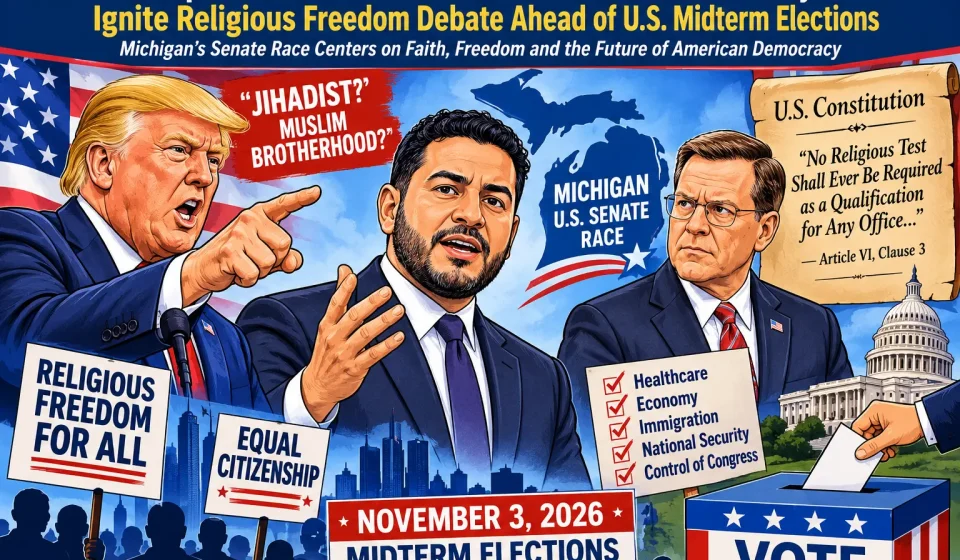
WASHINGTON, D.C. — With the United States approaching its November 3, 2026, midterm elections, an increasingly contentious political confrontation in Michigan has brought religious freedom, national identity, and constitutional equality into sharp focus. President Donald Trump’s criticism of Democratic Senate candidate Abdul El-Sayed, a Muslim American politician seeking a historic victory, has intensified debate over the role of religion in American electoral politics.
The controversy has transformed Michigan’s closely watched Senate contest into a broader national discussion about political tolerance, national security, religious discrimination, and the constitutional principles underpinning American democracy.
El-Sayed, who is challenging Republican candidate Mike Rogers for the Senate seat being vacated by Democratic Senator Gary Peters, could become the first Muslim elected to the United States Senate if victorious.
His candidacy carries significance beyond the boundaries of Michigan. The outcome could influence the balance of power in Washington, where both major political parties are competing for control of Congress during the remaining two years of President Trump’s second term.
Trump’s Campaign Rhetoric Fuels National Controversy
The political dispute intensified following President Trump’s October 25 campaign appearance in Port Huron, Michigan, where he directed a series of accusations against El-Sayed.
Trump described the Democratic candidate as a jihadist and alleged connections to the Muslim Brotherhood, without publicly presenting substantiated evidence establishing such an affiliation.
The president also suggested that El-Sayed would require additional security screening before entering the United States Senate if elected, invoking concerns associated with terrorism and national security.
The remarks generated criticism from religious freedom advocates and political figures who argued that associating a candidate’s Muslim identity with extremism risks reinforcing religious stereotypes.
Independent fact-checking assessments subsequently challenged the allegations, finding no credible evidence that El-Sayed belonged to the Muslim Brotherhood or supported religiously motivated violence.
Republican candidate Mike Rogers has also questioned El-Sayed’s political associations and positions on national security, arguing that voters are entitled to scrutinize the foreign policy views and political relationships of individuals seeking federal office.
El-Sayed and his supporters, however, have maintained that legitimate political scrutiny should not be confused with attempts to portray religious identity as evidence of disloyalty.
The confrontation raises a fundamental question for American democracy: should candidates be judged primarily on their policies, qualifications, and public records, or can religious affiliation become a defining issue in determining political legitimacy?
Abdul El-Sayed Responds to Allegations
El-Sayed has rejected the allegations against him, describing them as politically motivated attacks designed to divert public attention from the economic and social challenges confronting American families.
Speaking to journalists in Detroit on October 26, the Democratic candidate disputed Trump’s assertions and emphasized that the election should focus on healthcare affordability, housing costs, inflation, economic opportunity, and the everyday concerns of Michigan residents.
His response reflected a broader Democratic campaign argument that economic security and access to essential services should remain central to the midterm elections.
The controversy has also drawn attention to Michigan’s substantial Arab American and Muslim communities, particularly in Detroit and its surrounding metropolitan areas.
These communities have played an increasingly visible role in American political debates involving immigration, civil liberties, Middle East policy, Palestinian rights, and religious inclusion.
The president’s remarks also prompted criticism from some Arab American figures who had previously supported him, illustrating disagreements within political constituencies that cannot be reduced to a single party affiliation.
For Michigan voters, the dispute has added another dimension to an already competitive Senate election, connecting local political concerns with wider questions about belonging, representation, and citizenship.
Republican Senator Bernie Moreno’s Remarks Deepen Religious Freedom Debate
The controversy expanded beyond Michigan when Republican Senator Bernie Moreno of Ohio criticized El-Sayed’s religious beliefs during an October 28 political gathering in Chillicothe.
Moreno invoked Christian beliefs concerning Jesus Christ and questioned whether El-Sayed should serve in Washington.
His remarks intensified the debate over whether religious convictions should play any role in assessing an American citizen’s eligibility for public office.
Religious freedom advocates have emphasized that the United States Constitution expressly prohibits religious tests for federal office.
Article VI, Clause 3 of the Constitution establishes that no religious test may be required as a qualification for holding public office under the United States.
The provision reflects a foundational constitutional principle: Americans are entitled to seek federal office regardless of their religious beliefs.
Consequently, a qualified American citizen who identifies as Muslim, Christian, Jewish, Hindu, or adheres to another faith cannot be constitutionally excluded from federal office because of religious affiliation.
Nevertheless, the distinction between constitutional eligibility and campaign rhetoric remains important. Political candidates enjoy substantial freedom of expression, even when their statements provoke public criticism or allegations of prejudice.
The controversy therefore raises broader questions about the relationship between political speech, religious liberty, and the standards of public debate in a pluralistic democracy.
November 3 Midterm Elections: Control of Congress at Stake
The November 3 elections represent a major political test for President Trump’s second administration.
All 435 voting seats in the House of Representatives will be contested, alongside 35 Senate elections, including two special elections.
Republicans currently control the Senate with 53 seats, compared with 45 Democratic senators and two independents who caucus with the Democrats.
For Democrats, securing a Senate majority would require a net gain of four seats, assuming the existing party alignments remain unchanged.
The outcome of the elections could reshape Washington’s legislative agenda, including immigration enforcement, federal spending, healthcare, taxation, national security, and congressional oversight of the executive branch.
Michigan is particularly important because Democratic Senator Gary Peters is retiring, leaving an open seat contested by El-Sayed and Rogers.
The race has attracted national attention and substantial political investment from both parties.
Republicans have emphasized border security, immigration restrictions, public safety, economic policy, and national security.
Democrats have concentrated on healthcare affordability, rising living costs, housing, social protections, and concerns about the administration’s domestic policies.
The religious controversy surrounding El-Sayed has added another dimension to these competing political agendas.
Latest Michigan Polls Reveal a Competitive Senate Contest
Recent polling illustrates the intensity of the Michigan Senate race, although surveys differ in their estimates of voter support.
A Mitchell Research & Communications survey conducted October 26–27 among 636 likely voters found El-Sayed receiving 51 percent support, compared with 44 percent for Rogers.
The poll, reported by CBS Detroit on October 28, had a margin of error of approximately 3.9 percentage points. 
An earlier Marist survey, conducted October 15–18, recorded 50 percent support for El-Sayed and 48 percent for Rogers among likely voters, with a margin of error of 4.3 percentage points. 
Michigan State University’s October 26 survey release also described a competitive race, reporting 48 percent support for El-Sayed and 45.5 percent for Rogers. 
These surveys represent snapshots of voter sentiment rather than final election results. Differences in sampling, methodology, undecided voters, and turnout assumptions can produce varying estimates.
The final outcome will depend on ballots cast and counted in the November 3 election.
Barack Obama Enters the Campaign as National Leaders Focus on Michigan
The national importance of Michigan’s Senate contest was underscored when former President Barack Obama participated in Democratic campaign activities in Detroit on October 24.
Obama criticized attempts to question El-Sayed’s American identity because of his Muslim faith, emphasizing the broader principles of citizenship and political inclusion.
President Trump appeared in Port Huron the following day to campaign for Republican candidates, highlighting the importance both parties attach to Michigan’s electoral contests. 
The state has a history of closely contested elections.
In the 2024 presidential election, Trump carried Michigan by approximately 1.4 percentage points, demonstrating the narrow margins that can characterize statewide competition.
Michigan’s political landscape includes major urban centers, industrial communities, suburban districts, rural counties, and substantial immigrant populations.
These demographic and economic differences contribute to a complex electoral environment in which healthcare, manufacturing employment, trade, immigration, and international affairs can influence political discussion.
The participation of nationally prominent figures reflects the broader significance of Michigan’s election for both parties.
Religious Identity, National Security and the Limits of Political Rhetoric
The El-Sayed controversy illustrates a recurring challenge in democratic politics: distinguishing legitimate scrutiny of a candidate’s political positions from allegations that rely primarily on religious identity.
Republicans defending their campaign approach argue that candidates seeking federal office should face rigorous examination of their foreign policy positions, public statements, political relationships, and national security judgments.
Critics of the attacks contend that questioning a Muslim candidate’s loyalty without credible supporting evidence risks conflating religious affiliation with extremism.
Both questions require careful separation.
Candidates’ political records, policy proposals, public associations, and statements are legitimate subjects of democratic scrutiny. Allegations of involvement with terrorist organizations, however, require credible evidence and should not be presented as established facts without substantiation.
The Associated Press reported that El-Sayed also faced criticism over previous remarks concerning an attack on a Detroit-area synagogue, for which he later apologized. This aspect of the campaign demonstrates that controversies over a candidate’s statements can be examined independently of religious affiliation. 
The broader debate concerns whether political campaigns can maintain a distinction between legitimate accountability and identity-based accusations.
For American Muslim communities, the dispute also raises questions about political representation and whether candidates from religious minority backgrounds face additional barriers in seeking national office.
A Historic Possibility for Muslim Representation in the U.S. Senate
El-Sayed’s candidacy carries historical significance because no Muslim has previously served in the United States Senate.
Muslim Americans have served in the House of Representatives and participated in state and local government, but the Senate has yet to elect a Muslim member.
If El-Sayed wins, his election would mark a milestone in the religious diversity of America’s federal legislature.
A victory for Rogers, meanwhile, would transfer Michigan’s retiring Democratic-held Senate seat to the Republican Party.
The contest therefore combines questions of political representation with the practical consequences of partisan control.
For Michigan residents, the election will also determine who represents their interests in Washington on federal funding, manufacturing, healthcare, infrastructure, environmental policy, and national legislation.
What the Midterm Results Could Mean for Washington
The November elections will determine the composition of the next Congress and influence the political environment surrounding the remainder of President Trump’s term.
Changes in the balance of power in either chamber could affect legislative negotiations, congressional investigations, federal budget decisions, and the administration’s ability to advance its policy agenda.
If Republicans retain their existing majorities, the institutional balance between Congress and the White House would remain under the same party’s control.
If Democrats secure a majority in either chamber, divided government could introduce additional negotiations and oversight, potentially changing the legislative process.
These are institutional consequences rather than predictions of the election results.
Beyond congressional arithmetic, the Michigan controversy has highlighted questions that are likely to remain relevant after Election Day.
What responsibilities do political leaders have when discussing the religious identity of their opponents? How should voters distinguish national security concerns from unsupported allegations? And how can constitutional guarantees of religious equality be maintained amid increasingly confrontational political campaigns?
Conclusion: An Election That Tests America’s Political and Constitutional Principles
The 2026 midterm elections are about more than the distribution of seats in Congress.
They represent a significant moment for American political institutions, with voters assessing competing visions of economic management, immigration, national security, healthcare, and the role of federal government.
Michigan’s Senate contest has introduced an additional debate concerning religious freedom, equal citizenship, and the boundaries of political rhetoric.
The confrontation between President Trump, Republican leaders, and Abdul El-Sayed has demonstrated how questions of faith and national identity can become central to an electoral campaign.
Regardless of the outcome, the controversy underscores the importance of distinguishing documented political disagreements from allegations based on religious identity.
On November 3, voters will determine who represents them in Congress. The wider debate over religious pluralism, constitutional equality, and political tolerance, however, may continue well beyond the election.
For a nation whose constitutional framework prohibits religious qualifications for federal office, the enduring question is how those principles are reflected not only in law, but also in the conduct of democratic politics.
Editorial note: Prepared as a seven-column international newspaper feature, with reporting and polling information available through October 30, 2026. Contested allegations are attributed to their speakers, and polling figures are not presented as election results.