
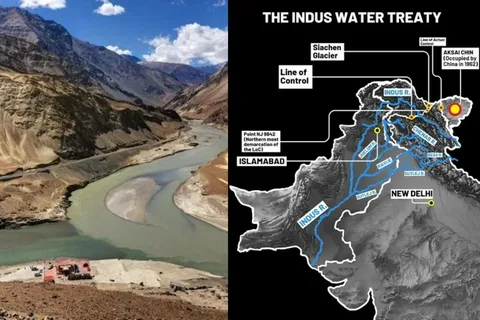
Tensions over water-sharing agreements in South Asia have resurfaced as discussions around the Indus Water Treaty face renewed political pressure. Statements from officials and rising diplomatic exchanges have triggered concern across the region. The debate now extends beyond Pakistan and India, linking wider issues involving the Ganga water Treaty and India Bangladesh water relations.
The situation highlights growing stress on shared river systems, where population growth, climate pressure, and political disagreements are increasing friction between neighboring countries.
Background: Water Sharing in South Asia
The Indus Water Treaty was signed in 1960 between India and Pakistan with the mediation of the World Bank. It is considered one of the most durable water-sharing agreements in the world. The treaty divides river systems of the Indus basin between the two countries, allowing regulated usage.
Over time, disputes have continued over dam construction, river flow management, and interpretation of treaty clauses. Pakistan has repeatedly raised concerns about India’s hydro projects on western rivers.
In parallel, water-sharing issues in the east also exist. The Ganga water Treaty, signed between India and Bangladesh in 1996, regulates the distribution of Ganges River water, especially during dry seasons.
The broader region now faces a shared challenge: increasing water demand and declining predictability of river flows.
Rising Diplomatic Tensions and Recent Statements
Recent diplomatic exchanges have revived attention on the Indus Water Treaty, with strong warnings issued by Pakistani officials regarding any attempt to reduce or block river flows. According to regional reporting, officials stated that any unilateral action could have serious consequences for regional stability.
The phrase Indus Water Treaty has once again become central in political discourse, as both countries defend their respective positions.
At the same time, water relations between India and Bangladesh also remain sensitive. The India Bangladesh water relationship depends heavily on seasonal river flow management, making cooperation essential during dry months.
These overlapping issues show that South Asia’s water diplomacy is deeply interconnected.
Details: Why Water Is Becoming a Political Issue
Water in South Asia is no longer just a resource issue; it is increasingly a geopolitical concern. The Indus Water Treaty continues to be tested by new dam projects, changing climate patterns, and growing energy demands.
Experts note that hydropower development in upstream regions often raises concerns downstream. Pakistan depends heavily on Indus river systems for agriculture, while India seeks to expand its energy infrastructure.
The Ganga water Treaty similarly faces challenges during low-flow seasons when Bangladesh raises concerns about water availability and river management.
The keyword India Bangladesh water reflects this growing concern about shared river sustainability.
Official and Expert Views
Water policy experts argue that existing treaties have largely prevented large-scale conflict, but stress is increasing due to environmental change.
One South Asian water specialist stated that:
“Treaties like the Indus Water Treaty and Ganga water agreements remain critical, but climate change is putting unprecedented pressure on their implementation.”
Officials on both sides continue to emphasize dialogue, although political rhetoric occasionally intensifies tensions.
The term Indus Water Treaty remains one of the most sensitive diplomatic topics between India and Pakistan.
Regional Impact: Why This Matters Beyond Borders
The implications of water disputes extend beyond bilateral relations. Agriculture, food security, and energy production across South Asia depend on stable river systems.
If tensions escalate, the impact could include:
- Reduced agricultural productivity
- Increased rural economic pressure
- Strain on hydroelectric projects
- Diplomatic instability in the region
The Indus Water Treaty is often cited as a model for peaceful resource sharing, making its stability crucial for regional peace.
Similarly, India Bangladesh water cooperation plays a key role in maintaining stability in eastern river systems.
Growing Concern Over Climate and Water Stress
Climate change is intensifying the situation. Glacial melting in the Himalayas and irregular rainfall patterns are affecting river flows across the region.
The Ganga water Treaty and Indus Water Treaty were designed under historical flow conditions, which may not fully reflect current environmental realities.
This mismatch is becoming a central issue in modern water diplomacy.
Future Outlook
Experts believe that instead of treaty breakdown, South Asia will likely move toward updated water-sharing frameworks. Strengthening data-sharing mechanisms and improving river management systems are seen as key steps.
The Indus Water Treaty is expected to remain in place, but pressure for renegotiation or technical revision may increase in the coming years.
Regional cooperation under both the Ganga water Treaty and India Bangladesh water frameworks will also be critical for long-term stability.
Conclusion
Water diplomacy in South Asia is entering a sensitive phase. The Indus Water Treaty, once seen as a stable agreement, now faces renewed scrutiny amid political tensions and environmental stress.
At the same time, issues involving the Ganga water Treaty and India Bangladesh water highlight that the challenge is regional, not bilateral alone.
The future of water security in South Asia will depend on cooperation, climate adaptation, and diplomatic engagement.
FAQs
Who signed the Sindhu Jal Samjhauta?
The Sindhu Jal Samjhauta, commonly known as the Indus Water Treaty, was signed in 1960 between India and Pakistan. It was brokered by the World Bank after years of negotiations following the partition of the subcontinent. The agreement allocated the eastern rivers to India and western rivers to Pakistan.
Has India stopped Chenab water?
There is no verified evidence that India has completely stopped the Chenab River water flow. However, India has constructed hydropower and storage projects on tributaries of the Chenab, which have occasionally led to diplomatic concerns from Pakistan regarding flow regulation and treaty interpretation.
Can India break the Sindhu water treaty?
The Indus Water Treaty does not have a unilateral exit clause. Technically, it is considered a permanent treaty unless both parties agree to modify or replace it. However, disputes can be raised through formal channels such as the Permanent Indus Commission or international arbitration mechanisms.