
NATO is accelerating its Eastern Flank security strategy with a groundbreaking new initiative that replaces human soldiers with machines along its border with Russia and Belarus. The alliance’s Eastern Flank Deterrence Line a network of AI-driven drones, robotic ground systems, and automated missile defenses is set to be operational by the end of 2027. This marks the most significant transformation of NATO eastern flank security posture since the Cold War.
Background: Why NATO Eastern Flank Security Became a Priority
The story of NATO eastern flank security starts with a pattern of Russian aggression that has steadily intensified over more than a decade. Russia’s illegal annexation of Crimea in 2014 and its full-scale invasion of Ukraine in 2022 fundamentally changed the security environment in Europe, with hostile actions toward NATO members and partners including airspace violations, cyber attacks, and acts of sabotage increasing in frequency.Europe is now facing its most dangerous security environment in decades, with Russia utilizing a mix of gray zone tactics and open threats of military action to weaken NATO and assert a practical veto over its neighbors’ geopolitical alignments. These developments have forced NATO eastern flank countries to rethink their defense models entirely.
NATO eastern flank countries stretch across a wide geographic arc. NATO’s Forward Land Forces consist of eight multinational battlegroups located in Bulgaria, Estonia, Hungary, Latvia, Lithuania, Poland, Romania, and Slovakia. These nations form the first line of defense against any potential Russian military action, making NATO eastern flank security concerns central to the alliance’s entire strategy.
Details: The Eastern Flank Deterrence Line Explained
The most significant new development in NATO eastern flank security is the Eastern Flank Deterrence Line (EFDL) a concept that is rapidly moving from planning to reality in 2026.
The Eastern Flank Deterrence Line will feature layered defenses built on autonomous weapons systems, surveillance sensors, and AI-integrated monitoring tools. Brigadier General Thomas Löwin of the German Bundeswehr became the first NATO official to publicly outline the EFDL concept, describing the zone as a “hot area” designed to weaken the adversary’s offensive capabilities before direct engagement with NATO’s operational forces.
The Eastern Flank Deterrence Initiative envisions an “autonomous zone” where only unmanned systems can operate effectively before either side starts taking casualties. Brigadier General Chris Gent, Deputy Chief of Staff for Transformation and Integration at NATO’s Land Command, told Defense News: “There is now a zone in front of you where you’re not going to put humans in harm’s way, and it’s all about machines taking the risk and absorbing that risk for you, and attrition.”
The project involves the creation of a unified network of interconnected sensors, unmanned systems, as well as offensive and defensive capabilities. NATO also plans to deploy acoustic and electro-optical sensors, as well as anti-drone systems, along its eastern borders.NATO Eastern Flank Security
NATO Eastern Flank Weapons: What Is Being Deployed
The NATO eastern flank security weapons arsenal being assembled for the Eastern Flank Deterrence Line is unlike anything previously deployed by the alliance.
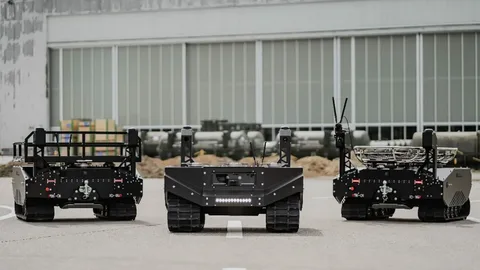
The Eastern Flank Deterrence Line would be filled with sensors and “effectors” and have an AI system linking armed drones, sensor-equipped quadrupedal robots, semi-autonomous combat vehicles, unmanned robotic ground systems, and automated air and missile defenses, designed to “break the enemy’s advance.”
Brigadier General Löwin noted that the alliance intends to build a “comprehensive multi-layer defence system” along the border with Russia and Belarus. It would rely not only on conventional troops but also on obstacles and technology to create a robotic or automated zone close to the border that an enemy would have to overcome first. A network of reconnaissance sensors and largely automated robotic weapons would help stop Russian forces at the first stage of an attack while preserving NATO soldiers’ lives.
NATO scrambled Polish F-16 and Dutch F-35 fighter jets over Polish territory in September 2025 and shot down several Russian drones, including armed drones that resembled Shahed attack drones, demonstrating the urgency of expanding counter-drone capabilities along the NATO eastern flank security perimeter.
NATO Eastern Flank Security Ukraine: The Connection
NATO eastern flank security Ukraine concerns are deeply linked to the alliance’s broader deterrence strategy. Ukraine’s battlefield experience with drones and autonomous systems has directly shaped the Eastern Flank Deterrence Line concept.
Brigadier General Gent cited Ukraine capturing a position in April 2026 using only unmanned systems, saying: “This is here right now. We’re not talking about science fiction, we’re not talking about the future. We’re not talking about 2040. We are talking about the requirement today.”
Russia’s full-scale invasion of Ukraine has fundamentally reshaped Europe’s security environment and nowhere more so than along NATO’s Eastern Flank. A comprehensive assessment of frontline states found that while NATO eastern flank countries have made significant progress since 2022, readiness remains uneven and in some cases fragile, due to persistent gaps in mobilisation speed, sustainment, infrastructure, and institutional agility.
The NATO eastern flank security Ukraine dimension also extends to weapons and intelligence sharing. Lessons learned from the Ukraine conflict, particularly about drone warfare and electronic countermeasures, are being directly integrated into NATO eastern flank security planning across all frontline states.
Quotes: What Officials Are Saying
Brigadier General Chris Gent put the urgency plainly: “There’s no secrets here, it’s how warfare develops. The challenge then becomes how many autonomous systems one side has, how effective they are, and how effective the counters are and the only way to understand that is through exercises.”
Brigadier General Löwin stated: “We will see noticeably larger stockpiles than before in NATO states bordering Russia,” referring to weapon and ammunition depots for rearming defense systems in the automated zone and for equipping NATO forces.
Löwin emphasized that while advanced technologies will play a leading role, all decisions to use force will remain under human control, in accordance with international law and ethical guidelines.
NATO Eastern Flank Security Concerns: Russia’s Response
Russia has not remained silent about the transformation of NATO eastern flank security. The Russian Foreign Ministry stated that NATO is actively building up its military potential on its eastern flank and has already undermined the security architecture in Europe. Moscow views the Eastern Flank Deterrence Line as a direct provocation and continues to frame NATO expansion as the root cause of regional instability.
The European Union has been urged to significantly expedite efforts including the Eastern Flank Watch, the European Drone Defence Initiative, the European Air Shield, and the European Space Shield all aimed at defending against Russian threats through coordinated multilateral mechanisms.The broader NATO eastern flank security concerns include not just a direct military strike but also hybrid warfare. Cyber attacks, sabotage of undersea cables, GPS jamming over Baltic airspace, and covert influence operations are all considered active parts of Russia’s toolkit against NATO eastern flank countries.
Impact: What the Eastern Flank Deterrence Line Means Globally
The NATO eastern flank security shift carries major implications well beyond Europe’s borders. The Eastern Flank Deterrence Line represents the first time a major military alliance has formally committed to deploying AI-integrated autonomous combat systems as a primary layer of border defense.
The entire NATO system is expected to be operational by the end of 2027, marking a definitive shift in how the alliance intends to deter and if necessary defeat Russian aggression.
Analysts suggest that while a Russian attack on Europe remains unlikely in 2026, Moscow is expected to continue testing NATO’s response thresholds. This ongoing pressure makes the consolidation of NATO eastern flank security not merely a regional necessity but a cornerstone of global strategic stability.
For NATO eastern flank countries like Poland, Lithuania, Latvia, Estonia, and Romania, the Eastern Flank Deterrence Line and Eastern Flank Deterrence Initiative represent a genuine security upgrade that reduces reliance on slow-moving conventional troop deployments in favor of a faster, technology-driven response to any Russian incursion.
Conclusion: The Road Ahead for NATO Eastern Flank Security
The NATO eastern flank security transformation is accelerating at a pace few would have predicted even five years ago. The Eastern Flank Deterrence Line, backed by real exercises, real technology, and real political commitment, signals that NATO is serious about making its eastern borders effectively unbreakable.
The central conclusion from readiness assessments is clear: deterrence today depends not just on capabilities or spending, but on how effectively nations can align military, political, and industrial systems under compressed timelines.
With the Eastern Flank Deterrence Initiative moving from concept to field testing in Latvia and other NATO eastern flank countries, the alliance appears to be betting on machines, AI, and speed as the foundations of its next-generation deterrence posture. How Russia responds and whether this technological escalation raises or lowers the overall risk of conflict remains the defining question of European security in the years ahead.
FAQs
What is happening between Russia and NATO?
Russia and NATO are engaged in a deepening strategic standoff across Europe’s eastern frontier. Following Russia’s full-scale invasion of Ukraine in 2022, NATO dramatically expanded its military presence across NATO eastern flank countries including Poland, the Baltic states, Romania, and Bulgaria. In 2026, NATO launched the Eastern Flank Deterrence Initiative (EFDI) and began developing the Eastern Flank Deterrence Line (EFDL) an AI-powered autonomous zone along the Russian and Belarusian border designed to deter any military aggression. Russia views this buildup as a direct threat and has responded with increasing hybrid warfare tactics including drone incursions, cyber attacks, and airspace violations.
How strong is NATO vs Russia?
NATO collectively holds a significant advantage over Russia across most conventional military metrics. The alliance’s combined defence spending vastly exceeds Russia’s, and its member states collectively operate thousands of advanced fighter jets, armored vehicles, naval vessels, and precision weapons. Russia, despite a large ground army and nuclear arsenal, has seen its conventional capabilities degraded significantly by the ongoing war in Ukraine. However, NATO’s eastern flank security concerns focus not on a full-scale war but on Russia’s ability to conduct rapid, limited territorial grabs or sustained hybrid warfare scenarios where sheer numbers matter less than speed, coordination, and readiness.
Who is stronger, NATO or BRICS?
NATO and BRICS are fundamentally different in nature and cannot be directly compared as military powers. NATO is a formal military alliance with integrated command structures, shared doctrine, and mutual defence obligations under Article 5. BRICS comprising Brazil, Russia, India, China, South Africa, and newer members is primarily an economic and diplomatic grouping with no unified military command or mutual defence treaty. China and India, the largest BRICS military powers, have their own strategic interests that frequently diverge from Russia’s. In terms of pure collective military capability, NATO currently holds a decisive advantage over any realistic BRICS military coalition, though China’s rapid military modernisation is narrowing certain technological gaps over the long term.