
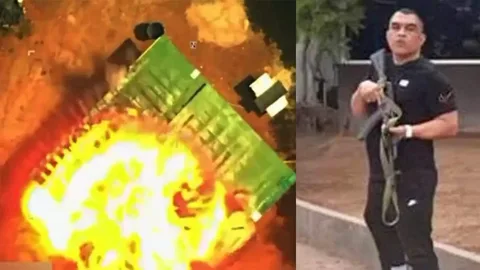
A name that has haunted security agencies across Latin America for years may have just been removed from the picture. According to international reports, a Venezuela strike has killed Nino Guerrero Venezuela gang leader the man identified as the head of the notorious Tren de Aragua network. The operation has set off a wave of debate about security across the region and reignited concerns over how far Venezuela gang members have spread beyond the country’s borders.
Officials have tied the strike to a coordinated security operation involving the United States and Venezuela. Beyond the immediate news, the incident has reopened a much larger conversation — about Venezuela gang leader networks, the reach of organized crime across South America, and what transnational policing actually looks like when the criminal networks themselves are this decentralized.
Background: Who is Nino Guerrero Venezuela?
The man known publicly as Nino Guerrero Venezuela is widely identified as Héctor Guerrero Flores, the figure long associated with leading the Tren de Aragua criminal organization. The group’s origin story is a striking one — it began inside Venezuelan prisons before growing into one of the most powerful transnational criminal networks operating in the Americas today.
Over the years, the gang has built a reputation tied to drug trafficking, extortion, human smuggling, and a level of violence that has made it one of the most feared names in regional crime. What started in Venezuela did not stay there — reports indicate Venezuela gang members have expanded operations into Colombia, Peru, Chile, and parts of North America, following routes that, in many cases, mirror the broader migration patterns out of Venezuela itself.
Security agencies across multiple countries have flagged the organization as one of the most dangerous in the region, and its profile has grown to the point that “Venezuela gang Wikipedia” has become a genuine search term — a reflection of just how far this story has traveled beyond Venezuela’s own borders.
Details of the Venezuela Strike
According to recent reports, the Venezuela strike targeted a location connected directly to the gang’s leadership structure. Officials have described the operation as a precision action language that signals an intent to hit specific individuals rather than conduct a broader sweep.
The reported outcome was the death of the individual identified as Nino Guerrero Venezuela gang leader a development that, if confirmed, represents a significant escalation in efforts to dismantle organized crime networks operating in the region.
This was framed as part of a wider anti-crime push aimed at Venezuela gang members involved in cross-border violence and trafficking. Authorities have indicated that intelligence-sharing between agencies played a critical role in locating the target, with advanced surveillance and strike capabilities used to carry out the operation itself.
Venezuela Gang Leader and Criminal Network
The phrase “Venezuela gang leader” covers more ground than people might assume. It refers broadly to individuals who sit atop structured criminal organizations operating both inside Venezuela and across its borders — and Tren de Aragua is, by most accounts, the most prominent example of this kind of operation.
What makes these networks particularly difficult to dismantle is their structure. Tren de Aragua operates through a highly decentralized model — smaller cells that function with real independence while still maintaining ties back to central leadership. Experts have been fairly blunt about what this means in practice: removing a single Venezuela gang leader, even a high-profile one, does not necessarily collapse the organization underneath them.
That is exactly why security analysts tend to caution against treating leadership strikes as decisive victories. The network of Venezuela gang members beneath the leadership often has the capacity to keep functioning, regroup, or even fracture into new factions that can be just as dangerous.
Venezuela Gang Members and Global Expansion
One of the more sobering parts of this story is how closely the spread of Venezuela gang members has tracked alongside the mass exodus of ordinary Venezuelans fleeing economic collapse and political instability. As millions of people left the country in search of safety and opportunity, some criminal networks moved with them embedding small but organized cells within migrant communities in destination countries.
Authorities in several nations have linked these cells to extortion schemes targeting fellow migrants, drug distribution networks, and illegal migration operations that prey on the same vulnerable populations the gangs themselves emerged from. It is a grim irony that has not gone unnoticed by analysts people fleeing instability sometimes find that the instability has, in some form, followed them.
This dynamic has transformed what might once have been seen as a domestic Venezuelan problem into a genuinely regional security concern that spans much of the Americas.
Aragua Translation in English
For those wondering about the name itself “Aragua translation in English” is a search that comes up fairly often, and the answer is simpler than people sometimes expect. Aragua is not a descriptive word that translates into something meaningful in English. It is a geographic name a state in Venezuela where the gang originally formed.
“Tren de Aragua” translates literally to “Train of Aragua,” with the group taking its name directly from the region of its origin. What began as a regionally specific name has, through the gang’s expansion, become recognized internationally a name now associated with organized crime far beyond the borders of the state it was named after.
TdA Gang Tattoos and Identification
Law enforcement agencies tracking the organization have paid close attention to TdA gang tattoos as part of their identification efforts. Members have reportedly used symbolic markings references to the gang’s name, specific numbers, crowns, and imagery connected to prison culture as visual indicators of affiliation.
These tattoos have become part of how authorities in multiple countries attempt to identify suspected members during investigations and arrests. But experts have been careful to note the limitations here tattoo-based identification is not foolproof. Symbols evolve, get imitated by people with no actual connection to the organization, or get deliberately used to mislead investigators. It is one tool among several, not a definitive marker on its own.
Venezuela Gang President Claims and Political Debate
The phrase “Venezuela gang president” surfaces fairly often in online discussions and political commentary, but it is worth being clear there is no official role or title that corresponds to this phrase. It exists primarily in the realm of misinformation and politically charged speculation.
That said, the underlying question behind the phrase is a real one that gets debated seriously: do criminal organizations in Venezuela operate with some form of political protection or influence over local governance? Venezuelan authorities have firmly and repeatedly denied any formal connection between the state and organized crime leadership.
Regardless of where the truth sits, this remains one of the more politically sensitive threads running through international coverage of the situation and it is unlikely to be resolved by a single strike or a single news cycle.
Impact of the Venezuela Strike
If the reported death of Nino Guerrero Venezuela gang leader is confirmed, the regional implications could be significant. A few outcomes that analysts are watching closely: a possible disruption to Tren de Aragua’s command structure, the risk of an internal power struggle as different factions within Venezuela gang members vie for control, increased security cooperation between countries across Latin America responding to the news, and perhaps most concerning the potential for the organization to fragment into smaller, harder-to-track criminal cells.
That last point is the one security analysts keep coming back to. Removing a leader is significant, but the broader Venezuela gang leader network has shown an ability to adapt quickly. Whether this strike represents a genuine turning point or simply a temporary disruption before new leadership emerges is something that will only become clear over time.
International Response
Reactions to the Venezuela strike have been far from unanimous. Some governments have welcomed the operation, framing it as a meaningful step in the broader fight against organized crime in the region. Others have raised more cautious concerns particularly around questions of sovereignty and the legal basis for cross-border military action of this kind.
Human rights organizations are also watching closely, looking into questions about civilian impact and the legal justification behind the strike. These are not minor procedural questions they go to the heart of how operations like this are conducted and what precedent they set for future actions.
Conclusion
The reported killing of Nino Guerrero Venezuela gang leader is being treated as a significant moment in the broader effort against organized crime in South America. But significant does not mean final. Experts are united on one point the deeper challenge posed by Venezuela gang members and the transnational networks they operate within remains very much unresolved.
As investigations continue, attention is shifting toward how the remaining structure of the organization responds whether it fractures, regroups, or simply continues operating under new leadership and whether this strike marks the beginning of a sustained campaign or remains an isolated action.
What this situation makes clear, more than anything, is just how deeply rooted these networks have become tied not just to a single region like Aragua, but to migration routes, border economies, and communities across an entire continent. Dismantling that kind of structure was never going to be a one-strike job, and nobody involved seems to be pretending otherwise.
FAQs
What are the guerilla groups in Venezuela?
Venezuela’s armed group landscape today is dominated less by traditional ideological guerrilla movements and more by criminal organizations operating along similar lines — Tren de Aragua being the most prominent example, alongside various illegal armed networks active in border regions, particularly along the frontier with Colombia. These groups are primarily driven by profit through drug trafficking, smuggling, and extortion rather than the kind of political or ideological goals that historically defined guerrilla warfare in Latin America. The line between organized crime and armed insurgency has become increasingly blurred in this context.
Why did 7 million people leave Venezuela?
The exodus from Venezuela one of the largest displacement crises anywhere in the world in recent decades was driven by a combination of factors that compounded each other over time. Economic collapse and hyperinflation wiped out savings and made basic goods unaffordable. Chronic shortages of food and medicine made daily survival a genuine struggle for millions. Political instability and a breakdown in public services added further pressure. Faced with this combination, millions of Venezuelans made the difficult decision to leave, with most settling in neighboring Latin American countries, though significant numbers have also moved further afield, including to North America and Europe.
What is the main religion in Venezuela?
Roman Catholicism remains the majority religion in Venezuela, reflecting the country’s long history of Spanish colonial influence and its broader place within Latin America’s predominantly Catholic cultural landscape. That said, the religious picture has been shifting in recent decades, with a growing and increasingly visible presence of Protestant denominations, particularly evangelical churches, alongside smaller communities representing other faiths.