
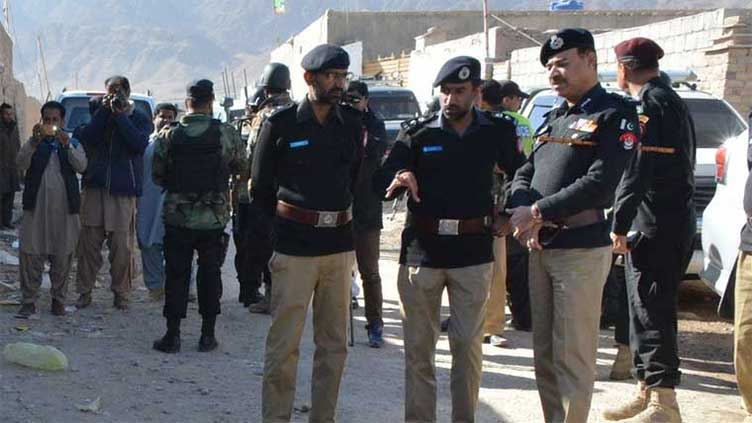
The ten-day sit-in staged by families of policemen martyred in the Ziarat terrorist attack has finally ended in Quetta after the Balochistan government signed a written agreement addressing the protesters’ key demands. The deal, brokered by a government committee, includes a judicial inquiry into the Mangi Dam massacre, official martyr recognition for the slain officers, and financial and educational support for their families. Funeral prayers for the fallen personnel are scheduled to be held at Ayub Stadium in Quetta.
Background
This whole crisis began when armed terrorists attacked a group of police personnel near the Mangi Dam area in Ziarat district. Seven officers were kidnapped and subsequently murdered in cold blood. The brutality of the attack shook Balochistan, and for the families left behind, waiting for answers while their loved ones remained unburied was simply too much to bear.
The families refused to bury the bodies. Instead, they brought eight of the eighteen martyred officers’ remains to Koila Phatak Chowk on the main Quetta airport road and sat down in protest. They were not moving, they said, until the government gave them something in writing not promises, not assurances, but a signed commitment. The sit-in effectively froze traffic between Quetta, Pishin, and Ziarat for nearly a week and a half, causing significant disruption to daily life across the city.
What followed was days of on-and-off negotiations, political pressure, and growing public frustration. Reports in The Dawn Pakistan latest news, ARY News Latest, Pakistan Geo News, and other major outlets had been tracking every round of talks. By the fourth day of the protest, sources were telling reporters that the government had agreed “in principle” to form a judicial commission but families weren’t accepting in-principle. They wanted ink on paper.
Details
After ten gruelling days, that ink finally came. The agreement was signed on Saturday following negotiations led by Balochistan Health Minister Bakht Muhammad Kakar, who headed the government delegation. The committee also included provincial ministers Mir Ziaullah Langau, Saleem Khan Khosa, and Mir Asim Kurd Gello, alongside Senator Manzoor Kakar, Bilal Kakar, and Quetta Commissioner Shahzaib Kakar.
On the families’ side, protest committee member Nasrullah Zehri confirmed that both parties had reached consensus on the draft and that it was formally signed by representatives from all sides.
According to Pakistan news paper today coverage of the agreement, the written accord includes the following commitments from the Balochistan government:
Judicial Commission: An independent judicial commission will be established specifically to investigate the Ziarat terrorist attack at Mangi Dam. The commission is expected to identify what exactly went wrong, why the officers were vulnerable, and where accountability lies.
Martyr Recognition: The slain police personnel will be officially classified as martyrs under provincial government policy. This is not just symbolic it carries legal and financial implications for how their families are treated going forward.
Financial and Educational Support: Families of the martyred officers will receive compensation packages, ongoing financial assistance, and educational support for their children in line with existing government regulations.
High-Level Law and Order Meeting: Chief Minister Mir Sarfraz Bugti will personally chair a joint meeting bringing together opposition parties and the families of the martyrs to discuss Balochistan’s broader security situation. This is an unusual commitment opposition leaders are rarely formally included in such processes.
Revenue Committee: A separate committee headed by the provincial revenue minister will address public concerns over revenue-related grievances. It will include government officials and local community representatives.
Police Strengthening: The government also agreed to expand manpower, improve training, and upgrade the operational capacity of Balochistan Police in urban centres to better handle security threats.
Public Buildings Named After Martyrs: Selected public buildings will be renamed in honour of the slain officers, a decision that means something to families who felt the state was too quick to move on from the loss.
Following the signing, the provincial administration immediately made arrangements to transport the bodies of the martyred officers back to their native Ziarat district, with full security and logistical support. Ambulances were arranged, and the Chief Minister directed that the transfer be handled with the dignity and respect the families had been demanding all along. Funeral prayers are scheduled at Ayub Stadium in Quetta.
Quotes
Chief Minister Mir Sarfraz Bugti, addressing the media after the agreement was signed, said: “The sacrifices of the Ziarat martyrs will never be forgotten.”
Shahid Rind, Aide to the Chief Minister on Media and Political Affairs, stated that the government stands firmly with the families of the martyrs and remains committed to addressing their concerns and ensuring their dignity through all possible means.
Protest committee member Nasrullah Zehri confirmed the deal publicly, saying both sides had reached consensus on the draft agreement, which was formally signed by representatives of the government, the victims’ families, and the committee.
Provincial Home Minister Mir Ziaullah Langove, who had led earlier rounds of negotiations, had previously appealed to the families to bury their loved ones, acknowledging that the government had accepted most of their demands though formal sign-off took several more days.
Impact
This agreement matters well beyond the ten-day sit-in it ends. For anyone following Pakistan news today live, whether through BBC news about Pakistan today, The Dawn Pakistan latest news, or Pakistan Geo News, this story touches something bigger than one protest in one city.
Balochistan has struggled with terrorist violence against security forces for years. Officers are killed, families are left in the dark about what happened and why, and the state machinery often moves slowly. When families feel they have no choice but to block a major highway with their loved ones’ bodies just to get heard, that says something about how broken the feedback loop between grief and governance has become.
What the families won here is not just compensation it is the principle that a signed commitment matters. The judicial commission, if it functions properly, could become a model for how Balochistan investigates future attacks on its own security personnel. The formal martyr recognition means these officers are not just forgotten statistics. And the inclusion of opposition parties in the law and order meeting, while still just a meeting, signals at least an awareness that the government cannot manage Balochistan’s security crisis alone.
There are skeptics, of course. Pakistan international news outlets covering Balochistan have documented how previous commissions and committees have produced little concrete accountability. Families know this too which is probably exactly why they held out for ten days before they trusted the paper in front of them.
The arrest and prosecution of those behind the Ziarat attack remains the real unfinished business. No commission can replace justice in court.
Conclusion
The Quetta sit-in has ended, and the bodies of the martyred officers are finally on their way home to Ziarat. For ten days, their families refused to let the world look away and in doing so, they extracted a written commitment from a provincial government that had initially offered only verbal assurances.
Whether the agreement holds, whether the judicial commission delivers real findings, and whether the families receive what they were promised will all play out in the weeks and months ahead. Pakistan Geo News, The news epaper, ARY News Latest, and other outlets will continue to track what happens next. For now, at least, the families have something in their hands. After ten days on the pavement in Quetta, that is what they came for.
Frequently Asked Questions (FAQs)
What is the current condition of Pakistan today? Pakistan is currently grappling with serious internal security challenges, particularly in Balochistan, where terrorist attacks on security personnel have intensified in recent months. On the political front, the country remains tense following a period of constitutional disputes and economic strain. Inflation has eased somewhat compared to its peak in 2023, but the cost of living remains a burden for ordinary Pakistanis. The government is simultaneously managing diplomatic relationships with regional neighbours, navigating relations with the IMF over economic reforms, and trying to restore investor confidence. The Quetta sit-in and the Ziarat massacre are part of a broader pattern of instability in Balochistan that authorities have struggled to contain despite repeated high-level commitments to improve the security situation in the province.
What is the current problem in Pakistan?
Pakistan faces several overlapping crises right now. The most immediate is the ongoing terrorism threat in Balochistan and Khyber Pakhtunkhwa, where attacks on police and military personnel have continued despite large-scale military operations. The Ziarat massacre in which seven policemen were kidnapped and killed near Mangi Dam is only one of dozens of attacks that have occurred in the province this year alone. Beyond security, Pakistan is still working through economic instability, including foreign exchange pressures, high debt servicing costs, and slow growth. Politically, tensions between federal and provincial authorities, as well as between the ruling coalition and opposition parties, continue to complicate governance. Citizens in many parts of the country, especially in Balochistan, feel that accountability for attacks on civilians and security forces is rarely delivered, which is precisely why protests like the Quetta sit-in tend to draw such strong public support.
What is the breaking news today in Pakistan?
The biggest breaking news in Pakistan today, as reported across ARY News Latest, Pakistan Geo News, BBC news about Pakistan today, and The Dawn Pakistan latest news, is the end of the Quetta sit-in staged by families of policemen martyred in the Ziarat terrorist attack. After ten days of protest on the airport road, the Balochistan government signed a written agreement with the families’ protest committee that includes an independent judicial inquiry into the Mangi Dam attack, formal martyr status for the slain officers, financial compensation for their families, educational support for their children, and a high-level law and order meeting to be chaired by Chief Minister Mir Sarfraz Bugti. The bodies of the martyred officers are being transported back to Ziarat district, and funeral prayers are set to be held at Ayub Stadium in Quetta.