
Protests, Refugee Seats and Political Crisis in Azad Kashmir
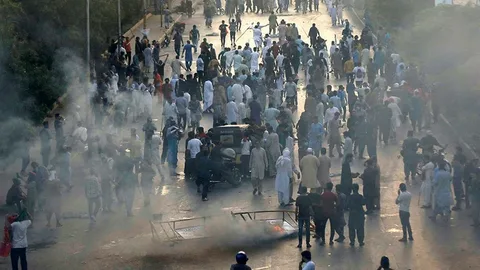
In Pakistan-administered Kashmir, at least twenty-four people have reportedly been killed in clashes between police and protesters. In addition, dozens of others, including police personnel and civilians, have been injured.
These reports have dominated headlines in recent days. On Sunday, June 7, the region’s top court ruled that the twelve seats reserved in the Kashmir Assembly for Kashmiri refugees in Pakistan have constitutional protection and therefore cannot be abolished without a constitutional amendment. The demand to scrap these twelve reserved seats had been raised by the Joint Awami Action Committee, an organisation in Azad Kashmir that has since been declared banned by the government. These twelve seats have now emerged as one of the major triggers behind the latest wave of unrest in Azad Kashmir.
For the past three years, the region has repeatedly witnessed episodes of turmoil that have led to protests, violent clashes and loss of life. The question now is what exactly is happening in Azad Kashmir that conditions have deteriorated to such an extent that several lives have been lost in the past three years.
As noted, the demand to abolish the twelve seats allocated in Azad Kashmir had been put forward by the Joint Awami Action Committee, the organisation that has now been outlawed by the government. To understand the current crisis, it is first necessary to understand what the Joint Awami Action Committee is and how it came into existence.
The roots of the present tensions go back to May 2023, when citizens in Kashmir took to the streets against soaring electricity bills. At the same time, complaints also surfaced over the alleged smuggling of flour and the severe shortage of subsidised wheat flour. With time, these grievances evolved into an organised protest movement. It was against this backdrop that, in 2023, hundreds of protesters gathered in Muzaffarabad and the movement came to be known as the Joint Awami Action Committee.
The first major and decisive phase of this movement emerged in May 2024, when protesters launched a long march towards Muzaffarabad. Clashes broke out between police and demonstrators, leaving five people dead, including a police officer. Following this, Pakistan’s Prime Minister expressed willingness to address some of the protesters’ key demands, after which the movement temporarily suspended its agitation.
After the successful long march of May 2024, this rights movement in Azad Kashmir entered a new and more intense phase in 2025. When the government failed to fully implement its earlier promises, the Joint Awami Action Committee signalled a fresh round of protests. By late 2025 and early 2026, the dispute over the 12 refugee seats had once again pushed the movement towards violence, turning cities such as Rawalakot and Kotli into battlegrounds.
By the middle of 2026, the crisis had evolved, not towards resolution, but into one of the gravest administrative and humanitarian deadlocks in the region’s recent history. In May and June 2026, despite the Supreme Court’s final ruling, the political deadlock over the refugee seats persisted, prompting the Joint Awami Action Committee to announce a complete wheel-jam and shutter-down strike in Muzaffarabad and Rawalakot.
In response, the government adopted its toughest line yet, formally banning the Action Committee and placing the names of more than 150 local activists, including members of its central leadership, on the Fourth Schedule, followed by widespread arrests. The crackdown triggered direct and bloody confrontations in the first week of June 2026 between local residents and security forces in Rawalakot, Kotli and Khoi Ratta. Protesters targeted police checkpoints and government vehicles, while tear-gas shelling and alleged firing by security forces resulted in the deaths of more than 20 people, including the SHO of Rawalakot and personnel of the Frontier Constabulary, while dozens more were seriously injured.
The situation spiralled so badly out of control that the administration imposed an indefinite curfew in the districts of Rawalakot and Kotli. In an effort to maintain order and cut communication among protesters, the government also enforced a complete shutdown of mobile data, internet services and social media platforms across Azad Kashmir, a suspension that has continued for several weeks.
The digital blackout has paralysed medicine supplies in local hospitals, disrupted students’ education and crippled the banking system. With additional forces deployed by the federal government and local leadership reportedly in hiding, Azad Kashmir is now gripped by a deep political deadlock and an atmosphere of fear and uncertainty, with neither side appearing ready to move towards meaningful compromise.
The crisis in Azad Kashmir no longer appears likely to be contained through the use of force or prolonged internet shutdowns. More than 20 deaths, persistent unrest and an entrenched political deadlock have made the situation increasingly volatile, while uncertainty, fear and anxiety continue to define life across the region. If the current tensions continue to escalate, their consequences may extend far beyond questions of law and order, leaving a lasting impact on peace, stability, daily life, the economy and the broader social fabric of Azad Kashmir.