

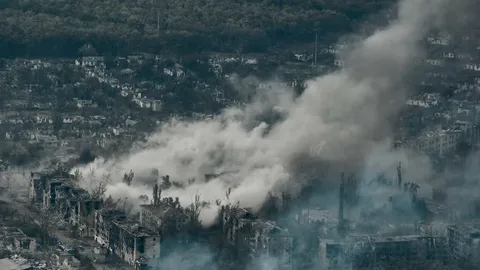
Russia has made Kostiantynivka, at the southern edge of Ukraine’s Donetsk fortress belt, the main target of its 2026 spring-summer offensive, and the latest assessments show Russian troops have actually broken into parts of the city rather than just shelling it from outside. Two Russian assault groups have pushed into the western and northeastern districts and are now roughly two kilometers apart, though Ukrainian forces are still holding the railway station and other key positions.
Russia missed its own self-imposed deadline of May 2026 to take the city, and the wider fortress belt, Sloviansk, Kramatorsk, and Druzhkivka, remains out of reach for now. Meanwhile, Ukraine has kept up long-range strikes inside Russian territory even while defending Donetsk, and Ukrainian commanders say the country has made net territorial gains elsewhere along the front this year even as Kostiantynivka comes under heavier pressure.
Background
Ukraine’s fortress belt is a network of heavily fortified cities built up over more than a decade, starting after the conflict in eastern Ukraine first broke out in 2014. Military engineers and local authorities turned these urban centers into layered defensive positions designed specifically to slow down or stop advancing Russian forces.
It isn’t a wall in any literal sense. It’s a chain of interconnected towns backed by trenches, underground shelters, fortified buildings, anti-tank obstacles, and artillery positions, and it’s become one of Ukraine’s most valuable military assets through the full-scale invasion.
This belt has repeatedly forced Russian forces into long, costly fights for limited territorial gains, which is exactly why it’s become Moscow’s main objective again this year.
What Is the Ukraine Fortress Belt?
The fortress belt runs through several strategically important cities in Donetsk Oblast: Sloviansk, Kramatorsk, Druzhkivka, and Kostiantynivka, along with nearby settlements that support Ukraine’s eastern operations.
When analysts talk about the Ukraine fortress belt map, they’re describing this chain of urban defensive positions connected by roads, railways, logistics hubs, and prepared military infrastructure.
What makes these fortress belt cities valuable isn’t just the fortifications themselves. It’s that they let Ukrainian forces coordinate troop movement, keep supply routes open, and run defensive operations across multiple sectors at once instead of one isolated position at a time.
Russia Increases Pressure on the Donetsk Fortress Belt
Russia opened its campaign for Kostiantynivka back in August 2025, after capturing Toretsk and most of Chasiv Yar. Russian troops first infiltrated the city itself in October 2025, and by this June, two tactical groups, one pushing from the east along the Bakhmut-Pokrovsk road, the other from the south through Illinivka, had reportedly worked their way into roughly a tenth of the urban area, with their forward elements only about two kilometers apart.
Russian command had reportedly set a May 2026 deadline to take the city. That deadline came and went, even after reinforcing the attacking units significantly. Russian forces also tried pushing toward Sloviansk from the north earlier in the year, but that effort stalled and command appears to have shifted weight south toward Kostiantynivka instead.
Ukrainian troops have so far kept Russian forces from seizing the railway station, a key objective inside the city, and cleared infiltrators from at least one nearby village. Outside Kostiantynivka, Ukrainian commanders say Ukraine has actually recorded a net gain in territory so far this year when fighting elsewhere on the front is factored in, even as this particular city comes under intense pressure.
Ukraine Strengthens Defensive Lines
Ukraine has kept reinforcing its positions throughout this, expanding trench systems, anti-tank barriers, observation posts, and protected logistics routes across eastern Ukraine even while under sustained attack.
The latest assessments of Ukraine’s defensive lines show real investment in layered defenses meant to absorb repeated assaults without losing overall combat effectiveness. Urban terrain works in the defenders’ favor here too. Buildings, underground facilities, and narrow streets all cut into the advantages a larger attacking force would normally have.
Ukraine Strikes Russia Amid Defensive Battle
While defending Donetsk, Ukraine has kept up its own long-range strikes inside Russia using drones and precision weapons. Ukrainian officials say these target military airfields, logistics hubs, fuel storage, ammunition depots, and command centers supporting Russian operations, the idea being to damage the infrastructure that sustains the offensive rather than just absorbing it at the front line.
Russia has responded with large-scale drone and missile attacks of its own against Ukrainian military facilities, infrastructure, and industrial sites, so this part of the war is very much a two-way exchange.
Why the Fortress Belt Matters
This is one of the most strategically important defensive systems Ukraine has left in the east.
If Russian forces actually break through these fortified cities, rather than just infiltrating parts of one of them, they’d gain better access to transport routes running deeper into Donetsk Oblast, and that would put more pressure on Ukrainian positions farther west. Holding the belt, on the other hand, lets Ukraine keep coordinating its defense while protecting the civilian population centers still inside it.
Capturing heavily fortified cities is slow, costly work almost by design, which is part of why even a tactical breakthrough into one city, as Russia has managed in Kostiantynivka, doesn’t automatically translate into control of the wider belt.
Ukraine War Map Shows Intensifying Eastern Fighting
Recent battlefield assessments confirm that eastern Ukraine, and specifically the approach to the fortress belt, remains the focus of Russia’s offensive effort. The heaviest fighting is concentrated around the logistical corridors connecting these cities, with Russia applying pressure on multiple fronts rather than betting everything on one breakthrough point.
Ukraine has responded by rotating in reserve units, reinforcing positions, and stepping up drone surveillance to track Russian movements. The front line keeps shifting in small increments, but nothing close to a rapid strategic breakthrough has materialized for either side.
International Response
Western governments continue providing military assistance, intelligence sharing, training, and financial support to Ukraine.
Several allied countries have announced fresh deliveries of air defense systems, artillery ammunition, armored vehicles, and drone technology meant to strengthen Ukraine’s defenses specifically. International officials keep pushing for diplomatic progress while reaffirming support for Ukraine’s sovereignty, and there’s real concern that prolonged fighting will keep straining humanitarian conditions and displacing more people in the affected regions regardless of how the front line moves.
Humanitarian Situation
People living near the fortress belt are dealing with genuinely difficult conditions as shelling hits civilian infrastructure. Local authorities report damage to homes, electricity networks, medical facilities, and transport systems across several frontline communities, in some cases turning entire neighborhoods unrecognizable.
Emergency services keep evacuating civilians from the areas seeing the most intense fighting, and humanitarian organizations are working to provide food, shelter, medical care, and psychological support to those who remain or have been displaced. Security conditions stay genuinely dangerous for both residents and the teams trying to help them.
Military Analysis
Russia’s current approach combines slow, grinding territorial gains with sustained pressure meant to wear Ukrainian defenders down over time, rather than betting on a single rapid offensive. Continuous artillery fire, drone surveillance, and repeated infantry probes are the tools doing most of that work, and the infiltration into Kostiantynivka follows the same playbook Russia used in Pokrovsk: probing for weak points from multiple directions, then pushing small infantry groups in once a gap opens.
Ukraine, for its part, is leaning on defensive resilience, precision strikes against Russian logistics, and battlefield coordination backed by intelligence from international partners. The wider expectation among analysts is that the fight for the fortress belt drags on for months yet, mainly because both sides have already committed so much here that walking away isn’t really an option for either of them.
Future Outlook
The coming weeks matter. Russia is expected to keep pressing on Kostiantynivka and the rest of the fortress belt, while Ukraine continues reinforcing its defenses and striking military targets inside Russia.
Whether either side manages a real operational breakthrough is still genuinely uncertain, and probably depends more on troop availability, ammunition supplies, air defense, and logistics than on any single battle. The Russia-Ukraine war remains one of the most closely watched conflicts in the world for exactly this reason: what happens around this stretch of Donetsk is likely to shape both sides’ planning for the rest of the year.
Conclusion
The battle for Ukraine’s fortress belt, and for Kostiantynivka specifically, has become one of the defining fights of the current phase of the Russia-Ukraine war. Russia has gained an actual foothold inside the city, which is more than it had managed in months of trying, but the wider fortress belt is still standing, and that gap between local gains and a real breakthrough is the story to watch.
As both sides adjust their strategies, this stretch of the eastern front is likely to stay central to the broader war for some time. Nothing in the latest reporting suggests a quick resolution either way, which is exactly why the fortress belt remains one of the most important battlefields to keep an eye on in the months ahead.
FAQs
Is Russia’s army weakening?
It’s facing real strain: equipment losses, personnel casualties, and the cumulative cost of a war that’s run far longer than originally planned. Recruitment numbers have also reportedly slowed compared to a year earlier. That said, Russia still has considerable capability left, backed by ramped-up defense production and large weapons stockpiles, and most analysts still consider it capable of sustained offensive operations rather than close to collapse.
How many females per 1000 male in Russia?
Recent demographic estimates put it at roughly 1,150 to 1,170 women for every 1,000 men. The gap comes mostly from higher male mortality and life expectancy differences, and it widens significantly in older age groups rather than staying constant across the population.
Which war killed the most Russians?
World War II, by a wide margin. The Soviet Union lost an estimated 24 to 27 million people between military and civilian deaths, making it the deadliest conflict in Russian and Soviet history and a defining part of the country’s national memory to this day.