
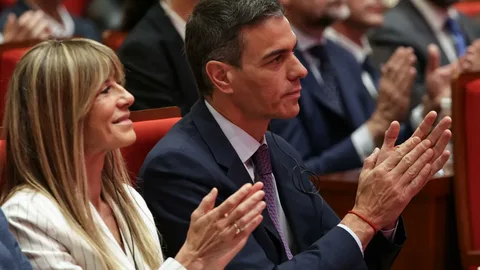
Spain’s political landscape is shaking under the weight of multiple corruption scandals. Former Prime Minister José Luis Rodríguez Zapatero has become the first ex-Spanish premier to be formally investigated for corruption since Spain returned to democracy. At the same time, Begoña Gómez the wife of current President of Spain Pedro Sánchez is heading toward trial on charges of influence peddling and embezzlement. The Spain corruption crisis is now the defining political story of 2026.
Background: A Country Long Battling Corruption
Spain has struggled with political corruption for decades. The Spain corruption index, as measured by Transparency International’s Corruption Perceptions Index (CPI), paints a worrying picture. In 2025, Spain scored just 55 out of 100 its lowest score ever recorded placing the country 49th out of 182 nations globally. The score dropped one point from the previous year, and Spain has fallen 10 points since 2012, making it one of the biggest decliners in Western Europe over that period.
The Spain corruption rank has slipped three places in the world rankings compared to 2024. Transparency International noted that Spain has made regulatory progress but remains in early stages of effectively implementing anti-corruption reforms. A National Anti-Corruption Strategy remains pending, something experts have called urgently necessary.
Is Spain considered a corrupt country? By international standards, it sits in a middle tier — above the global average of 43 but well behind European leaders like Denmark (89) and Finland (88). For ordinary Spaniards, corruption has long ranked as one of the country’s top concerns, second only to unemployment.
Zapatero Becomes First Ex-PM Investigated for Corruption
The Spain corruption news took a dramatic turn on May 19, 2026, when Spain’s National Court (Audiencia Nacional) formally placed former Socialist Prime Minister José Luis Rodríguez Zapatero under investigation for influence peddling, money laundering, and related crimes. He has been summoned to testify on June 2.
Zapatero, who led the country from 2004 to 2011, is the first former Spanish head of government to be formally investigated since the country’s return to democracy after the death of Francisco Franco. This marks a historic and deeply uncomfortable moment for Pedro Sánchez Spain’s current ruling Socialist party (PSOE), of which Zapatero remains a prominent figure.
The case centres on the controversial bailout of Plus Ultra, a Venezuelan-linked airline that received a €53 million public loan in March 2021 from a pandemic recovery fund managed by state holding company SEPI. Opposition parties questioned the bailout at the time, arguing Plus Ultra was financially marginal and did not qualify as a “strategically important” company. Investigators allege Zapatero used his political connections to help secure the rescue for the airline.
Anti-Corruption prosecutors are also examining whether Zapatero secretly collected illicit commissions for acting as an intermediary between governments and businesses seeking public contracts and subsidies. Investigators are probing alleged hidden assets, shell companies, and cross-border money movements linked to the former leader. A company called Análisis Relevante reportedly paid Zapatero around €70,000 per year for consultancy work and also employed two of his daughters.
Zapatero told a Senate inquiry he received around €600,000 from the firm in exchange for “oral and written reports,” the details of which he declined to share. He has firmly denied all wrongdoing and described the accusations as a politically motivated campaign to discredit him.
Begoña Gómez: Pedro Sánchez’s Wife Faces Trial
The story of Begoña Gómez has dominated Spain corruption news for two years. Begoña Gómez, 55, is the wife of current President of Spain Pedro Sánchez. She now faces a formal trial after a judge ruled there was sufficient evidence to proceed with charges.
Begoña Gómez is accused of using her position as the prime minister’s spouse to secure a senior academic role at Madrid’s prestigious Complutense University despite allegedly lacking the required qualifications. Prosecutors have charged her with embezzlement, influence peddling, corruption in business dealings, and misappropriation of public resources for private benefit.
The private prosecution group Hazte Oír is seeking a 24-year prison sentence — a figure that has drawn criticism from commentators across the political spectrum as disproportionate. Madrid’s chief prosecutor has moved to have the charges dismissed, and both Begoña Gómez and Pedro Sánchez have consistently denied any wrongdoing. The final decision on whether the case proceeds rests with the courts.
The investigation, led by judge Juan Carlos Peinado, has been running for two years. Critics have noted a pattern of court orders being timed to coincide with Pedro Sánchez’s official foreign trips, which supporters of the government argue reflects political motivation behind the case.
Pedro Sánchez himself was named in a separate Koldo Case trial in April 2026, where a defendant alleged the prime minister was aware of a scheme to rig public contracts. Sánchez has denied all involvement. The case involves his former Transport Minister José Luis Ábalos and top aide Koldo García, who allegedly accepted kickbacks to award lucrative face-mask contracts during the COVID-19 pandemic.
Examples of Corruption in Spain: A Wider Network of Scandals
The Spain corruption index decline reflects a broader pattern. Here are key examples of corruption in Spain that have emerged in recent years:
The Koldo Case: Former Transport Minister José Luis Ábalos and aide Koldo García were detained in November 2025. They allegedly accepted secret payments to direct government mask procurement contracts during the pandemic to businessman Víctor de Aldama. Public funds were also reportedly used to pay for holidays and a home for Ábalos’s secret partner.
Santos Cerdán Case: Sánchez’s successor as PSOE organisation secretary, Santos Cerdán, was placed in pre-trial detention in June 2025 on bribery allegations related to public contract manipulation.
The Begoña Gómez Case: As outlined above, the President of Spain’s wife faces trial for exploiting proximity to power to secure academic appointments and funding.
The Plus Ultra Bailout / Zapatero Probe: The €53 million state loan to a Venezuela-linked airline is now at the centre of Spain’s biggest political corruption probe in decades.
Popular Party Convictions: Before Sánchez came to power vowing to clean up Spanish politics, the main conservative Popular Party (PP) itself was convicted in a major corruption case. The current Spain corruption scandals are therefore not limited to any single party.
Quotes: What Officials and Experts Are Saying
Transparency International Regional Adviser Flora Cresswell issued a sharp warning after Spain’s 2025 CPI score was published: “In the current geopolitical climate, Europe should be raising, not lowering, its anti-corruption ambitions. Corruption is not inevitable: Europe and its leaders must act now to show ambitious, enforceable reform and global leadership.”
Spanish Prime Minister Pedro Sánchez and his wife Begoña Gómez have repeatedly and firmly denied any wrongdoing throughout all investigations.
Zapatero has maintained that all his consultancy services were legal and corresponded to real work performed. He is due to answer allegations before the court on June 2.
A centrist Spanish commentator wrote in The Olive Press: “In a mature democracy, it should be entirely normal to discuss whether preferential treatment has occurred due to proximity to power. The demand for integrity doesn’t begin where the Criminal Code ends it starts much earlier.”
Impact: What This Means for Spain and Europe
The Spain corruption crisis carries serious consequences at home and abroad. Pedro Sánchez leads a fragile minority coalition that depends on support from far-left partner Sumar and an array of fringe and regional separatist parties. The mounting corruption scandals implicating his wife Begoña Gómez, former allies, and now a former Socialist prime minister are straining those coalition relationships and threatening the government’s ability to pass legislation.
Spain’s falling corruption index score also affects its standing within the European Union. As Spain faces governance questions, the EU adopted its first Anti-Corruption Directive in December 2025, intended to harmonize criminal laws across member states. Spain will need to demonstrate genuine implementation commitment if it is to recover lost ground on the corruption index.
At the regional level, the Zapatero probe has drawn international attention because of its alleged links to Venezuela’s Nicolás Maduro regime, adding a geopolitical dimension to what began as a domestic political scandal. U.S. forces captured Maduro in January 2026, making these alleged Venezuela connections even more politically sensitive.
The Spain corruption news continues to erode public trust. Polls consistently show Spaniards view political parties and parliamentary institutions as among the most corrupt in their society. The cumulative impact of the Begoña Gómez case, the Koldo scandal, and now the Zapatero probe threatens the broader credibility of the Spanish political class.
Conclusion: What Comes Next
The next major date in Spain’s corruption calendar is June 2, when Zapatero is due to testify before the National Court. The Begoña Gómez trial preparation continues, with charges formally in place and a court date yet to be set. The Ábalos trial is ongoing, with a verdict possible in coming months though sentencing may take longer.
Pedro Sánchez, who came to power promising to clean up Spanish politics after PP’s graft convictions, now governs under a cloud of investigations touching his wife, his former allies, and a former prime minister from his own party. Whether the courts will find wrongdoing, and whether the coalition can survive the political pressure, are the two questions that will define Spanish politics in the months ahead.
Spain’s corruption index trajectory will depend on whether these trials lead to real accountability or whether the proceedings stall, as has happened many times before in Spanish legal history. Transparency International has been clear: meaningful reform requires bold leadership, and right now that leadership is in short supply.
FAQs
Q: What is the major issue in Spain?
Spain’s major issue in 2026 is a deep and widening political corruption crisis. Multiple members of Prime Minister Pedro Sánchez’s inner circle including his wife Begoña Gómez, former Transport Minister Ábalos, aide Koldo García, and former PM Zapatero face serious criminal investigations or charges. These scandals have destabilized the ruling coalition and damaged public trust in government institutions.
Q: Is Spain considered a corrupt country?
Spain is not classified among the world’s most corrupt nations, but its corruption perception has worsened significantly. According to Transparency International’s 2025 Corruption Perceptions Index, Spain scored 55 out of 100, placing it 49th out of 182 countries. This is Spain’s lowest-ever CPI score and represents a decline of 10 points since 2012 one of the steepest drops among Western European nations.
Q: Who is Begoña Gómez?
Begoña Gómez is the 55-year-old wife of Spanish Prime Minister Pedro Sánchez. She has been at the centre of a two-year corruption investigation and now faces a formal trial on charges that include influence peddling, embezzlement, and misuse of public resources. She is accused of using her status as the prime minister’s spouse to secure academic positions and funding at Madrid’s Complutense University. Both she and her husband deny all wrongdoing.