
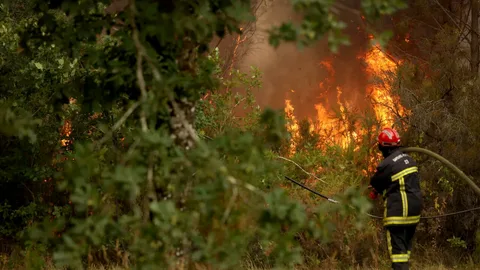
Devastating wildfires in France and Spain have forced more than 300,000 people to abandon their homes as firefighters battle raging fires across southwestern Europe. The wildfires, described as climate change-driven, have displaced hundreds of thousands of residents, with new evacuation orders continuing to be issued as of Sunday, July 27, 2026.
The evacuation operation now ranks among the biggest seen since World War II, with more than 250,000 people ordered out of the danger zone in one region of France alone. Both countries are facing one of the worst wildfire crises in recent memory, with no immediate end in sight.
Background: What Sparked the Crisis?
The wildfires in France and Spain did not emerge overnight. A combination of extreme summer heat, dry conditions, and strong shifting winds created the perfect conditions for fires to spread rapidly across large areas of forest and residential land. This pattern has become increasingly familiar across southern Europe in recent summers, but the 2026 wildfires are already proving to be far more destructive in scale.
Authorities in both countries have been stretched to their limits. France appealed for international help, while Spain declared a national emergency as the fires spread faster than firefighters could contain them. The crisis has underscored the growing danger that rising global temperatures pose to communities across Europe.
Wildfires in France: Bordeaux Under Threat
The wildfires in France have been most severe in the Gironde region of southwestern France, home to the world-famous Bordeaux wine country. The fires have been burning for several days, pushing dangerously close to the city of Bordeaux itself and forcing mass evacuations across multiple towns and villages.
In southwest France, 198,000 people have been evacuated across the Gironde, Landes, Var and Tarn regions, with the majority of evacuations coming from Gironde, according to French Interior Minister Laurent Nunez. The final stage of the Tour de France on Sunday was shortened so that some security forces could be freed up and sent to help with the wildfires.
France’s Interior Minister posted on social media that the fire had again become “extremely virulent and unpredictable, generating its own winds and advancing erratically toward the Bordeaux metropolitan area.” Authorities continued issuing fresh evacuation orders overnight as wind directions shifted and dry conditions made the situation increasingly volatile.
Residents who returned to some villages found their homes completely destroyed. Gardens, homes, and entire plots were left charred and burned as the wildfire ripped through them. The emotional toll on affected communities has been enormous, with families left unsure whether their properties would survive.
Wildfires in Spain: Fires Close In on Madrid
While France has seen the largest number of evacuations, Spain’s wildfire situation has been equally alarming, particularly in the regions surrounding Madrid. Two major fires have been burning west of the capital, threatening populated areas and stretching emergency resources across multiple provinces.
Spain’s interior ministry said the flames had ravaged nearly 10,000 hectares in the Madrid region and between 13,000 and 15,000 hectares in the neighbouring province of Avila, with around 70,000 people evacuated. Firefighters worked through the night to prevent two separate blazes from merging into a single, even more destructive fire.
Hundreds of firefighters in Spain have been battling to prevent two wildfires west of the capital Madrid from merging. The two blazes were being tackled by a single command at Spain’s Military Emergency Unit, and were touching at certain points along a 14 to 15 kilometre strip near San Martin de Valdeiglesias, a town located between Madrid and Avila.
In total, uncontrolled blazes in Spain this week have forced 116,000 people out of their homes. Evacuees fretted about what they would find when allowed to return. “It looked like the apocalypse. You couldn’t see anything. Everything was covered in ash,” said one resident who evacuated with her dog from a town west of Madrid.
Deaths Reported as Emergency Deepens
The human cost of the wildfires in France and Spain is already being felt. At least one confirmed death has been reported in Spain, and officials have warned that the situation remains dangerous and unpredictable.
A 78-year-old man died in the Spanish town of Manises, northwest of Valencia, in an area affected by the fire. The victim had reduced mobility and was caught in the blaze near his orchard, according to the local fire brigade. The fire at that location is now under control, and the town has declared two days of official mourning.
Several other people have received treatment for smoke inhalation and burns across both countries as the blazes continue. With firefighters still battling uncontrolled fires in multiple locations, authorities have warned that the situation could deteriorate further if wind conditions worsen.
Official Statements and Government Response
Leaders in both Spain and France have addressed the crisis publicly, calling it a major national emergency and stressing that saving lives remains the absolute priority.
Spanish Prime Minister Pedro Sanchez said the priority in tackling the wildfires was to “save lives”, warning that a “complex” fight lay ahead. Speaking after attending an emergency planning meeting, Sanchez told reporters: “Our priority, our thinking, our aim is for your lives, to save your lives and protect inhabited areas.”
Carlos Novillo, the Madrid regional government’s emergency management chief, said the wildfire near the capital was “at its peak and is currently beyond the capacity of firefighters to contain.” He warned that erratic winds continued to pose a serious risk and that firefighters were operating under extremely challenging conditions.
Interior Minister Fernando Grande-Marlaska of Spain also issued a stark warning, saying that the night ahead would not be easy and that weather conditions had not helped at all, according to state broadcaster RTVE.
Climate Change: The Bigger Picture
The wildfires in France and Spain are not isolated incidents. They are part of a clear and worsening pattern of extreme fire events across southern Europe that scientists have been warning about for years. Rising temperatures, prolonged droughts, and drier summers are creating conditions that allow wildfires to ignite more easily and spread more rapidly than in previous decades.
The wildfires burning across parts of Spain and France are among the most devastating, but they are far from the only blazes burning in Europe this week. Fires have also been reported in other parts of the continent, adding to concerns about the region’s readiness to deal with increasingly severe wildfire seasons driven by climate change.
Experts have long argued that Europe must invest more heavily in fire prevention infrastructure, early warning systems, and international firefighting cooperation if it is to protect its forests and communities in the decades ahead. The 2026 fires have added fresh and painful urgency to that argument.
Impact on Tourism, Wine, and Local Economies
The timing of the wildfires in France and Spain has dealt a damaging blow to the summer tourism season, one of the most economically important periods of the year for both countries. Beaches, campsites, and resort towns near Bordeaux have been emptied as evacuation orders spread across the region.
As wildfires burn west of Bordeaux, one of France’s most famous wine-producing regions, concerned wine lovers around the world have reached out asking about the fate of the 2026 vintage. One Bordeaux-based wine expert reassured callers that the vineyards are not impacted at the moment, as the grapes are not yet large enough to absorb wildfire smoke a phenomenon known in winemaking as “smoke taint.” However, she added that the local community is deeply distressed by the destruction being caused to homes and forests.
The broader economic damage from the wildfires in France and Spain is expected to run into the hundreds of millions of euros once the full scale of destruction is assessed. Tourism revenue losses, property destruction, agricultural impact, and the cost of firefighting and emergency services will all contribute to a significant financial burden for both governments.
What Happens Next
As of Sunday, July 27, 2026, firefighters in both France and Spain continued to battle the blazes with the support of military units, water-bombing aircraft, and international emergency teams. The immediate priority remains containing the fires near Bordeaux and Madrid before conditions worsen.
Authorities in France’s Gironde region issued overnight evacuation orders for five more localities as shifting winds and arid conditions complicated the massive effort to limit the spread of the blaze. Weather forecasts indicating rising temperatures in the days ahead have added to concerns that the situation could become even harder to manage before it begins to improve.
Both governments have pledged to conduct full investigations into the causes of the wildfires and to review existing emergency protocols once the immediate crisis has passed. International support has begun to arrive, with several European Union member states sending firefighting aircraft and personnel to assist the overstretched response teams.
Frequently Asked Questions (FAQs)
Which country is burning right now?
As of late July 2026, both France and Spain are dealing with major active wildfires. France is battling fires in its southwestern Gironde, Landes, Var and Tarn regions, with the fires threatening to reach the city of Bordeaux. Spain is simultaneously dealing with fires near its capital Madrid, specifically in the provinces of Madrid and Avila, as well as additional fires in the Valencia region. Together, these wildfires in France and Spain have displaced over 300,000 people and killed at least one person. These are currently among the worst active fire situations anywhere in the world and are being described by officials as a major national emergency in both countries.
Which country has the worst fires in the world?
Historically, countries like Australia, the United States, Canada, Brazil, and Russia have recorded some of the largest and most destructive wildfires in the world due to their vast land areas and varied climates. Australia’s 2019 to 2020 Black Summer fires burned around 18.6 million hectares and killed an estimated three billion animals, making it one of the worst wildfire events in recorded history. The United States regularly deals with massive fires in California, Texas, and the western states.
Are there wildfires in Pakistan?
Yes, Pakistan does experience wildfires, and their frequency and intensity have been increasing in recent years. Pakistan’s wildfires are rising in frequency and intensity, driven by heatwaves, erratic rainfall patterns, and human activity. The fires threaten biodiversity, local livelihoods, and long-term ecological stability across multiple regions of the country. Pakistan has less than five percent of its total land area under forest cover, making its forests particularly vulnerable to fire damage. Wildfires are most common in northern and northwestern regions, including Khyber Pakhtunkhwa, Balochistan, and Azad Kashmir, particularly during dry and hot summer months. In 2024, wildfires ravaged the Margalla Hills near Islamabad, threatening critical biodiversity and highlighting ongoing challenges in wildfire management.