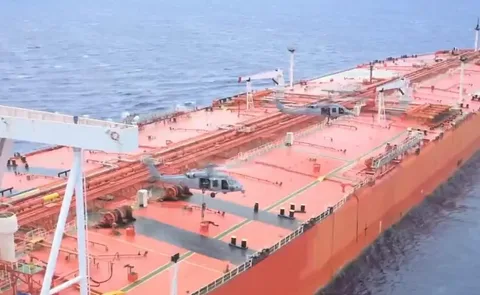
Iranian oil tankers continue offloading crude in waters off Malaysia’s east coast despite a renewed US naval blockade meant to choke off Tehran’s oil revenue. Satellite tracking shows the sanctions-evasion network has barely slowed down, even as tensions between Iran and the US keep escalating across the wider region.
Background
The current standoff traces back to February 2026, when US and Israeli strikes on Iran triggered a war that sent oil markets into chaos. Since then, Iran strikes and counterstrikes have repeatedly disrupted the Strait of Hormuz, a narrow waterway carrying roughly a fifth of the world’s oil and gas supplies.
Washington first imposed a naval blockade of Iranian ports in April, an action that sent oil prices surging past $103 a barrel after the US announced the blockade of Iran, with Brent briefly topping $111 a barrel days earlier amid the collapse of ceasefire talks. That blockade ran until mid-June, when a temporary US-Iran truce briefly lifted restrictions.
The pause didn’t last. After Iran resumed attacks on commercial ships in the Gulf in early July, the US reinstated its blockade on July 14, once again barring vessels from entering or leaving Iranian ports. Yet Iran oil sanctions enforcement at sea has proven far harder than the policy on paper suggests.
Details
According to satellite data reviewed by Al Jazeera, at least 18 Iranian-flagged oil tankers arrived at Malaysia’s Eastern Outer Port Limits over the past month before switching off their tracking transponders and going dark. As many as 200 ships anchor in the area on any given day, with roughly half believed to have ties to Iran.
The Eastern Outer Port Limits, known as the EOPL, has functioned for years as an unofficial marketplace for sanctioned Iranian, Russian, and Venezuelan crude oil. Analysts say Malaysia crude oil waters offer a convenient midpoint for ship-to-ship transfers before cargo continues on to buyers in China, Iran’s principal remaining customer.
Payment for much of this Iranian oil sanctions-evading trade flows through China’s Cross-Border Interbank Payment System, which allows transactions in renminbi outside the dollar-based financial system that underpins most sanctions enforcement. Maritime security researchers say dozens of vessels have been observed broadcasting false or decommissioned identities while moving oil from the Gulf to the EOPL and onward to northern China.
The scale of what’s getting through is significant. During the brief truce in June and early July, roughly 20 Iranian tankers arrived off Malaysia’s coast carrying close to 70 million barrels of crude, worth an estimated $5 billion to $6 billion. Iran’s oil ministry says the country sold a combined $18 billion worth of oil across the war and the ceasefire period that followed.
That figure contrasts sharply with earlier claims from Iranian officials. In late June, Iran’s parliament speaker and chief negotiator, Mohammad Bagher Ghalibaf, said Tehran had been unable to export a single barrel during the blockade, a statement that data on the Malaysia transfers appears to directly contradict.
Quotes
Maritime security researcher Ray Powell, director of the Stanford-affiliated SeaLight project, told Al Jazeera he has tracked 62 ships broadcasting false or decommissioned identities since the start of the year while moving between the Gulf, Malaysia’s coastal waters, Hong Kong, and northern China.
Erica Downs, a senior research scholar at Columbia University’s Center on Global Energy Policy, said the ships form part of a middleman network that supplies China’s independent “teapot” refineries, which operate separately from the country’s large state-owned oil companies and face less scrutiny over sanctioned crude purchases.
Marc Ayoub, an energy policy researcher, said the blockade has sharply reduced new oil leaving Iran, but noted Tehran is increasingly forced to store crude it cannot sell, adding that real pressure builds once that storage capacity runs out.
Impact
The gap between the blockade’s intent and its real-world effectiveness raises questions central to Iran US relations going forward. If sanctioned oil keeps moving through Malaysian waters largely unimpeded, Washington’s central economic lever against Tehran risks losing much of its bite over time.
Malaysia itself faces mounting diplomatic pressure. The country’s Maritime Enforcement Agency has rejected accusations that it is enabling Iran’s shadow fleet, arguing that transfers happen in remote waters outside radar coverage and exploit jurisdictional gaps rather than reflecting government inaction.
For global oil markets, the uncertainty over whether Iran can keep circumventing sanctions feeds directly into price volatility. Traders are also watching closely whether Iran will attack blockade-enforcing US vessels directly, a scenario that could trigger a much sharper spike in prices than anything seen so far this year.
According to Kpler data, roughly 147 million barrels of Iranian crude and condensate currently sit in floating storage, with about 67 million barrels stranded inside the Gulf and unable to move past the blockade line. That’s a lot of oil still bottled up, even with what’s leaking through Malaysia.
Conclusion
With Iran US tensions showing no clear sign of easing, the underground trade routes through Malaysian waters are likely to remain a critical pressure valve for Tehran’s economy. Whether Washington moves to tighten enforcement around the Eastern Outer Port Limits, or whether the current cat-and-mouse dynamic simply continues, will shape how much financial pressure the blockade actually delivers in the months ahead.
Analysts caution that as long as buyers in China keep absorbing discounted Iranian crude and payment channels outside the dollar system stay open, sanctions alone are unlikely to fully cut off Tehran’s oil revenue.
Frequently Asked Questions
How much oil does Iran sell?
Iran’s oil ministry reported roughly $18 billion in total oil sales across the recent war and the ceasefire period that followed it, though export volumes have fluctuated dramatically depending on whether the US naval blockade was in effect. During a brief one-month truce in June and July, Iran managed to export around 70 million barrels, worth an estimated $5 to $6 billion, largely through ship-to-ship transfers off the coast of Malaysia. Before the conflict escalated, Iran had typically exported over a million barrels of oil per day, primarily to China, though current figures remain well below prewar levels due to the ongoing blockade and periodic military escalations.
Where is 90% of Iran’s oil?
This is something of a misconception, since Iran’s oil isn’t concentrated in one single location but rather exported almost entirely to one dominant buyer. The overwhelming majority of Iran’s oil exports, often cited as roughly 90 percent or more, goes to China, making it by far Tehran’s most important energy customer despite ongoing US sanctions. Much of this oil is produced in Iran’s southwestern fields near Khuzestan province and shipped from ports along the Persian Gulf and, more recently, the eastern port of Chabahar, before making its way through waters off Malaysia and onward to Chinese refineries.
Who is the biggest consumer of Iran oil?
China remains by far the largest consumer of Iranian oil, absorbing the vast majority of Tehran’s crude exports despite ongoing US sanctions targeting the trade. Much of this demand comes from China’s independent “teapot” refineries, smaller processing plants that are more willing to accept the compliance risk associated with sanctioned crude in exchange for steep discounts compared to standard market prices. These refineries typically pay for Iranian oil through non-dollar payment channels, including China’s Cross-Border Interbank Payment System, which helps insulate the transactions from US-dollar-based sanctions enforcement mechanisms.