
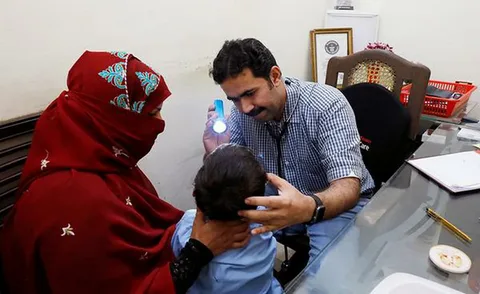
Sindh has become the face of a healthcare failure that Pakistan can no longer ignore. From the streets of Larkana to the hospitals of Karachi, HIV cases in Pakistan 2025 are telling a story of contaminated syringes, broken systems, and children paying the heaviest price. What is happening, why does it keep happening, and what do health experts say needs to change?
Pakistan’s HIV Crisis Is Bigger Than Official Numbers Show
Pakistan’s National AIDS Control Programme has reported over 76,167 registered HIV cases by March 2025. But UNAIDS estimates the actual number is over 210,000, meaning a massive proportion of infections remain undiagnosed.
More than 10,000 people were confirmed HIV-positive in just the first nine months of 2025, making it the fastest year of HIV case escalation in the country’s history. Health authorities warn the total could exceed 14,000 by year’s end, surpassing 2024’s 13,001 confirmed cases.
New infections have surged by 200 percent over the past 15 years, rising from 16,000 in 2010 to 48,000 in 2024. Pakistan now carries the largest share of HIV burden across the entire WHO Eastern Mediterranean Region.
The Larkana HIV Outbreak: Where It Began
The Larkana HIV outbreak is not a single event. It is a wound that has been reopening for years. In April 2019, Ratodero in Larkana District became the center of one of Pakistan’s worst HIV emergencies, which the World Health Organization declared a Grade II Emergency. By mid-June 2019, at least 751 people had tested positive, with children making up more than 80 percent of confirmed cases out of over 26,000 people screened.
In Taunsa, a BBC investigation documented 331 paediatric HIV infections over a 12-month period, with contaminated needles identified as the probable source in more than half of those cases.
Larkana did not learn its lesson the first time. The same failures in infection control, syringe reuse, and blood screening continued. And the consequences followed.
HIV Cases in Sindh 2025: Children at the Center
The crisis at Kulsoom Bai Valika Hospital in Karachi first came to public attention in November 2025, when residents of Karachi’s SITE Town noticed a cluster of infections among children treated there. Officials trace the outbreak to October 2025, when the first six HIV-positive cases were reported to the provincial health department.
At least 78 children contracted HIV at this government-run hospital in Sindh, according to provincial labour minister Saeed Ghani, who confirmed that an investigation had been launched. “We assure the families of the affected children that the Sindh government will not leave them alone,” he stated.
In May 2026, another alarming incident surfaced at the Gambat Institute of Medical Sciences in Khairpur, where more than two dozen HIV-positive children were brought to the hospital, once again raising concerns about the spread of HIV among children in Sindh.
HIV Cases in Karachi: Hospitals Overwhelmed
Three hospitals in Karachi reported a sharp increase in paediatric HIV admissions. At the Sindh Infectious Diseases Hospital and Research Centre, admissions increased from just 10 HIV-positive children in 2024 to 70 in 2025. A further 30 children were admitted in early 2026, most of whom had previously received treatment at Valika Hospital.
A separate screening drive at a SESSI facility in Karachi’s Landhi area identified 10 additional cases. The Pakistan Medical Association warned that 329 of the 894 HIV cases recorded across Sindh during just the first quarter of 2026 involved children describing these figures as “merely the tip of the iceberg.”
The numbers make one thing clear. HIV cases in Karachi and across Sindh are not slowing down. They are accelerating.
What Is Causing the Outbreaks?
Children have been exposed to HIV through unsafe injections and blood transfusions in recent outbreaks across multiple districts, including Shaheed Benazirabad, Hyderabad, Naushahro Feroze, and Pathan Colony in 2025, as well as Taunsa, Mirpur Khas, Jacobabad, Shikarpur, and Larkana in previous years.
In 2016, several dialysis patients in Larkana contracted HIV, triggering scrutiny of the Sindh Blood Transfusion Authority and blood banks. But experts say permanent reforms were never fully implemented, leaving the door open for every outbreak that followed.
Unsafe blood management, reuse of syringes, deficiencies in infection prevention, inadequate HIV testing during antenatal care, stigma, and restricted access to HIV services have all been identified as key drivers of HIV in Pakistan by WHO and UNAIDS.
What Officials and Experts Are Saying
Sindh labour minister Saeed Ghani stated: “There must have been negligence on someone’s part.” Thirty-seven doctors and hospital staff at Valika Hospital were issued show-cause notices.
A Sindh High Court petition alleged the outbreak stemmed from reused syringes. Ghani, however, told reporters on July 4 that the infections were not caused by syringe reuse.
Public health experts are not satisfied with individual accountability measures. One infectious disease specialist summed it up plainly: “For many of us working in this field, this is a systemic problem. It is not linked to any one hospital or healthcare system.”
The Medical Microbiology and Infectious Diseases Society of Pakistan reported in a white paper released in April that the number of people living with HIV in Pakistan has increased 4.3 times since 2010, while annual AIDS-related deaths have also risen significantly.
HIV in Pakistan: The Treatment Gap Is Alarming
Pakistan currently estimates around 369,000 people are living with HIV, but only about 78,000 are registered with treatment centres, and roughly 55,000 receive antiretroviral therapy. Many who know their status either drop out or never initiate therapy, posing serious risks of ongoing transmission.
Only 21 percent of people living with HIV in Pakistan know their status, just 16 percent are receiving treatment, and only 7 percent have achieved viral suppression. The country reported more than 1,100 AIDS-related deaths in 2024. Treatment access for pregnant women is critically low, with only 14 percent receiving the therapy needed to prevent mother-to-child transmission.
HIV Symptoms: What You Need to Know
HIV in Pakistan 2025 is spreading partly because many people do not recognize the early warning signs. Understanding HIV symptoms can lead to faster testing and earlier treatment.
According to the CDC, most people develop flu-like symptoms within 2 to 4 weeks after HIV infection. These symptoms may last for a few days or several weeks. This is the body’s natural response to the virus.
Common early HIV symptoms include:
- Fever and chills
- Sore throat
- Skin rash
- Swollen lymph nodes
- Fatigue and muscle aches
- Headaches
- Mouth ulcers
In the acute stage of infection, HIV multiplies rapidly and attacks the CD4 cells of the immune system. The level of HIV in the blood is very high during this period, which significantly increases the risk of transmission.
Not everyone will have the same symptoms. Some people have no symptoms at all in the early stage. The only way to know for sure if you have HIV is to get tested.
Regarding how HIV rashes appear: the rash typically presents as flat or raised red spots, often spreading across the chest, back, face, or palms. It usually appears during the acute infection stage and can be mistaken for other viral skin conditions. Because early HIV symptoms closely resemble other viral illnesses, many people do not realize they are infected. Getting tested is the only way to know for certain.
Can HIV Be Cured at an Early Stage?
This is one of the most commonly asked questions about HIV in Pakistan. The direct answer is: HIV cannot be cured, but it can be controlled effectively if caught early.
There is currently no effective cure for HIV. Once people get HIV, they have it for life. But proper medical care can control the virus. People with HIV who get on and stay on effective HIV treatment can live long, healthy lives and protect their partners.
Starting antiretroviral therapy during acute infection provides optimal outcomes, including faster viral suppression, better immune system preservation, and reduced risk of progression to AIDS. Modern ART has transformed HIV from a terminal diagnosis into a manageable chronic condition with near-normal life expectancy.
Early diagnosis and immediate treatment remain the most powerful tools available anywhere in the world, including in Pakistan.
The CDC HIV/AIDS Sindh Angle: What Global Health Bodies Are Watching
The CDC HIV/AIDS Sindh situation has drawn international attention. WHO has declared past outbreaks in Sindh as Grade II Emergencies, a classification that signals a serious public health crisis requiring coordinated international and national response. The Lancet HIV journal, in a June 2026 article, described Pakistan’s repeated healthcare-acquired HIV outbreaks as a systemic failure, noting that children represented more than 80 percent of detected cases across Larkana, Jacobabad, Shikarpur, Taunsa, and multiple Sindh sites between 2019 and 2025.
International health organizations have called on Pakistan to implement mandatory HIV screening, eliminate unsafe injection practices, strengthen blood transfusion oversight, and fund long-term systemic reform not just short-term investigations after each outbreak.
What Needs to Happen Now
Despite repeated outbreaks, experts say authorities have yet to implement a comprehensive and sustainable strategy to improve infection control, ensure the safe use of syringes, strengthen blood transfusion screening, regulate private clinics, and eliminate unsafe medical practices.
Public health experts are calling for mandatory HIV screening for high-risk groups, deported migrants, and individuals undergoing surgical procedures. Pakistan still lacks legislation requiring screening for these groups, leaving thousands undiagnosed and unknowingly transmitting the virus.
The families in Larkana, the parents in Karachi, and the patients across Sindh are not just asking for justice for past outbreaks. They are demanding a healthcare system that will not create the next one.
Conclusion
HIV cases in Pakistan 2025 represent more than a health crisis. They represent a failure of governance, healthcare regulation, and political will that has repeated itself across more than a decade. The Larkana HIV outbreak set off alarm bells in 2019. HIV cases in Sindh 2025 show those alarms were not adequately answered. HIV cases in Karachi are now adding a new chapter to the same story.
The science is clear. HIV symptoms are recognizable. Treatment exists. The CDC and global health organizations have provided frameworks for response. What Pakistan needs now is the institutional commitment to finally implement them before another generation of children becomes the next statistic.
Frequently Asked Questions
Which city in Pakistan has the most HIV cases?
Karachi currently has the highest reported concentration of HIV cases among Pakistan’s major cities. Multiple hospitals in Karachi have reported sharp increases in paediatric HIV patients, with one facility seeing admissions rise from just 10 cases in 2024 to 70 in 2025. The Kulsoom Bai Valika Hospital in Karachi’s SITE Town became the center of a major outbreak in late 2025, with at least 78 children testing positive. However, when measured at the district level, Larkana in Sindh has historically been the most affected area, with multiple outbreaks recorded since 2016. The Pakistan Medical Association has warned that 329 of 894 HIV cases recorded across Sindh in the first quarter of 2026 alone involved children, indicating that the crisis is province-wide rather than limited to one location.
How do HIV rashes look like?
An HIV rash is one of the earliest visible signs of infection and typically appears during the acute stage, which begins roughly two to four weeks after exposure. Acute HIV infection causes a brief flu-like syndrome that can include fever, malaise, lymphadenopathy, pharyngitis, arthritis, or skin rash. Most individuals experience at least one symptom, though some may be completely asymptomatic. The rash itself usually appears as flat or slightly raised reddish spots, often covering the chest, back, face, and sometimes the palms or soles of the feet. It is not typically itchy, which distinguishes it from allergic rashes. The spots can merge into larger blotchy patches and generally fade on their own within a few weeks. Because this rash closely resembles rashes caused by other viral infections, it is frequently overlooked or misdiagnosed. Since early HIV symptoms can mirror those of common viral illnesses, getting tested is the only reliable way to confirm an HIV diagnosis.
How to cure HIV at an early stage?
There is no cure for HIV at any stage, including the early stage. However, the earlier HIV is diagnosed and treatment is started, the better the long-term outcome for the patient. Once a person contracts HIV, they carry the virus for life. But with proper medical care, the virus can be effectively controlled. People who begin and maintain HIV treatment can live long, healthy lives and significantly reduce the risk of transmitting the virus to others. The treatment used is called antiretroviral therapy, or ART, which works by suppressing the virus to undetectable levels in the bloodstream. Starting ART during acute infection, the earliest stage, has been shown to produce faster viral suppression, better preservation of the immune system, and a reduced risk of the disease progressing to AIDS. Modern ART has transformed HIV into a manageable chronic condition with a near-normal life expectancy for those who stay on treatment consistently. In Pakistan, ART is available at government-run treatment centres across the country, though access and awareness remain major challenges, particularly in rural Sindh.