
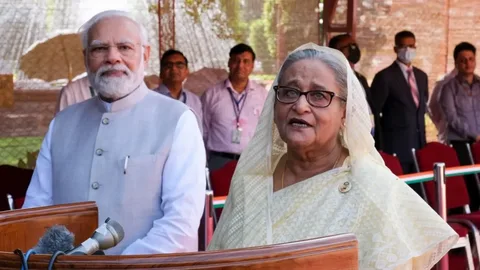
Bangladesh India relations 2026 have hit a fresh point of friction after Dhaka formally asked New Delhi to clarify its position on ousted former prime minister Sheikh Hasina’s planned virtual address from Indian soil. The diplomatic exchange marks the most direct public confrontation between the two neighbors in recent months.
Background
Understanding current problems between India and Bangladesh requires looking back to August 2024, when Sheikh Hasina fled to India following a student-led uprising that ended her 15-year rule. She has remained in India since, despite Bangladesh’s repeated efforts to secure her extradition to face multiple legal cases, including a 2025 death sentence handed down in absentia.
The question of whether Bangladesh and India are friends has grown more complicated as Hasina’s continued presence in India has become a persistent irritant in bilateral ties. Dhaka’s interim government, which took shape after Hasina’s ouster, has consistently pressed New Delhi on the issue, viewing her political activity from Indian territory as inconsistent with normal diplomatic conduct between neighboring states.
This is not the first time the two countries have clashed over Hasina’s public statements. Bangladesh has previously conveyed concerns to India over similar remarks made by Hasina and other Awami League leaders while residing in India, arguing that such activity risks destabilizing an already fragile relationship.
Details
The latest flashpoint centers on an event scheduled for August 5 in New Delhi, hosted by the Foreign Correspondents’ Club of South Asia, marking the second anniversary of the uprising that removed Hasina from power. According to organizers, Hasina, now 78, is expected to address the event by video link alongside her son, Sajeeb Wazed Joy, and other speakers.
Bangladesh’s State Minister for Foreign Affairs, Shama Obaed Islam, told reporters that Dhaka is pursuing what she called a forward-looking approach with India, but stressed that progress in the relationship should not be jeopardized by this kind of political activity. She said plainly that India needs to be clear about where it stands.
Islam added that Bangladesh does not want India-Bangladesh political relations to be damaged by public statements from individuals it considers fugitives from justice, noting that India had previously signaled it did not expect such figures to engage in political activity while on its territory. She indicated Dhaka could raise the matter formally through diplomatic channels if the situation isn’t addressed.
Adding another layer to the story, Hasina told Reuters in a recent interview that she intends to return to Bangladesh in December. That statement has added urgency to Dhaka’s push for extradition and for clarity from New Delhi on how it plans to handle her continued presence and public activities.
Quotes
Shama Obaed Islam’s remarks captured Dhaka’s balancing act clearly, stating that Bangladesh is moving forward with India using a forward-looking approach and does not want that progress affected by the current controversy, while still insisting that New Delhi needs to state its position plainly.
She went further in describing the government’s concerns, saying Bangladesh does not want its relationship with India harmed by statements from individuals facing serious legal cases at home, a reference to the multiple charges Hasina faces, including a death sentence issued last year.
The Foreign Correspondents’ Club of South Asia, which is organizing Wednesday’s event, said the panel was not arranged by the Indian government, though it did not immediately respond to further questions about Bangladesh’s specific objections to the event going forward.
Impact
For readers tracking India-Bangladesh political relations, this episode illustrates how a single figure’s continued political activity can strain an otherwise improving relationship between two major South Asian neighbors. Trade, border security, and water-sharing agreements between the countries have all seen renewed cooperation efforts since Hasina’s departure, making this kind of flashpoint especially sensitive for both governments.
The dispute also has domestic political weight inside Bangladesh, where public sentiment toward Hasina and the Awami League remains deeply divided following the 2024 uprising. Any perception that India is providing a platform for her political comeback could fuel further tension between Dhaka’s interim administration and segments of the public still processing the fallout from her removal.
Regionally, the episode adds to broader questions about how India manages its relationships with exiled political figures from neighboring countries, a dynamic that regional analysts say could shape India’s diplomatic posture toward South Asian neighbors well beyond this single incident.
Conclusion
With Hasina’s video address scheduled for August 5 and Bangladesh publicly pressing India for a clearer position, the coming days will test whether the two governments can manage the disagreement without derailing broader cooperation. How India responds to Dhaka’s request for clarity will likely shape the tone of Bangladesh India relations 2026 for months to come, especially with Hasina’s stated plan to return to Bangladesh in December now setting a firm timeline on an already sensitive standoff.
Frequently Asked Questions
Is Bangladesh and India friends?
Bangladesh and India maintain a generally cooperative relationship built on decades of trade, cultural ties, and shared history, but the friendship has grown noticeably more complicated since Sheikh Hasina’s ouster in 2024. While both governments have publicly committed to strengthening ties and avoiding disruption to progress made on economic and security cooperation, recurring friction over Hasina’s presence in India, along with broader disagreements over border management and river-sharing agreements, means the relationship today is best described as cooperative but strained rather than simply friendly.
What are the current problems between India and Bangladesh?
The most immediate current problems between India and Bangladesh center on Sheikh Hasina’s continued residence in India and her ongoing political statements and public appearances from Indian soil, which Dhaka argues undermine its efforts to hold her accountable through Bangladesh’s legal system. Beyond the Hasina issue, the two countries have also faced periodic tension over border security incidents, water-sharing disputes tied to shared rivers like the Teesta, and disagreements over trade policy. Dhaka’s interim government has repeatedly urged India to formally extradite Hasina, a request India has not yet acted on, keeping the issue as one of the central irritants in the bilateral relationship.
How is Bangladesh and India different?
Bangladesh and India differ significantly in scale, political system, and recent governance history, even though they share a long border, common cultural roots, and overlapping colonial-era history. India is a much larger federal democracy with a longer track record of stable electoral transitions, while Bangladesh has experienced more frequent political upheaval, including the 2024 uprising that abruptly ended Sheikh Hasina’s 15-year tenure as prime minister. Economically, India’s much larger and more diversified economy contrasts with Bangladesh’s export-driven economy, which remains heavily reliant on its garment manufacturing sector, a difference that shapes how the two countries approach trade negotiations and regional economic cooperation.