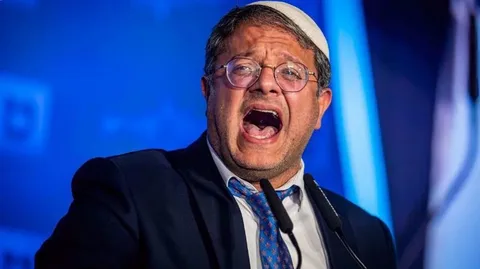
Israeli National Security Minister Itamar Ben-Gvir has sparked a major international diplomatic crisis after posting a video taunting bound and kneeling detainees from the intercepted Gaza flotilla. Dozens of activists can be seen in the clip forced to kneel on the ground with their hands tied at an Ashdod port facility, where they were being processed ahead of likely deportation. The incident has triggered a wave of diplomatic protests across Europe, North America, and Asia, and has even drawn sharp criticism from within Israel’s own government.
Background: The Global Sumud Flotilla and Gaza Naval Blockade
The Gaza flotilla news that has dominated global headlines this week centres around the Global Sumud Flotilla one of the largest civilian maritime attempts in recent history to challenge Israel’s naval blockade of Gaza. The flotilla comprised 50 ships carrying activists from 44 countries, billed as a humanitarian effort to deliver aid to Gaza.
Israel, however, viewed the mission very differently. Ben-Gvir presented a plan to the cabinet aimed at halting the flotilla, emphasising that despite its claimed humanitarian intentions, it would be regarded as an attempt to undermine Israel’s sovereignty and support Hamas in Gaza. The Israeli government authorised a naval interception, and the fleet was seized in international waters earlier this week.
The flotilla had departed from the port of Marmaris, Turkey, on May 14, 2026, in an attempt to break the Israeli naval blockade. Activists included citizens from more than 40 nations, which is precisely why the aftermath of the interception has carried such explosive diplomatic consequences.
Details: What Ben-Gvir Did at Ashdod Port
Ben-Gvir was seen in the video waving a large Israeli flag and shouting in Hebrew, “Welcome to Israel! We are in charge here!” while dozens of bound activists knelt on the ground. Israel’s national anthem was simultaneously blasted over a loudspeaker in the background.
Ben-Gvir is also heard urging guards at the facility “not to be bothered by their screams,” as a woman cries out in the background. The footage, which Ben-Gvir himself posted to his official social media account, spread rapidly across the world within hours.
A non-profit legal centre, Adalah, which provided legal advice to many of the flotilla participants who were arrested, claimed that many of them reported extreme violence, sexual humiliation and serious injuries at the hands of Israeli forces. The organisation said a legal team met with hundreds of flotilla participants at Ashdod Port and collected their testimonies.
In a second video, Ben-Gvir said the activists “came here all full of pride like big heroes; look at them now,” and also made a public appeal to Prime Minister Benjamin Netanyahu to grant him permission to imprison them.
Ben-Gvir’s Prior Plan: Designating Activists as Terrorists
Before the interception even took place, Ben-Gvir had already laid the groundwork for a harsh response. He presented a plan to have the flotilla activists designated as terrorists, with proposals to hold them in prisons meant for terror suspects and deny them privileges such as television, radio, and specialised food.
Ben-Gvir stressed that Israel would not tolerate “soft arrests” or quiet returns of flotilla participants, saying: “We must create a clear deterrent. Anyone who chooses to collaborate with Hamas and support terrorism will meet a firm and unyielding response from Israel.” His stance alarmed human rights organisations and foreign governments even before the taunt video emerged.
Quotes: Officials and Leaders React
The reaction from world leaders was swift and unsparing. Italian Prime Minister Giorgia Meloni called the footage “unacceptable,” stating that “these protesters, including many Italian citizens, are subjected to treatment that violates their human dignity.” Italy formally summoned Israel’s ambassador to Rome.
Spain’s Foreign Minister Jose Manuel Albares called the treatment of the activists “monstrous,” while Ireland’s Foreign Minister Helen McEntee said she was “shocked” by the footage and called for the activists’ immediate release.
Canadian Prime Minister Mark Carney called Israel’s treatment of detained Gaza flotilla activists “abominable,” announcing that Israel’s ambassador would be summoned to Ottawa.
South Korean President Lee Jae Myung called Israel’s actions “way out of line,” after confirming South Korean citizens were among those detained, questioning the legal basis for seizing vessels in international waters.
Even within Israel, Ben-Gvir faced a public rebuke. Israeli Foreign Minister Gideon Sa’ar publicly chastised Ben-Gvir on X, posting that “you knowingly caused harm to our State in this disgraceful display” and that he had “undone tremendous, professional and successful efforts made by so many people.
Prime Minister Netanyahu said Ben-Gvir’s conduct and public taunting of the detainees did not reflect “Israel’s values,” confirming he wanted the activists deported quickly rather than turned into a political spectacle.
On the US side, US Ambassador to Israel Mike Huckabee said Ben-Gvir “betrayed dignity of his nation” by publishing footage showing the treatment of detainees.
Ben-Gvir and His Wife: A Politically Hardline Household
Ben-Gvir and his wife Ayala Ben-Gvir are both known for holding deeply nationalist views, and Ayala has previously appeared publicly alongside her husband at controversial political events. Ben-Gvir’s Otzma Yehudit (Jewish Power) party is widely regarded as the most far-right faction in Israel’s current governing coalition. His actions at Ashdod Port are consistent with a long pattern of provocative public conduct that has divided Israeli society and alarmed international observers. Discussion on Ben Gvir Reddit threads exploded this week, with users across political communities debating whether his behaviour constitutes a war crime or simply aggressive political theatre.
Impact: A Global Diplomatic Storm
Within hours of Ben-Gvir releasing the videos, Canada, France, Italy, Spain, Portugal and the Netherlands had all summoned Israel’s ambassadors to demand explanations for the treatment of their citizens. This level of coordinated diplomatic protest from Western allies is highly unusual.
The Netherlands’ Foreign Minister Tom Berendsen stated that Ben-Gvir’s “treatment of detainees violates basic human dignity.” Portugal’s Foreign Ministry separately issued a strong condemnation of what it called “intolerable behavior.”
The Gaza flotilla news has also reignited the broader debate about the legality of Israel’s naval blockade, the rights of humanitarian activists operating in international waters, and the extent to which allied governments are willing to push back against Israeli actions. The incident has put significant pressure on Western governments that have historically balanced support for Israel with commitments to human rights standards.
According to organisers of the Global Sumud Flotilla, Irish President Catherine Connolly’s sister was among activists from more than 40 countries aboard the flotilla. The presence of such high-profile relatives of European leaders has amplified the political sensitivity of the crisis considerably.
Conclusion: What Happens Next
Netanyahu has already moved to limit the political damage, instructing authorities to deport the detained activists as quickly as possible. Netanyahu issued instructions that the activists be deported “as soon as possible,” appearing to reject Ben-Gvir’s call to imprison them inside Israel.
However, the damage to Israel’s international standing particularly among European allies may take far longer to repair. Ben-Gvir shows no signs of backing down and continues to frame his actions as a necessary defence of Israeli sovereignty. Whether Netanyahu will impose formal consequences on his far-right coalition partner, or whether the coalition itself will face strain over the episode, remains the central political question in Jerusalem in the days ahead.
For the global community, the Gaza flotilla news has once again brought the humanitarian situation in Gaza, the legality of the naval blockade, and the conduct of Israeli officials directly to the centre of international debate.
FAQs
Which country gave the most aid to Palestine?
Qatar has historically been among the largest donors of aid to Palestinians, particularly to Gaza, channelling billions of dollars through agreements brokered with UN agencies and the Hamas administration. Among Western nations, the United States, Germany, and the European Union collectively represent the largest institutional donors to Palestinian humanitarian programmes through UNRWA and related agencies. Turkey has also been a major provider of humanitarian aid and political support to Palestinians, which is reflected in the fact that the Global Sumud Flotilla departed from Turkish waters in May 2026.
Who started the Gaza Flotilla?
The original Gaza Freedom Flotilla in 2010 was organised by the Free Gaza Movement and the Turkish humanitarian organisation IHH (İnsani Yardım Vakfı). The most infamous voyage, the Mavi Marmara, was intercepted by Israeli naval forces, resulting in the deaths of ten activists and a major international crisis. The 2026 Global Sumud Flotilla was organised by a coalition of international pro-Palestinian and humanitarian activist groups from over 40 countries, departing from Marmaris, Turkey, with the stated aim of delivering aid and challenging the ongoing naval blockade of Gaza.
Why is the US protecting Israel so much?
The United States-Israel relationship is built on several interconnected foundations that have remained consistent across decades and administrations. These include deep security cooperation and intelligence sharing, strong domestic political support for Israel within the US Congress driven partly by influential lobbying organisations, shared democratic values as framed by successive US governments, and Israel’s strategic importance as a regional ally in the Middle East. Additionally, evangelical Christian communities a significant political bloc in the US — hold strong theological and ideological support for Israel. Economic and military aid to Israel has become deeply embedded in annual US defence budgets, making it institutionally difficult to reduce regardless of political shifts.