
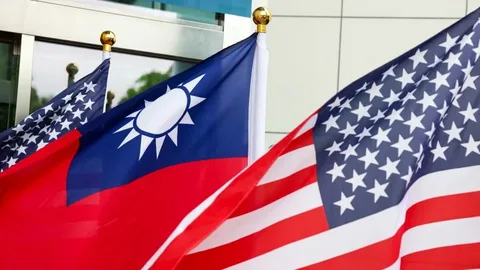
U.S.-Taiwan relations remain one of the most sensitive and strategically significant issues in global politics. From the landmark Taiwan Relations Act of 1979 to the latest debates under President Donald Trump, Washington’s approach to Taiwan continues to evolve and the world is watching closely.
Background: A Complex Diplomatic History
The foundation of U.S.-Taiwan relations history stretches back decades. During Jimmy Carter’s presidency in December 1978, the United States and the People’s Republic of China announced mutual recognition and as part of that deal, the U.S. withdrew its formal diplomatic recognition from Taiwan, known as the Republic of China (ROC).
The United States had recognized the ROC from 1913 until the end of 1978, and then shifted to recognize the PRC. Since 1979, the Taiwan Relations Act (TRA) has governed U.S. policy toward Taiwan.
This shift marked a turning point. While the U.S. ended formal diplomatic ties with Taipei, it never fully abandoned the island.
What Is the Taiwan Relations Act?
The U.S.-Taiwan Relations Act is the legal backbone of the relationship between Washington and Taipei. The TRA became law on April 10, 1979, and stated that it is the policy of the United States to provide Taiwan with arms of a defensive character and to maintain the capacity to resist any resort to force that would jeopardize Taiwan’s security.
Since the spring of 1979, the scope of the One China policy has considerably broadened. The Taiwan Relations Act was intended to complement China’s recognition with a commitment to a continued unofficial relationship with the people of Taiwan and an expression of concern regarding threats from China.
The Act does not constitute a formal U.S.-Taiwan defense treaty, but it lays the groundwork for arms sales and security cooperation. It remains the cornerstone of U.S.-Taiwan relations to this day.
Does the U.S. Recognize Taiwan as Part of China?
This is one of the most frequently asked questions in U.S.-Taiwan-China relations. The answer is nuanced. When the United States recognized the PRC in 1979, it stated that the PRC was the sole legal government of China but the U.S. did not give in to Chinese demands that it formally recognize Chinese sovereignty over Taiwan.
The State Department spokesperson confirmed on July 29, 2025, that the United States remains committed to its longstanding One China policy, which is guided by the Taiwan Relations Act, the Three Joint Communiqués, and the Six Assurances, while also remaining committed to preserving peace and stability across the Taiwan Strait.
So technically, the U.S. does not formally recognize Taiwan as an independent country but it also does not accept China’s claim of sovereignty over the island. This deliberate ambiguity has defined U.S.-Taiwan-China relations for over four decades.
U.S.-Taiwan Relations Under Trump: A New Era of Uncertainty
U.S.-Taiwan relations under Trump have entered a particularly complex phase during his second term. Trump suggested a delayed $14 billion weapons package for Taiwan could serve as a negotiating chip with China, sparking a major debate over U.S. strategic ambiguity and its long-term defense commitments to the island.
When asked in February 2025 about a U.S. commitment to defend Taiwan, Trump said: “I never comment on that. I don’t want to ever put myself in that position.” This essentially reflects the simplest explanation of the policy of strategic ambiguity.
Critics argue this approach sends mixed signals. Supporters say it keeps Beijing guessing and preserves diplomatic flexibility. Either way, U.S.-Taiwan relations news continues to dominate foreign policy discussions globally.
China’s Military Pressure and U.S. Response
The security dimension of U.S.-Taiwan relations cannot be understated. China has launched multiple large-scale military drills around Taiwan in 2025, citing recent statements by the U.S. and Taiwan as provocation. State Department spokesperson Tammy Bruce condemned the drills, saying: “In the face of China’s intimidation tactics and destabilizing behavior, the United States’ enduring commitment to our allies and partners, including Taiwan, continues.”
The Trump administration’s National Security Strategy, unveiled in late 2025, makes it clear that deterring a conflict with China over Taiwan via military might and existing partnerships marks a near-term priority.
The National Security Strategy mentions Taiwan eight times compared to seven in the 2022 Biden version and stresses its importance because of its proximity to major shipping routes and its dominance in the semiconductor industry. “Deterring a conflict over Taiwan, ideally by preserving military overmatch, is a priority,” the document states.
Taiwan’s Defense Spending: Trump’s Demands
A recurring theme in current U.S.-Taiwan relations news is the question of defense burden-sharing. Elbridge Colby, nominee for undersecretary of defense for policy, suggested during his March 2025 confirmation hearing that Taiwan should increase its military spending from 2.5% to 10% of its GDP.
Taiwan has proposed increasing defense spending in response, in a bid to address President Trump’s calls for the island to take greater responsibility for defending itself against threats from China.
This demand reflects a broader Trump administration doctrine: allies must pay more for their own security. It adds a transactional layer to what has historically been a values-based U.S.-Taiwan defense relationship.
Expert Quotes and Official Statements
Following a Trump-Xi meeting, China’s foreign ministry said Xi warned Trump that Taiwan remained the “most important issue” in U.S.-China relations and cautioned that mishandling it could lead to “clashes and even conflicts” between the two powers.
According to CFR Asia Studies Fellow David Sacks, Trump’s 2025 National Security Strategy “relegates geopolitics to a supporting role, while positioning economics as the ultimate stakes.”These statements underscore just how high the stakes are in the ongoing U.S.-Taiwan-China triangle.
Global and Regional Impact
The trajectory of U.S.-Taiwan relations has far-reaching consequences beyond the Taiwan Strait. Taiwan produces over 60% of the world’s semiconductors and over 90% of the most advanced chips making its security a global economic issue, not just a regional one.
The National Defense Authorization Act signed in December directs the Pentagon to step up joint operations with Taiwan, provide drone and anti-drone technology, and authorizes up to $1 billion for Taiwan’s defense.
Japan, South Korea, and other Indo-Pacific allies are also closely watching how U.S.-Taiwan-China dynamics evolve under Trump, as any military conflict in the Taiwan Strait would have devastating economic and security consequences for the entire region.
Conclusion: What Comes Next?
U.S.-Taiwan relations history shows a pattern of careful, calibrated engagement always balancing Beijing’s red lines against Taipei’s security needs. Under Trump, however, that balance appears more transactional and less predictable than before.
Whether Washington will maintain its unofficial but robust support for Taiwan, or use it as a bargaining chip in broader U.S.-China negotiations, remains the central question. What is clear is that U.S.-Taiwan relations will continue to define the geopolitical landscape of the 21st century.
FAQs
Why is Taiwan so important for the USA?
Taiwan sits at the crossroads of critical Indo-Pacific shipping lanes and dominates global semiconductor production. Its security directly affects U.S. economic and military interests. Losing Taiwan to Chinese control could shift the regional balance of power dramatically against Washington and its allies.
Does Taiwan have U.S. support?
Yes though not through a formal U.S.-Taiwan defense treaty. The Taiwan Relations Act obligates the U.S. to provide Taiwan with defensive arms and treat any forceful change to its status as a matter of serious concern. The U.S. has sold billions in weapons to Taiwan and regularly conducts naval operations in the Taiwan Strait.
Why is the U.S. defending Taiwan?
The U.S. defends Taiwan for a combination of strategic, economic, and democratic reasons. Taiwan’s semiconductor industry is vital to global supply chains. Its location is militarily significant. And many U.S. policymakers view defending Taiwan as upholding the broader principle that democracies should not be subjugated by authoritarian force.