
Brazil sits on one of the largest rare earths reserves in the world, and the race to unlock them has gone global. With China dominating production, the United States, Australia, and other nations are pouring investment into Brazil’s mining sector. But despite enormous potential, Brazil remains a marginal producer today. The path from potential to production is far more complex than it appears.
Background: Why Rare Earths Matter So Much Right Now
Rare earths are a group of 17 metallic elements that power almost every modern technology. They are essential for making smartphones, electric vehicles, wind turbines, military missiles, and advanced electronics. Without them, the clean energy transition and modern defence systems simply cannot function.
Despite their name, rare earths are not actually scarce in the earth’s crust. What makes them difficult is that they are extremely complex and expensive to extract and process. They are found mixed with dozens of other compounds and must be separated through hundreds of costly industrial steps.
China currently dominates the entire rare earths supply chain. It accounts for around two-thirds of total global production and controls most of the world’s processing capacity. This dominance has made governments and corporations deeply uncomfortable, driving a global search for alternative sources. Brazil has emerged as one of the most promising answers to that search.
How Large Are Brazil’s Rare Earth Reserves?
Brazil’s rare earth reserves are enormous. According to estimates by the US Geological Survey, Brazil holds more than 20 million tons of rare earths. That makes it the second-largest reserve holder in the world, behind only China. India is in third place with an estimated 6.9 million tons, far behind Brazil.
Despite these vast reserves, Brazil currently exports only a tiny fraction of global production. Brazil exported just 20 tons of rare earths in 2024, out of total global production estimated at 390,000 tons that year. The gap between what Brazil holds underground and what it produces above ground is one of the most striking contrasts in global mining today.
Brazil already ranks among the world’s leading mining nations, producing large quantities of iron ore, gold, bauxite, and graphite. It dominates the global supply of niobium, a mineral used to strengthen steel. But on rare earths, it remains far behind its true potential as a Brazil rare earths supplier.
Which Rare Earths Does Brazil Have?
Brazil’s rare earth deposits are diverse and spread across the country in different geological formations. Light rare earths including neodymium and praseodymium are abundant, particularly in monazite deposits distributed along the Brazilian coastline from the state of Pará to Rio Grande do Sul. These elements are critical for making permanent magnets used in electric motors and wind turbines.
Heavy rare earths including dysprosium and terbium are found at deposits such as Pitinga in the Amazon. These are especially valuable because they are rarer globally and essential for high-performance magnets that operate at high temperatures.
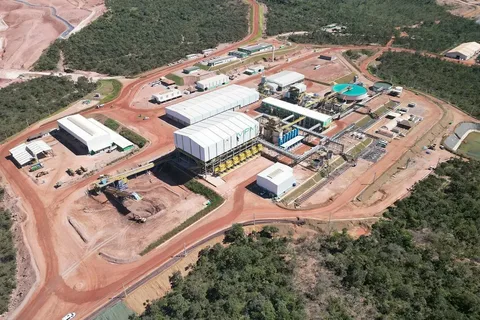
The key deposit sites in Brazil include Araxá in the state of Goiás, which holds an estimated resource of more than 40 million tons of ore and is the most advanced rare earth project in the country. Serra Verde, also in Goiás, is Brazil’s only currently producing rare earth mine. Catalão and Morro do Ferro are under feasibility study. Pitinga in the Amazon is known for heavy rare earths as a byproduct of tin mining.
Why Is Brazil’s Production So Low?
If the reserves are so large, why is Brazil such a marginal Brazil rare earths supplier today? The answer comes down to technology, capital, and infrastructure.
Pablo Cesario, president of the Brazilian Mining Institute known as IBRAM, explained the challenge clearly. Between what is extracted from the ground and producing a 99.9 percent pure rare earth oxide, there are at least 400 industrial processes involved. Brazil can perform this at laboratory scale. But scaling that up to industrial production is an entirely different matter, one that almost no country in the world has fully mastered outside of China.
Julio Nery, director of mining affairs at IBRAM, added that the country needs infrastructure investment, technological research, and a cheaper and more abundant energy supply to meaningfully ramp up production. Processing rare earths is enormously energy-intensive, and Brazil’s industrial energy costs remain a constraint.
Environmental regulations also play a role. Brazil’s Amazon region contains significant rare earth deposits, but mining there faces strict environmental scrutiny and logistical challenges that add time and cost to any project.
Who Is Leading the Global Scramble for Brazilian Rare Earths?
The United States has moved most aggressively to secure access to Brazil’s rare earths. Washington signed a memorandum of understanding with the state of Goiás to encourage rare earth mining, and an American embassy spokesperson confirmed that over 600 million dollars has already been invested in Brazil’s rare earths sector, with billions more anticipated.
The most significant deal came in April 2026, when the American company USA Rare Earth acquired Serra Verde, the company operating Brazil’s only producing rare earth mine in Goiás, for approximately 2.8 billion dollars. The transaction consists of 300 million dollars in cash and 126.9 million newly issued shares of USA Rare Earth stock. The deal is expected to close in the third quarter of 2026.
Following the announcement, shares of USA Rare Earth jumped sharply, reflecting investor enthusiasm for the deal’s potential to establish a major non-Chinese rare earths supply chain for the Western world.
Australia has also entered Brazil’s rare earths scene. The company Foxfire Metals has emerged as an active player, while Brazilian Critical Minerals is developing large clay-hosted rare earth deposits in the Apuí region of northern Brazil with high-grade neodymium, praseodymium, dysprosium, and terbium.
China, meanwhile, has a stake in a project in the Brazilian Amazon, highlighting that the competition for Brazilian rare earths is truly a multi-power geopolitical contest.
Quotes: What Brazil’s Leaders and Industry Are Saying
President Luiz Inacio Lula da Silva struck a carefully balanced tone on foreign investment. He said he is willing to make agreements with all countries but that no one will ever lay claim to Brazil’s natural wealth.
Days after meeting US President Donald Trump at the White House, Lula publicly invited the United States to partner with Brazil in rare earth exploration, signalling that Brasilia sees strategic value in cooperating with Washington without surrendering sovereign control.
Pablo Cesario of IBRAM raised concerns about a new bill passed by Brazil’s lower house of Congress that grants the executive branch veto power over foreign company agreements for reasons of economic or geopolitical security. He described the situation plainly: “What is written there is that the government has the final say in everything. And that is a concern.” He added that the expectation is the bill will change when it reaches the Senate.
Impact: What a Major Brazil Rare Earths Supplier Would Mean for the World
If Brazil successfully develops its rare earths sector, the global implications would be significant. Western nations, particularly the United States and its allies, have been deeply concerned about their dependence on China for critical minerals that underpin both their clean energy transitions and their defence capabilities.
A major Brazil rare earths supplier could reduce China’s leverage over global supply chains. It would give electric vehicle manufacturers, wind turbine producers, and defence contractors access to a reliable non-Chinese source for the minerals they depend on most.
For Brazil itself, the economic prize is enormous. The country could join a very small group of nations that control the global flow of materials essential to 21st-century technology. The revenue, employment, and geopolitical influence that would come with that position are hard to overstate.
However, the risks are equally real. Heavy foreign investment in sensitive natural resources always carries political complications. Lula’s government is trying to balance attracting capital with maintaining national sovereignty, and the new legislation giving the executive veto over foreign deals reflects that tension directly.
Conclusion: Potential Is Vast, But the Road Is Long
Brazil’s potential as a Brazil rare earths supplier is real and enormous. With more than 20 million tons of reserves, the world’s second-largest deposits, and surging global demand, the opportunity is clear. The US acquisition of Serra Verde, the entry of Australian companies, and bilateral agreements with Washington all signal that the world is taking Brazil’s rare earths seriously.
But transforming underground wealth into industrial production requires technology Brazil does not yet fully possess, infrastructure it has not yet built, and a regulatory environment that still creates uncertainty for investors. The gap between laboratory capability and industrial-scale production is not a small one. It could take many years and tens of billions of dollars to bridge it.
The question of whether Brazil becomes a major rare earths supplier is not really about geology. Brazil has the minerals. The question is whether it can develop the technology, attract the right investment on its own terms, and navigate the geopolitical pressures that come with sitting on one of the world’s most strategically valuable mineral deposits.
FAQs
What is the rare earth company in Brazil?
Several companies are active in Brazil’s rare earths sector. Serra Verde operates Brazil’s only currently producing rare earth mine in the state of Goiás and was acquired by the American company USA Rare Earth in April 2026 for approximately 2.8 billion dollars. Brazilian Rare Earths, listed on the Australian Stock Exchange, is an exploration company reporting high-grade discoveries including neodymium, praseodymium, dysprosium, and terbium at its Pelé Target project. Brazilian Critical Minerals is developing the large Ema clay-hosted rare earth deposit in the Apuí region of northern Brazil. The state-linked CBMM, best known for niobium, is also advancing rare earth production at the Araxá Alkaline-Carbonatite Complex, considered the most advanced rare earth project in Brazil.
What is the stock price of Brazilian Rare Earths Limited?
Brazilian Rare Earths Limited is listed on the Australian Stock Exchange under the ticker BRE. Stock prices change daily and readers should check a current financial platform for the latest trading price. Separately, USA Rare Earth is listed on the NASDAQ under the ticker USAR. Following its April 2026 announcement of the Serra Verde acquisition, USAR shares rose approximately 13 to 14 percent, trading at around 22.61 dollars per share at that time. The deal was valued at approximately 2.8 billion dollars based on USA Rare Earth’s closing share price of 19.95 dollars as of April 17, 2026.
Which rare earths does Brazil have?
Brazil holds a wide range of rare earth elements across different deposit types. Light rare earths including neodymium and praseodymium are the most abundant and are found mainly in monazite deposits along the Brazilian coastline and in carbonatite formations such as Araxá and Catalão. These elements are critical for permanent magnets used in electric vehicles and wind turbines. Heavy rare earths including dysprosium and terbium are found at deposits such as Pitinga in the Amazon and at clay-hosted deposits in Goiás and the Apuí region of northern Brazil. Brazil also holds scandium, niobium, and yttrium in various locations. The Serra Verde mine specifically produces ionic clay rare earths, valued for their easier extraction compared to hard rock deposits. Brazil’s mineralogy is diverse, making it one of the few countries with significant quantities of both light and heavy rare earth elements.