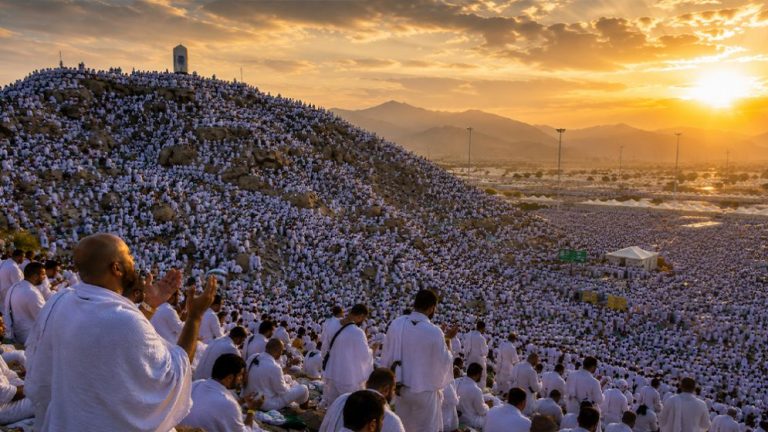

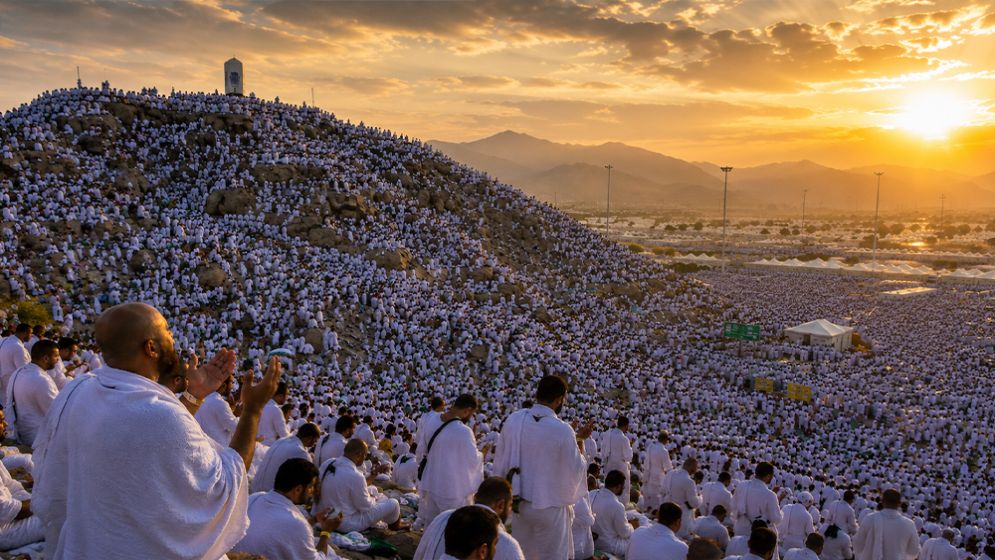
More than 1.6 million Muslim pilgrims gathered at the plains of Mount Arafat on Tuesday, May 26, in what is considered the spiritual heart of Hajj 2026. The Hajj live scenes from Arafat showed seas of white-clad pilgrims engaged in prayer, supplication, and reflection under the blazing Saudi sun. The Hajj live Arafat gathering marks the single most important ritual of the entire pilgrimage and drew believers from every corner of the globe.
Background: What Is the Day of Arafat?
The Day of Arafat is the second day of Hajj and falls on the 9th of Dhul Hijjah every year in the Islamic lunar calendar. Pilgrims arrive early at the plains of Mount Arafat, about 15 kilometres from Mina, and spend the afternoon in wuquf meaning “standing” from midday to sunset, praying and repenting. Arafah is the most important ritual of Hajj and symbolises a preview of the Day of Judgement.
This is the climax of Hajj pilgrims gather on the plains of Mount Arafat from noon until sunset to seek forgiveness and mercy from God. Hajj is not complete without standing at Arafat, the mount where Prophet Muhammad (peace be upon him) delivered his final sermon during his last pilgrimage.For millions of Muslims watching Hajj 2026 live around the world, the live Hajj broadcasts from Arafat carry deep spiritual meaning. Muslims who are not performing Hajj are also encouraged to fast on this day and engage in extra prayers and reflection wherever they are.
Details: How Hajj 2026 Unfolded
Hajj 2026 officially began on Monday, 25 May the 8th of Dhul Hijjah known as the Day of Tarwiyah. Pilgrims draped in Ihram had visited the Grand Mosque in Makkah to perform Tawaf Al-Qudum, the Tawaf of Arrival. After staying in Mina Monday night, the pilgrims proceeded Tuesday morning 9th of Dhul Hijjah 1447 H, corresponding to May 26, 2026 after Fajr prayers to Arafat.
From the early hours of the morning, pilgrims made their way to Arafat, remaining within the sacred boundaries of the site until sunset. Throughout the day, worshippers engaged in recitation of the Holy Quran, remembrance of Allah Almighty, and personal supplications. Many pilgrims continuously recited Talbiyah and Takbeer while seeking forgiveness in an atmosphere marked by humility and faith.
The Hajj live stream from Arafat showed an extraordinary human gathering stretching across the vast plains, with tents, flags, and the sounds of prayers filling the air. The live Hajj coverage broadcast by Saudi channels was watched by hundreds of millions globally.
The Journey: From Mina to Arafat to Muzdalifah
Hajj 2026 follows a carefully structured sequence of sacred rituals across multiple holy sites. Understanding this journey gives context to the remarkable Hajj live Arafat scenes unfolding this week.
Standing on the plains of Arafat on the 9th of Dhul Hijjah is the key ritual of Hajj. Pilgrims are required to be at Arafat until sunset. At Arafat, pilgrims combine Zuhr and Asr prayers and also listen to the Hajj sermon from Masjid Namirah.
After sunset, pilgrims began leaving Arafat for Muzdalifah, where they were expected to combine Maghrib and Isha prayers before spending the night outdoors in worship and rest, ahead of the next Hajj rituals including the symbolic stoning ceremony.
On the third day of Hajj, which also marks the beginning of Eid al-Adha, pilgrims return to Mina before sunrise and begin the ritual of throwing seven stones at the largest pillar known as Jamrat al-Aqaba. This act symbolises the rejection of evil and follows the story of Prophet Ibrahim resisting the temptations of Satan. Pilgrims then perform the animal sacrifice connected to Eid al-Adha.
Quotes: Voices From the Plains of Arafat
The Hajj live Arafat coverage captured deeply moving moments and personal stories from pilgrims who have waited years or even decades for this experience.
“I have wanted to perform the pilgrimage my entire life, for 40 or 50 years,” said Jreish Mohammed, a 68-year-old pilgrim from Morocco, speaking from the sacred plains during the Hajj 2026 live gathering.
Saudi authorities also shared official statements about the scale and management of this year’s live Hajj operations. Prince Saud bin Mishaal, Deputy Emir of Mecca and Vice Chairman of the Permanent Hajj and Umrah Committee, commended the calm, spiritual atmosphere, saying from Arafat: “We are honored by God to serve His sacred sites. It is a great responsibility that we must carry out with sincerity.”
Health and Safety at Hajj 2026 Live
With millions congregating at Hajj live Arafat sites under extreme summer heat, Saudi authorities deployed massive resources to ensure the safety of every pilgrim.
Saudi health authorities remained on alert as temperatures climbed above 45 degrees Celsius, advising pilgrims to drink plenty of water and limit direct exposure to the sun during the day.
Over 52,000 verified medical personnel and emergency responders were stationed in portable triage field clinics across the holy path. Thousands of kilometres of pedestrian walkways were upgraded with high-reflectivity thermal coating alongside integrated misting fans.Modern buses and the Mashair Train ferried pilgrims under strict schedules and heavy security, distributing crowds efficiently across the vast plain of Arafat and avoiding major congestion. A network of smart cameras and a 24/7 monitoring hub enabled rapid decision-making.
Impact: A Global Spiritual Moment
The Hajj 2026 live broadcast from Arafat is more than a news event it is one of the most watched spiritual occasions on Earth. Hundreds of millions of Muslims who could not travel to Saudi Arabia followed the live Hajj through television channels, YouTube streams, and official Saudi broadcasts.
Despite ongoing regional tensions in parts of the Middle East, the number of pilgrims increased compared to last year. Saudi Passport Forces Commander Major General Saleh Al-Murabba confirmed that further arrivals were expected, potentially increasing the total figure further.The combined total of international and domestic pilgrims for Hajj 2026 is projected between 1.8 to 2.0 million individuals, aligning closely with carefully managed safety limits under Saudi Vision 2030 guidelines.
The Hajj live Arafat day also holds global significance for Muslims unable to attend. The Day of Arafat is regarded as one of the most blessed days of the Islamic year, with scholars across the world calling on believers to fast, pray, and seek forgiveness in solidarity with the millions gathered at the sacred plains.
Conclusion: What Comes Next After Arafat
As the sun set on the plains of Arafat, the spiritual peak of Hajj 2026 live gave way to the next stages of the pilgrimage. Pilgrims moved toward Muzdalifah to pray and collect pebbles, before returning to Mina the following morning for the stoning of the Jamarat.
On 10 Dhul Hijjah, Wednesday 27 May, pilgrims will observe Eid al-Adha, perform the stoning of Jamarat al-Aqabah, offer animal sacrifice, trim or shave their hair, and perform Tawaf al-Ifadah. The Days of Tashreeq from 11 to 13 Dhul Hijjah will follow, with stoning at all three Jamarat.
The Hajj 2026 live journey is entering its final and deeply meaningful days. For every pilgrim standing on these ancient plains, the experience is a once-in-a-lifetime spiritual transformation one that the entire Muslim world shares, whether present in body or watching through a live Hajj broadcast from thousands of miles away.
FAQs
How many people went to Hajj in 2026?
According to Saudi authorities, over 1,518,153 international pilgrims arrived for Hajj 2026, with domestic pilgrims expected to bring the total to between 1.8 and 2.0 million. This figure is consistent with Saudi Vision 2030 crowd management guidelines. On the Hajj live Arafat day on May 26, more than 1.6 million pilgrims were confirmed to have assembled on the plains of Arafat alone, making it one of the largest human gatherings on Earth.
Which day of Zil Hajj is Arafah?
Arafah, also spelled Arafat, falls on the 9th of Dhul Hijjah (Zil Hajj) every year in the Islamic lunar calendar. In Hajj 2026, this corresponded to Tuesday, 26 May 2026. It is the most important day of the entire pilgrimage Hajj is considered incomplete without the standing at Arafat. Muslims around the world who are not performing Hajj are encouraged to fast on this day, and it is widely regarded as one of the greatest opportunities for spiritual renewal in the Islamic year.
Is there a third waiting list for Hajj 2026?
Saudi Arabia manages Hajj quotas through a strict national allocation system administered by the Ministry of Hajj and Umrah. Each country receives a fixed number of slots based on population. In countries with high demand like Pakistan, India, and Indonesia, domestic lotteries and waiting lists are used to allocate spots. While some countries operate multiple-tier waiting or priority lists, there is no universal “third waiting list” system at the Saudi level. Prospective pilgrims should contact their national Hajj mission or Ministry of Religious Affairs for the most accurate and current information about waiting list status for future years.