Who Gets to Belong in America?
A conversation with author Curtis Chin on identity, immigrant life, and what the rest of the world thinks of us.
credits by Nasreen Khan
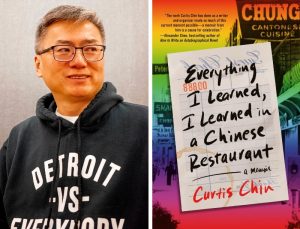
Curtis Chin’s memoir and the author. Chung’s Cantonese Cuisine, his family’s Detroit restaurant, is the setting at the heart of the book.
Curtis Chin’s family ran a Chinese restaurant in Detroit for decades. They served egg rolls to neighbors who had never heard of them, stayed open through the auto-industry collapse that gutted the city, and kept showing up even after Vincent Chin — no relation — was beaten to death in 1982 by two autoworkers who blamed Japanese imports for their layoffs. The killers saw an Asian face and didn’t stop to ask which kind.
That is the world Chin’s memoir, Everything I Learned, I Learned in a Chinese Restaurant (Little, Brown and Company, 2023), puts you inside. On May 22, American Community Media brought him into a virtual room with journalists from ethnic, multilingual, and community outlets across the country for a one-hour briefing — part of the organization’s AAPI Heritage Month series. The conversation ran from Detroit in the 1980s to a 10-country book tour, from the murder of Vincent Chin to what young Asian Americans are doing with their identity right now.
Simultaneous interpretation was provided in Korean, Mandarin, and Spanish. What follows is a full account of what was discussed.
The Restaurant Was the Story
Chung’s Cantonese Cuisine sat at the intersection of a city trying to figure out who belonged. Detroit in the 1980s was a Black-and-white city, Chin said — and he meant that literally. The Chinese American family that ran the restaurant didn’t fit neatly into either category. They were accepted in their Black neighborhood as neighbors who worked hard and were part of the fabric of the block. When the family moved to an all-white neighborhood, that familiarity didn’t follow them. They became curiosities rather than community.
Henrietta J. Burroughs asked directly whether there was a difference in acceptance between the two neighborhoods. Chin said yes, and said it shaped how he thinks about coalition-building to this day. Proximity matters, he said. Shared stakes matter. Abstract solidarity doesn’t do much on its own.
Nancy Tran noted, in the chat, that the restaurant is the book’s real legacy. Chin seemed to agree without quite saying so. The restaurant was where everything happened — where the community gathered, where racial and economic tension played out at the counter, where his family built something visible in a place that didn’t always want them there.
1982, and What Came After
The murder of Vincent Chin in 1982 — the first recorded anti-Asian hate crime in the United States — runs through the book as a fixed point. Chin was 27, Chinese American, beaten to death by two autoworkers who blamed Japan for taking American jobs. The men who killed him served no jail time. The case became a rallying point for Asian American civil rights organizing, and then, for a long time, it was mostly forgotten.
SweSwe Aye, whose audio wasn’t working, submitted her question through the moderator: had the American public and media failed to carry forward the lessons of 1982, given the surge in anti-Asian hate crimes in recent years?
Chin didn’t let the media off easy. He said the Vincent Chin case got covered and then absorbed into a general liberal narrative about civil rights — acknowledged, categorized, and set aside. What’s different now, he said, is that Asian American communities have more organizing infrastructure and more media of their own. Whether that produces lasting accountability is still an open question.
Sandy Close asked about inter-race relations in the current moment, with white supremacy more visible than it’s been in decades. Chin said he sees both regression and new coalition-building happening at the same time — and he was careful not to flatten either. He talked about the growing collaboration between Black and Asian American organizers, while also naming something that often goes unspoken: anti-Blackness exists within some Asian American communities, and pretending otherwise doesn’t help anyone.
What Ten Countries Asked Him
Chin came to this briefing fresh off a 10-country book tour. Ling Huang of the World Journal asked what people overseas misunderstand most about America, particularly on race, diversity, and identity.
His answer was direct: most people abroad see America as a single coherent thing. They don’t see the internal fractures — between cities and small towns, between communities of color and white suburban enclaves, between the country that exists in pop culture and the one that exists on the ground. The question he got asked most often wasn’t about policy. It was about daily life: what is it actually like to be Asian in America right now? That question, he said, was a lot harder to answer than it used to be.
Who Gets to Define It
Carlos Roa of Te Lo Cuento News asked what makes a person truly feel they belong in America. Chin’s answer didn’t reach for an easy definition. He talked about the gap between legal citizenship and felt belonging — how his family ran a restaurant, paid taxes, raised kids, and still had to prove themselves in ways their white neighbors never did. The Vincent Chin murder made that gap impossible to ignore.
Pamela Anchang pushed the question further: does race still shape which immigrants are more easily accepted as American, particularly comparing immigrants of color with white immigrant communities?
Chin said yes, plainly. The framework of who counts as American has always been racialized, he said. Asian Americans have historically occupied an unstable middle position — held up as a model minority when convenient, scapegoated when the economy sours. He pointed to 1982 as one of the clearest examples of that instability.
Araceli Martinez asked what Hispanics might take from the book in the current climate of uncertainty and fear. Chin didn’t offer a tidy answer, but he pointed to something structural: the book is partly about what happens when a community builds something physical and visible in a place that’s not sure it wants them. That dynamic, he suggested, isn’t specific to Chinese Americans.
The Younger Generation
Nancy Tran asked whether young Asian Americans are distancing themselves from their ancestry because of the white supremacy environment. Chin said he sees the opposite more often — a generation more willing to claim and explore Asian American identity than previous ones. He traced this partly to the wave of anti-Asian hate during the pandemic, which pulled younger people into organizing spaces that had previously been dominated by older activists.
Nicole Chang asked what message he’d leave for future generations. He didn’t give a slogan. He talked about his parents’ restaurant — how it stayed open through economic downturns, racial tension, and personal loss, not because they had a strategy but because closing wasn’t something they could afford to do. He acknowledged that this kind of resilience gets romanticized in retrospect. Living it is different. But the act of staying, of building something visible in a community that might not welcome you, is itself a form of resistance.
On Chinatowns and Memory
Keyang Pang submitted a question about Detroit’s Chinatown — what social and cultural role it played, and how to prevent gentrification from erasing what remains of Chinatowns across America.
Chin described how Detroit’s Chinatown shrank and largely disappeared — squeezed by highway construction and the economic collapse of the city. The same story has played out across the country, he said, driven first by disinvestment and more recently by overdevelopment. On preservation, his answer was blunt: community ownership is the only real answer. Cultural programming helps, but if the buildings aren’t owned by the community, the community can eventually be priced out of its own history.
Rebecca Bartus asked how immigrant stories can be preserved when historical erasure seems to be accelerating. Chin pointed to his documentary work as one response — putting faces and voices on record in ways that are harder to erase than text. He also made a point directed at the journalists in the room: every interview with an elder, every story about a neighborhood business, every record of a community meeting is an archive. That work is preservation, whether it’s framed that way or not.
On Supporting Each Other
Sandra Martinez of Peninsula 360 Press asked what other minority communities can do to support Asian American communities right now.
Chin said show up in the same way you’d want others to show up for you. He mentioned the Asian American civil rights movement’s debt to Black civil rights organizing, and said that debt is one reason cross-community solidarity isn’t optional — it’s historical. He wasn’t preachy about it. He framed it practically. Movements that stay siloed tend to stay small.
What’s Next
Chin’s most recent documentary, Warren King: King of Cardboard, premieres on American Masters (PBS) on May 28, 2026. The film follows Warren King, an artist who built a body of work and a life out of materials others discarded. More information is available at Bit.ly/WarrenKingDoc.
ABOUT THE SPEAKER
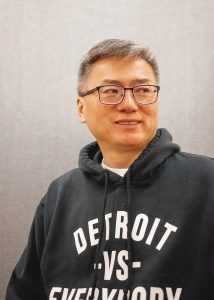
Curtis Chin |
Curtis Chin is the author of Everything I Learned, I Learned in a Chinese Restaurant (Little, Brown and Company, 2023), a memoir about growing up Chinese American in Detroit, coming out in a working-class immigrant community, and being a first-generation college student at the University of Michigan.
He has written for CNN, Bon Appetit, the Detroit Free Press, and the Boston Globe, and for comedy shows on network television. He holds fellowships from ABC/Disney Television, the New York Foundation for the Arts, and the National Endowment for the Arts, and has won awards from the National Association for Multicultural Education, the National Association for Ethnic Studies, the American Librarians Association, and Asian Americans Advancing Justice. Chin co-founded the Asian American Writers’ Workshop and served as Director of Outreach for the Democratic National Committee. He was on Barack Obama’s Asian American Leadership Committee during the 2008 presidential campaign and is a former Visiting Scholar at NYU. His documentary films have screened for more than 600 organizations across twenty countries, including the White House, Lincoln Center, Amnesty International, SXSWEdu, and the Government of Norway. His latest film, Warren King: King of Cardboard, premieres on American Masters (PBS) on May 28, 2026. |
JOURNALISTS WHO ATTENDED
| Mireya Olivera
Impulso Newspaper |
Christopher Young
The Mississippi Link, Jackson, MS |
Nora Estrada
Kiosko News |
| Hector Felix
El Informador del Valle |
Gavin Li
HTTV / China TV |
Mei Mei Huff
Huff Strategies |
| Charles Dong
AMTV |
Rachael U
Pearl Entertainment / Showbiz India TV |
Carlos Roa
Te Lo Cuento News |
| Araceli Martinez
Excelsior California / Spanish Media |
Minzi Zhu
World Journal LA |
Nestor Fantini
HispanicLA.com |
| Sandy Close
American Community Media |
Sunita Sohrabji
American Community Media |
Sandra Martinez
Peninsula 360 Press |
| Pilar Marrero | Nancy Tran | Rebecca Bartus |
| Pamela Anchang | Henrietta J. Burroughs | SweSwe Aye |
| Keyang Pang | Nicole Chang | Tariq Khan |
| Jessica Martin
ACoM |
Alexis Duenas | Ling Huang
World Journal LA |
| Orhan Akkurt | Aitana Vargas | Carlos Roa
Te Lo Cuento News |