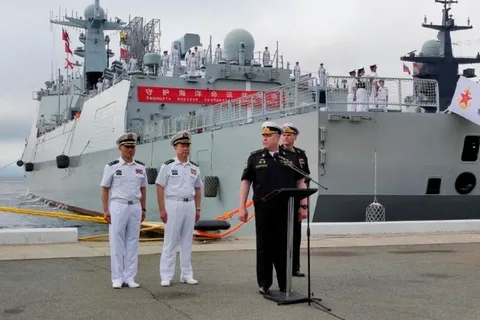

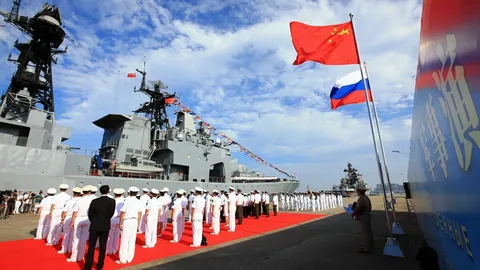
Beijing and Moscow have once again put their military partnership on full display. China Russia naval drills, formally named “Joint Sea-2026,” began this week off the coast of Qingdao, a major port city in China’s Shandong province. The exercise is scheduled to run from July 6 to July 13, followed by a joint maritime patrol across parts of the Pacific Ocean.
The announcement came directly from China’s Ministry of National Defense on Sunday, July 5, 2026. Russian state media confirmed the same details shortly after. According to officials, several Russian Pacific Fleet vessels, including a cruiser, a corvette, a diesel-electric submarine, and a rescue ship, have already arrived at the Qingdao naval port ahead of the drills.
Background: A Long-Running Military Tradition
The China Russia naval drills are not a new phenomenon. Beijing and Moscow have carried out “Joint Sea” exercises annually since 2012. Each year, the location alternates between Chinese and Russian waters. Last year’s edition took place near Vladivostok, a Russian port city on the Pacific coast, and was also followed by a joint patrol.
This year’s drills arrive roughly two months after Russian President Vladimir Putin’s visit to China. During that trip, Putin remarked that the relationship between the two nations had reached an “unprecedentedly high level.” Chinese leader Xi Jinping used similarly strong language, describing the partnership as “unyielding.”
The timing is notable. The exercise announcement came just two days after Germany summoned China’s ambassador for urgent diplomatic discussions. It also lands amid continued Western scrutiny of Chinese support for Russia’s ongoing war effort in Ukraine, even though Beijing has consistently denied taking sides in the conflict.
Details: What Joint Sea-2026 Involves
According to the Chinese defense ministry’s statement, the exercise will unfold in the waters and airspace surrounding Qingdao. Naval and air forces from both countries will take part, though Beijing has not released specific figures on troop numbers or the full scale of participating equipment.
Once the main phase of the exercise concludes, select naval units from China and Russia will move into the Pacific Ocean to conduct a joint maritime patrol. This follows the same pattern used in previous years, where the drills serve as a prelude to broader naval cooperation across contested waters.
Officials in Beijing described the exercise as part of a long-standing annual cooperation plan between the two militaries. Chinese defense authorities stated that the drills are intended to address shared security challenges and help preserve peace and stability in the wider region.
Separately, reports from Reuters and European intelligence sources have indicated that China provided military training to Russian soldiers on Chinese soil in late 2025, including instruction in drone operations. That training reportedly took place under a bilateral military agreement signed in July 2025, with some trainees later deployed to the front lines in Ukraine.
Quotes: What Officials Have Said
China’s Ministry of National Defense stated that the arrangement is <cite index=”2-1″>”aimed at jointly responding to security challenges and safeguarding regional peace and stability.”</cite>
The ministry also confirmed the operational sequence for the drills, noting that <cite index=”4-1″>following the exercises, some of the forces from both sides will proceed to relevant areas of the Pacific Ocean to carry out joint maritime patrols.</cite>
During his visit to Beijing earlier this year, Putin described the state of Russia-China relations in strongly positive terms, a sentiment echoed publicly by Xi Jinping around the same period.
Impact: Why This Matters Globally and Regionally
The China Russia naval drills carry weight well beyond routine military scheduling. For Western governments, particularly the United States and NATO members, the exercise is read as another signal of deepening strategic alignment between Beijing and Moscow at a moment when Russia remains engaged in its war against Ukraine.
Analysts tracking Sino-Russian military ties note that these exercises help the two navies build interoperability, meaning their ships, aircraft, and command systems can operate together more smoothly in future scenarios. That capability matters regionally, particularly for countries bordering the Pacific and East Asian waters, where both nations maintain competing territorial and strategic interests with the United States and its allies.
There is also a wider dimension to this cooperation. Analysts have increasingly grouped Russia, China, Iran, and North Korea under the label “Axis of Upheaval,” a term used to describe a loose but growing alignment of states pushing back against the Western-led international order. Understanding how these four countries interact requires looking beyond any single relationship.
Russia and Iran in Syria: A primary reason Russia and Iran cooperated for years in Syria centered on shared strategic interest in propping up an allied government and maintaining regional influence, since both nations viewed a stable, friendly Damascus as valuable to their broader positions in the Middle East. Iranian ground support paired with Russian air power formed a practical division of labor that sustained the Assad government for years.
Iran’s support for Russia in Ukraine: A key component of Iran’s support for Russia in the Ukraine war has been the transfer and later domestic co-production of Shahed-series attack drones, sometimes rebranded by Russia as “Geran-2.” These low-cost, long-range loitering munitions became central to Russia’s strategy of overwhelming Ukrainian air defenses through sheer volume rather than precision. Iran also reportedly provided technical expertise and training that helped Russia eventually build its own production facility at Alabuga, reducing its dependence on direct imports.
The analytical challenge with Axis of Upheaval countries: A key challenge in analyzing relationships among these four nations is that their cooperation is transactional and interest-based rather than built on a shared ideology or formal alliance structure. Russia, China, Iran, and North Korea do not always coordinate policy, and each maintains separate, sometimes conflicting, priorities. This makes it difficult to predict how durable or coordinated their cooperation will remain over time, since the relationships tend to strengthen or loosen depending on individual crises rather than a unified long-term strategy.
China’s economic relationship with Iran: China’s economic relationship primarily assists Iran by providing a critical market for Iranian oil exports and broader trade at a time when Western sanctions have cut Tehran off from many traditional partners. This steady demand for Iranian energy gives the Iranian government a vital source of revenue and helps it withstand economic pressure imposed by the United States and its allies.
Russia-China military cooperation: A primary way Russia and China demonstrate military cooperation, as reflected in exercises like Joint Sea-2026, is through joint naval drills and coordinated maritime patrols, which have occurred annually since 2012. These exercises allow both militaries to train together, refine joint operational procedures, and send a visible signal of solidarity to Western observers.
For Ukraine specifically, the continued flow of Chinese-sourced components into Russian drone production remains a pressing concern. Research groups tracking the war have found that Shahed and Geran-series drones increasingly rely on Chinese-made electronics and antennas, even as the original design came from Iran. This overlap illustrates how Axis of Upheaval cooperation often functions indirectly, through supply chains and dual-use technology, rather than through formal joint military action.
Conclusion: What Comes Next
The Joint Sea-2026 exercise is expected to conclude on July 13, after which attention will likely shift to the joint Pacific patrol phase. Western defense officials and regional governments will be watching closely for details on which vessels and aircraft take part, since past patrols have sometimes ventured close to contested waters watched by Japan, South Korea, and other regional players.
More broadly, the drills reinforce a pattern that has held steady for over a decade: Russia and China continue to treat military cooperation as a low-cost, high-visibility way to demonstrate alignment, even as their deeper economic and political interests do not always perfectly overlap. With the war in Ukraine still unresolved and Iran continuing to face pressure following its recent conflict with Israel and the United States, the coming months are likely to bring further signals of coordination among Axis of Upheaval countries, whether through additional exercises, arms transfers, or diplomatic gestures.
Frequently Asked Questions
What is Putin’s religion?
Vladimir Putin has publicly identified as a Russian Orthodox Christian. He has been photographed attending Orthodox Christian services and ceremonies on multiple occasions throughout his political career, and he has spoken publicly about his personal faith and its influence on his worldview. The Russian Orthodox Church, led by Patriarch Kirill, maintains a close relationship with the Russian state, and Putin has often emphasized the role of Orthodox Christianity in Russian national identity and culture.
Why did China and Russia choose Qingdao for this year’s naval exercise?
Qingdao is a major Chinese naval port and hosts significant elements of the Chinese navy’s North Sea Fleet, making it a practical and symbolically significant location for hosting joint exercises. Since the Joint Sea drills alternate locations between Russian and Chinese waters each year, and last year’s exercise was held near Vladivostok in Russia, this year’s rotation placed the drills on Chinese territory.
Does China officially support Russia’s war in Ukraine?
China has consistently stated that it maintains a neutral position on the war in Ukraine and has not formally endorsed Russia’s invasion. However, Western governments, including the United States, have repeatedly expressed concern that China’s economic and technological support, particularly the flow of dual-use components used in Russian weapons systems, has materially benefited Russia’s war effort despite Beijing’s official stance of neutrality.