
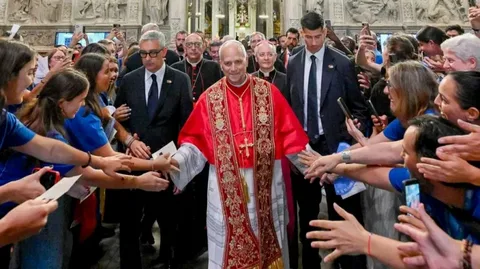
Pope Leo XIV travelled to the small Italian island of Lampedusa on Saturday, standing alongside Lampedusa migrants and residents to deliver a powerful appeal for compassion. He urged European leaders and the United States to do more to protect and integrate people fleeing war and poverty. The one-day pastoral visit placed fresh global attention on Lampedusa, a tiny outpost that has become one of the most symbolic frontiers of Europe’s migration story.
The pontiff’s trip fell on July 4, the same day the United States marked the 250th anniversary of its independence. As the first U.S.-born pope, Leo used the occasion to send a message home, saying that immigrants have shaped America’s character in every generation. His words carried added weight given his island setting, where thousands of migrants have arrived by sea in recent years.
Background: Why Lampedusa Matters
Lampedusa is a tiny island south of Sicily, closer to the coast of Tunisia than to mainland Italy. Because of this location, Lampedusa size may be small, but its role in the migration debate is enormous. The island sits along one of the world’s deadliest sea crossings, where people fleeing conflict and poverty in Africa attempt to reach Europe on overcrowded and often unsafe boats.
Anyone who studies a Lampedusa map will notice its position roughly 80 miles from the Tunisian coastline, far closer to Africa than to the Italian peninsula. This geography explains why the island has repeatedly become the first stop for so many arrivals over the past two decades.
The visit by Pope Leo XIV echoed a similar trip made by his predecessor, Pope Francis, who chose Lampedusa as the destination for his very first journey outside Rome back in 2013. Francis prayed for migrants who had died at sea and criticised what he called global indifference toward their suffering. Leo’s visit carried that same spirit forward, more than a decade later.
Details: What Happened During The Papal Visit
Pope Leo XIV landed on the island in the morning and began his day with a solemn stop at the local cemetery. There, he laid flowers on the graves of migrants who lost their lives while trying to reach Europe. Many of these graves are marked with simple crosses, some made from the wood of shipwrecked boats.
He then travelled to the “Porta d’Europa,” or Gateway to Europe, a memorial built to honour those who risk everything to reach the continent. The monument stands as a stark reminder of both hope and tragedy for the thousands of Lampedusa migrants who have passed through the island over the years.
From there, the pope stopped at Favaloro Pier, a site long associated with migrant landings. Officials formally renamed the pier in honour of Pope Francis during the ceremony. Leo greeted a migrant family at the pier before moving on to celebrate a public Mass at the island’s sports field, where an image of the local patroness, Our Lady of Portosalvo, was displayed.
In his homily, Pope Leo compared the dangerous route taken by migrants today to the road described in the biblical parable of the Good Samaritan. He said the world was facing an “enormity of suffering” that demanded a compassionate and concrete response, not indifference.
Quotes From Officials And Experts
During Mass, the pope stated that Europe was capable of handling the situation with both compassion and long-term planning. He called on leaders to combine “immediate relief efforts” with a broader strategy to receive, protect, support, and integrate arrivals.
Anna Leer, an official with the United Nations Refugee Agency, told reporters that the pope’s presence sent an important signal. She said his visit highlighted humanity at a time when much of the political debate around migration focuses on borders and deterrence rather than protection.
A local activist named Brhane, who leads the October 3rd Committee formed after a deadly 2013 shipwreck near Lampedusa, said he was moved by the moment. He expressed hope that the visit would push European governments to establish a formal registry to identify migrants who have died at sea, many of whom remain unnamed.
Lampedusa Population And People
Curiosity about Lampedusa population figures has grown alongside the island’s fame. According to recent estimates, the permanent Lampedusa population in 2021 stood at roughly 6,000 residents, a number that has stayed fairly stable in recent years. Given the island’s small land area, Lampedusa population density is naturally high for such a compact community, though it remains far smaller than mainland Italian cities.
The Lampedusa people themselves are mostly of Sicilian and Italian heritage, many working in fishing, tourism, and hospitality. Every year, however, their small community absorbs tens of thousands of new arrivals, creating a unique and often strained dynamic between permanent residents and transiting migrants.
Questions about Lampedusa population by race are common online, but official demographic data does not track residents by race in this way. Italian census records classify residents by nationality and citizenship rather than racial categories, and the vast majority of long-term Lampedusa residents identify as Italian nationals.
Lampedusa Language And Daily Life
The primary Lampedusa language spoken by residents is Italian, alongside the local Sicilian dialect common throughout the wider region. Migrants who pass through the island speak a wide range of languages, including Arabic, French, and various African languages, reflecting the diverse origins of those making the crossing.
Despite its small size, Lampedusa has developed a reputation far beyond migration alone. One of its southern beaches was once voted the world’s best beach by a major travel website, highlighting the island’s dual identity as both a frontier of crisis and a popular summer destination for tourists.
Scale Of The Migrant Crisis
Recent figures underline just how significant the flow of Lampedusa migrants has become. More than 49,500 refugees and migrants landed on the island’s coasts in 2025 alone, according to the United Nations Refugee Agency. This year, more than 14,000 migrants have already reached Italy by sea, with more than half of them landing specifically in Lampedusa.
The human cost remains severe. The International Organization for Migration has recorded more than 1,400 deaths or disappearances in the Mediterranean so far this year. These numbers explain why the island continues to attract global attention from journalists, humanitarian groups, and now, once again, the leader of the Catholic Church.
Impact: A Regional And Global Signal
The pope’s visit arrives at a politically sensitive moment. Governments across Europe and in the United States have increasingly emphasised stricter border controls, detention measures, and deportation policies rather than expanded humanitarian pathways. Pope Leo’s appeal directly challenges that trend, urging a shift toward protection and long-term integration instead.
His remarks are likely to resonate within Catholic communities worldwide and may add pressure on European Union leaders currently debating migration reform. The symbolism of a U.S.-born pope choosing to spend American Independence Day on a migrant frontier island was not lost on observers, many of whom noted the deliberate timing of the trip.
For the people of Lampedusa, the visit also brought a moment of recognition. Many residents have spent years assisting new arrivals, often without adequate government support, and the pope specifically thanked islanders for their continued solidarity during his address.
Conclusion: What Comes Next
Pope Leo XIV’s visit to Lampedusa is unlikely to change policy overnight, but it has reignited global conversation around how nations respond to migration. His call for a “comprehensive” approach that blends immediate relief with long-term integration strategies puts fresh moral pressure on policymakers ahead of upcoming European migration talks.
As boat crossings continue and the death toll in the Mediterranean rises, Lampedusa is expected to remain a focal point in this ongoing story. Humanitarian organisations say further advocacy, funding, and coordinated European action will be needed if conditions for migrants are to meaningfully improve in the months ahead.
Frequently Asked Questions
What language is spoken in Lampedusa?
The official and most widely spoken language on Lampedusa is Italian, since the island is part of the Sicily region of Italy. Many residents also use the local Sicilian dialect in everyday conversation, particularly among older generations and within fishing communities. Migrants who pass through the island often speak Arabic, French, or various African languages depending on their country of origin, though these languages are not spoken by the permanent population as a first language.
Can you stay in Lampedusa?
Yes, Lampedusa is open to tourists and functions as a popular summer holiday destination alongside its role as a migrant arrival point. Visitors can find hotels, guesthouses, and rental accommodation on the island, particularly during the peak summer season. However, migrants who arrive by boat are typically processed at a reception centre before being transferred to facilities on the Italian mainland, rather than remaining long-term on the island itself.
How many people live in Lampedusa?
The permanent Lampedusa population is estimated at around 6,000 residents, based on recent population figures. This number reflects the island’s small size and limited infrastructure, which is part of why the arrival of tens of thousands of migrants each year places such visible strain on local resources. Despite the small resident population, Lampedusa remains one of the busiest migration entry points in the entire Mediterranean region.