
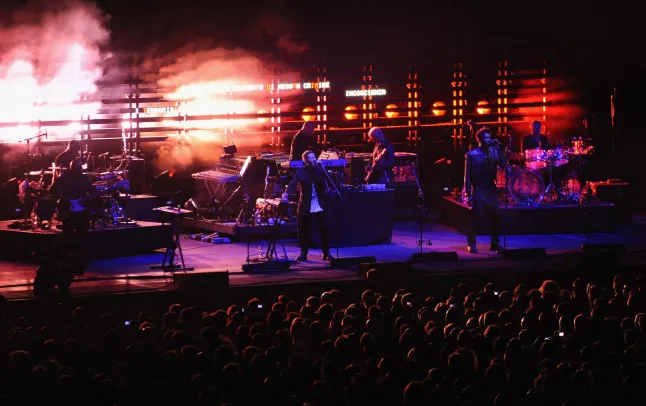
British trip-hop legends Massive Attack have been permanently banned from performing in Singapore after two band members raised a Palestinian flag on stage during a concert on July 29, 2026. The entire band was detained, questioned by police, and some members had their passports temporarily confiscated.
What Happened at the Star Theatre
Massive Attack performed at the Star Performing Arts Centre in Singapore on the night of July 29, 2026. It was their only scheduled stop in the country on their current tour. The concert was going smoothly until near the end, when two band members Robert Del Naja, known as 3D, and Grant Marshall, known as Daddy G held a Palestinian flag above their heads on stage.
The crowd responded immediately. Large sections of the audience broke into loud, sustained chants of “Free Palestine” both before the band stepped on stage and again after the performance ended. Singapore authorities later confirmed that at least one band member also shouted “Free Palestine” aloud during the show.
Videos recorded by audience members circulated widely on social media in the hours that followed, showing the flag being raised to visible applause and cheering from the crowd. Those videos triggered a swift response from Singaporean authorities.
Entire Band Detained and Questioned After the Show
Following the concert, Singapore police detained every member of the Massive Attack touring party. In a statement posted to their official Instagram account on August 2, the band described what happened after they left the stage.
<cite index=”30″>”Following our performance at the Star Theatre, Singapore on 29th July, we were surprised and disappointed that our entire band was detained by the police, isolated and separately questioned with some members subjected to hotel room searches and temporary passport confiscation,” the band wrote.</cite>
The band said the audience-led chanting appeared entirely organic, with fans seemingly aware that chanting “Free Palestine” in Singapore could technically breach the country’s censorship laws and choosing to do it anyway. Massive Attack said they themselves did not believe that raising the flag of a internationally recognized sovereign state would be treated as a legal violation.
<cite index=”29″>”We did not imagine that merely holding up the flag of a sovereign state recognised by 157 countries would violate any law,” the band said in their statement.</cite>
Singapore’s Law on Foreign Flags
Singapore has long maintained strict rules around public political expression, and its position on foreign flags is unambiguous. <cite index=”33″>Singapore bans the open display of all foreign flags, national emblems, or banners without a permit, with penalties including fines of up to $390 or six months in prison.</cite>
The Infocomm Media Development Authority, known as the IMDA, oversees entertainment licensing in Singapore. <cite index=”39″>According to the IMDA and Singapore police, band members were issued stern warnings for offences under the Foreign National Emblems (Control of Display) Act and the Public Order Act, specifically for “their actions of support for a political cause and unfurling of a foreign flag.
The concert promoter had acknowledged the licensing conditions before the event took place. <cite index=”40″>Police stated that license conditions included a specific rule that “there shall be no display of flags in support of any causes,” and that the police “take a serious view of acts which could potentially harm the racial and religious harmony in Singapore.”</cite>
The IMDA confirmed it was also investigating whether the event organizer had breached its own license conditions by failing to prevent the display from occurring.
Two Members Permanently Banned from Re-Entering Singapore
The consequences for Massive Attack did not stop at a warning. <cite index=”28″>On Saturday, authorities confirmed that band members Robert Del Naja and Grant Marshall were “banned from re-entering Singapore” and that any future applications for them to perform there would not be approved.</cite>
The IMDA went further, confirming that the ban extends to the entire band. <cite index=”39″>The IMDA added that it would not approve future applications for the band to perform in the country.</cite> This effectively means Massive Attack as a group is now permanently locked out of Singapore as a performance destination, regardless of lineup or circumstances.
It is a significant consequence. Singapore has in recent years positioned itself as one of Asia’s premier live music destinations, hosting major international acts including Taylor Swift, Coldplay, Ed Sheeran, and Bruno Mars. A ban of this nature closes that market entirely for the band and their touring operation.
A Band With a Long History of Palestinian Activism
Massive Attack’s stance on Palestine is not new or surprising. The Bristol-based group has been among the most openly vocal acts in the global music industry on this issue for years.
<cite index=”31″>The band has frequently spoken out about Israel’s military campaign in Gaza, describing Israel’s actions as a “genocide” and using their performances and public platform to support the Palestinian cause.</cite> They have boycotted performing in Israel for over 20 years.
<cite index=”37″>In 2025, Massive Attack helped establish an alliance of musicians and artists who publicly criticized Israel’s military campaign in Gaza, saying artists who spoke out had faced pressure within the music industry.</cite> The alliance was specifically set up to push back against what the band called attempted censorship of pro-Palestinian voices within the entertainment world.
Earlier in 2026, frontman Robert Del Naja was among those arrested during a demonstration at London’s Trafalgar Square in April, which was held in support of Palestine Action. His arrest in London came just months before the Singapore incident, making the Star Theatre moment part of a clear and consistent pattern of activism rather than a one-off gesture.
The Massive Attack Singapore Palestine incident has therefore drawn attention not just for the legal dimension, but for what it reveals about how far the band is willing to push their beliefs — even when performing in countries with tight restrictions on political expression.
Singapore’s Stance on Palestine and Political Neutrality
It is worth noting that Singapore’s legal response to the Massive Attack concert does not necessarily reflect hostility toward Palestine as a cause. <cite index=”28″>While Singapore’s national stance on the Israel-Palestine conflict is belief in a “two-state solution” and allowing Palestine to join the United Nations, the country has still clamped down</cite> on any public displays that could be seen as importing foreign political tensions into Singaporean public life.
Singapore’s approach to political expression is rooted in its broader governance philosophy, which prioritizes social cohesion, racial and religious harmony, and strict neutrality on divisive international conflicts. The law does not distinguish between Palestinian flags and any other foreign national symbol all are treated the same without a permit.
<cite index=”40″>Singapore authorities urged the public, “including foreigners, to refrain from importing foreign politics as this can undermine our social cohesion and the rule of law.”</cite> The statement was directed at a broad audience, not just at Massive Attack specifically.
Also Required to Remove a Song from Their Set
The Singapore concert had already revealed tensions before the flag moment. <cite index=”31″>Massive Attack told the audience that they had been required to remove a song from the set list because of “local laws,” according to news channel CNA. The band did not identify the song or provide further details, and authorities have not confirmed whether the change was connected to the investigation.</cite>
This detail suggests that the Massive Attack Singapore Palestine situation had already begun before anyone set foot on stage. The band had clearly been placed under conditions before performing, and the flag display that evening represented a deliberate decision to go further than those conditions allowed.
Global Reaction and Industry Impact
The Massive Attack Singapore Palestine story has generated significant coverage across global media outlets. Reactions have split broadly along predictable lines some voices defending Singapore’s right to enforce its own laws consistently, others arguing that the response was disproportionate and raised serious questions about artistic freedom.
<cite index=”37″>Singapore’s handling of the Massive Attack situation indicates that the country will diligently comply with its performance licensing laws, even for overseas artists with a big name.</cite> For international touring acts, the message is clear: Singapore enforces its rules without exception, and the size of the artist’s reputation provides no protection.
Human rights organizations and music industry commentators have raised concerns about what the episode signals for touring artists who use their global platforms to speak on political causes. The Massive Attack ban has been cited in several discussions about the growing tension between artistic freedom and government-imposed conditions on live performance licensing in Southeast Asia.
What Happens Next
Massive Attack has not publicly stated any plans to challenge the Singapore ban through legal channels. Their statement on August 2 was measured in tone, presenting their perspective without inflammatory language, while making clear they believed their actions were lawful.
The IMDA has confirmed it is continuing its investigation into possible licensing breaches by the concert promoter, meaning the legal and regulatory fallout from the Massive Attack Singapore Palestine incident may not yet be fully resolved. Further actions against the promoter could follow once that review is complete.
For now, the band remains banned. Whether that ban becomes a rallying point for a broader debate about political expression and international touring is a question that the global music industry will be watching closely.
FAQs
Who is Massive Attack?
Massive Attack is a British musical group from Bristol, England, widely credited as one of the founding acts of trip-hop a genre that blends hip-hop beats with atmospheric, soulful production and cinematic arrangements. The group was formed in the late 1980s and rose to international fame with their debut album Blue Lines in 1991. Their catalogue includes some of the most recognizable songs in British music history, including Teardrop which became globally known as the theme music for the television drama House MD as well as Protection, Angel, Unfinished Sympathy, and Safe from Harm. The band’s core members are Robert Del Naja, also known as 3D, and Grant Marshall, known as Daddy G. Massive Attack are known not only for their music but also for their outspoken political positions, particularly their long-standing support for Palestinian rights, their criticism of surveillance culture, and their advocacy on climate issues.
What are some major events that happened in Singapore in 2026?
Singapore has seen a number of significant developments in 2026. The country established its National Space Agency, reflecting its growing ambitions in the technology and innovation sector. Prime Minister Lawrence Wong signed a landmark fuel-for-food agreement with New Zealand to protect supply chains amid broader regional disruptions. Singapore also introduced substantially tougher penalties for vape users and those involved in distributing electronic cigarettes containing etomidate, raising maximum fines to S$10,000 and introducing mandatory caning for certain offenses. On the international stage, Singapore remained one of Southeast Asia’s most active hubs for major live entertainment, continuing to attract headline global touring acts.
What is the security situation in Singapore?
Singapore is consistently ranked as one of the safest countries in the world by every major international security index. It has extremely low rates of violent crime, theft, and organized criminal activity relative to its size and population. The country maintains a tightly governed public order framework backed by strict laws that are enforced consistently and transparently. Singapore prohibits unauthorized public assemblies, regulates political expression in public spaces, and enforces restrictions on the display of foreign flags and symbols without permits. These laws apply equally to citizens and foreign visitors, including international performers. Singapore’s Infocomm Media Development Authority regulates entertainment licensing and maintains conditions on all public performances. The security environment is stable and law enforcement is considered efficient and professional.