
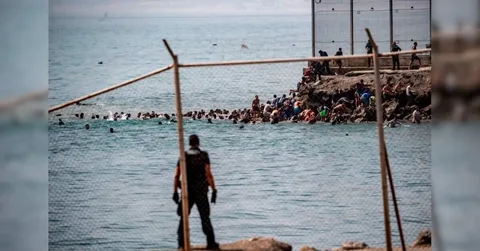
A wave of viral social media videos triggered one of the most dramatic border incidents in recent Spanish history, as tens of thousands of young Moroccans attempted to swim across the narrow strip of water separating Morocco from Spain’s North African enclave of Ceuta in late July 2026. More than 80 people drowned or were crushed in the resulting chaos.
Background
Ceuta, a small Spanish city on Morocco’s northern coast, has long been a magnet for migrants hoping to reach Europe, given its status as Spanish, and therefore European Union, territory sitting directly on the African continent. The Morocco-Spain border at Ceuta has historically seen periodic surges in crossing attempts, both over the land border fence and by sea.
This year’s 2026 Morocco-Spain border incident traces back to a Spanish Supreme Court ruling published roughly three weeks before the crisis, which found that migrants intercepted at sea could not be immediately pushed back at the border of Ceuta and Melilla. Legal experts later clarified that the ruling did not prevent authorities from returning migrants afterward, but that nuance was lost as misinformation spread rapidly across Morocco.
By July 23, only around 100 people had reached Ceuta, according to local outlet El Faro de Ceuta, which linked the early arrivals directly to the court ruling. Spanish and Moroccan officials later said human trafficking networks helped spread and exploit the confusion online.
Details
The situation escalated dramatically after a local news report showed young men celebrating with thumbs-up gestures after reaching Ceuta, footage that Reuters reported had the unintended effect of encouraging even more people to attempt the crossing. A second report on July 28, with a caption suggesting Ceuta could not cope with the influx, showed two young women walking through the city’s streets after making the swim, further fueling the rush.
Within days, influencers with tens of thousands of followers began posting their own videos of the crossing, some wearing wetsuits or using swim rings for the swim across the water separating Morocco from Spain. One video viewed millions of times falsely claimed to show a young man swimming toward Ceuta, when it had actually been filmed on Morocco’s Atlantic coast.
What began as a trickle of a few dozen young people turned into tens of thousands attempting the crossing by mass swim, according to Reuters reporting. More than 80 people ultimately drowned or died in stampedes during the chaotic rush, according to official tallies, while thousands more were intercepted and returned to Morocco.
For context on the Morocco-Spain border map, Ceuta sits on a peninsula jutting from Morocco’s northern coast, separated from the Moroccan mainland by a heavily fortified border fence rather than open water in most places, though migrants have periodically tried maritime routes around the enclave’s coastline as well.
The broader geography behind this incident often surprises people unfamiliar with the region. The distance between Morocco and Spain by sea is remarkably short at the Strait of Gibraltar, narrowing to just roughly 14 kilometers between Point Marroqui in Spain and Point Cires in Morocco, one of the narrowest points separating two continents anywhere in the world. On a clear day, the Moroccan coastline is visible from southern Spain.
For travelers rather than migrants, the Morocco to Spain distance by flight is typically short as well, with routes from cities like Casablanca to Madrid covering roughly 561 kilometers and taking under two hours in the air. Ferry crossings, by contrast, remain the most common legal route, with the popular Tarifa-to-Tangier connection covering the Morocco to Spain border distance by sea in under an hour.
By road, reaching Spain from Morocco requires a much longer journey, since there is no land bridge across the strait itself. Travelers driving from Morocco to Spain border crossing points must first reach a port city like Tangier and then complete the final stretch by ferry, since no bridge or tunnel currently connects the two countries despite decades of periodic discussion about a fixed link beneath the strait.
Quotes
Mounim Belhaj, a Moroccan dog groomer with 31,000 Instagram followers who joined the rush to Ceuta, told Reuters that Spanish media coverage showing good treatment of arriving migrants had encouraged many young Moroccans to attempt the journey themselves.
One migrant told Reuters that people should never believe claims that reaching Ceuta guarantees they won’t be sent back, reflecting growing awareness among some crossing attempters that the viral misinformation driving the rush had been misleading.
Spanish and Moroccan officials, in comments reported by Reuters, said trafficking networks had deliberately amplified confusion around the Supreme Court ruling to encourage more crossing attempts, exploiting both the legal ambiguity and the emotional power of viral social media content.
Impact
The incident has reignited debate over migration policy between Morocco and Spain, two countries that share both a maritime and land border and have a long, complicated history of cooperation and tension over border enforcement. Spanish authorities are now reviewing how court rulings and local news coverage can be misinterpreted at scale on social media, with potentially life-threatening consequences.
For Morocco, the crisis has renewed pressure on authorities to address the online instigators who encouraged the crossing, echoing a similar 2024 episode in which Moroccan prosecutors charged scores of people for organizing a foiled mass crossing attempt through social media.
The tragedy has also drawn fresh international attention to the risks migrants face attempting unauthorized crossings. Humanitarian organizations continue to warn that the short physical distance between Morocco and Spain can be deceptive, given strong currents, heavy shipping traffic, and cold water temperatures in the strait.
Conclusion
As Spanish and Moroccan authorities review their response to the crisis, questions remain about how to stop viral misinformation from triggering future mass crossing attempts. Migration pressure across the wider Mediterranean and Atlantic routes shows no sign of easing, and officials on both sides of the Morocco-Spain border say continued cooperation, along with clearer public communication about court rulings and asylum procedures, will be essential to avoiding a repeat of this summer’s tragedy.
Frequently Asked Questions
Can I cross from Morocco to Spain by land?
There is no direct land route connecting mainland Morocco to mainland Spain, since the two countries are separated by the Strait of Gibraltar. However, Morocco does share physical land borders with Spain’s North African territories of Ceuta and Melilla, both of which have official border crossings for authorized travelers with the correct documentation. For travelers moving between mainland Morocco and mainland Spain, the standard route involves reaching a Moroccan port city like Tangier and then taking a ferry across the strait, since no bridge or tunnel currently exists between the two countries.
Is there a border between Spain and Morocco?
Yes, Spain and Morocco share two land borders, both located around Spain’s North African enclaves of Ceuta and Melilla, which sit directly on Moroccan territory but remain under full Spanish and European Union sovereignty. These borders are among the only land frontiers between Africa and the European Union anywhere in the world, making them a persistent focal point for migration. Beyond these land borders, Spain and Morocco also share a maritime border across the Strait of Gibraltar and parts of the Alboran Sea.
Which city in Spain is closest to Morocco?
Tarifa, located in the Andalusia region of southern Spain, is the closest Spanish mainland city to Morocco and holds the distinction of being the southernmost point of continental Europe. From Tarifa, the Moroccan coastline is often clearly visible across the Strait of Gibraltar on clear days, and the city serves as a major ferry hub connecting to Tangier in Morocco, with crossings typically taking under an hour. Beyond mainland Spain, the city of Ceuta itself is technically the closest Spanish territory to Morocco, since it sits directly on the Moroccan coastline rather than across the strait.