
Latin America isn’t a country, even though people talk about it that way all the time. It’s a region of 33 independent countries running from northern Mexico to the southern tip of South America, plus most of the Caribbean. What ties them together isn’t a government or a border. It’s language and a shared colonial past.
That shared background shows up everywhere, from the dominance of Spanish and Portuguese to colonial cities built on top of Indigenous ruins. It also keeps the region relevant to conversations about trade, energy, and climate that have nothing to do with geography. Knowing which countries fall under the label, and why, makes a lot of international news easier to follow.
Background
Most of Latin America speaks a language descended from Latin: Spanish and Portuguese mainly, French in Haiti and a handful of smaller territories. That’s really the entire basis for the name. Not geography, not a shared government, just a common linguistic ancestor.
Before European colonization in the 1400s and 1500s, the region was home to the Maya, Aztec, and Inca, among other advanced civilizations. Centuries of Indigenous, European, African, and in some places Asian influence later, the result is one of the most layered cultural identities anywhere.
The countries cooperate through regional blocs and trade agreements, but each one runs its own government and answers to no one else.
What Is Latin America?
Latin America refers to the countries across North America, Central America, South America, and the Caribbean where Spanish, Portuguese, or French is the dominant language.
It isn’t a country. It’s a name for a region: dozens of sovereign nations, each with its own government and history, grouped together because of a shared linguistic family tree.
Is Latin America a Country?
No.
It’s a common mix-up, but Latin America is a name for a group of countries, not a nation. Brazil, Mexico, Argentina, Chile, Colombia, and Peru each have their own government, constitution, flag, currency, capital, and foreign policy. They’re as separate from one another as France is from Germany.
Is Latin America a Continent?
No.
It’s a region that spans parts of two continents, North America and South America, plus the islands of the Caribbean. The continents on a map stay the same. Latin America is a cultural and historical label sitting on top of that map, grouping countries by language rather than landmass.
Why Is It Called Latin America?
It comes down to language. Spanish, Portuguese, and French all descend from Latin, and in the 19th century the term started catching on as a way to separate these countries from English-speaking North America.
It’s stuck around since then. These days it’s shorthand for shared linguistic and historical roots, not a claim about political unity.
What Countries Are in Latin America?
Thirty-three sovereign countries make up Latin America, spread across four sub-regions.
North America
- Mexico
Central America
- Belize
- Guatemala
- El Salvador
- Honduras
- Nicaragua
- Costa Rica
- Panama
Caribbean
- Cuba
- Dominican Republic
- Haiti
- Antigua and Barbuda
- Bahamas
- Barbados
- Dominica
- Grenada
- Jamaica
- Saint Kitts and Nevis
- Saint Lucia
- Saint Vincent and the Grenadines
- Trinidad and Tobago
South America
- Argentina
- Bolivia
- Brazil
- Chile
- Colombia
- Ecuador
- Guyana
- Paraguay
- Peru
- Suriname
- Uruguay
- Venezuela
All told, that’s more than 650 million people across dramatically different economies, climates, and political systems. There’s no single “Latin American” experience.
What Are the 33 Countries in Latin America?
Here’s the full list in one place: Mexico, Belize, Guatemala, El Salvador, Honduras, Nicaragua, Costa Rica, Panama, Cuba, Dominican Republic, Haiti, Antigua and Barbuda, Bahamas, Barbados, Dominica, Grenada, Jamaica, Saint Kitts and Nevis, Saint Lucia, Saint Vincent and the Grenadines, Trinidad and Tobago, Argentina, Bolivia, Brazil, Chile, Colombia, Ecuador, Guyana, Paraguay, Peru, Suriname, Uruguay, and Venezuela.
Population, wealth, climate, and politics vary so much across this list that “Latin American” mostly describes shared history rather than shared circumstances.
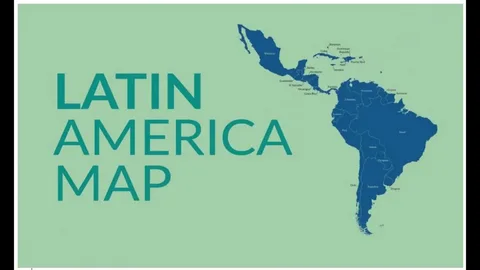
Latin America Political Map
A political map of the region shows international borders, capital cities, and the lines separating Central American nations, Caribbean island states, and South American republics. Governments, schools, and researchers rely on these maps for the same reason: they’re the clearest way to see where one country’s authority ends and another’s begins.
Latin America Map
Physically, the region is enormous and varied. Major features include:
- Amazon Rainforest
- Andes Mountains
- Patagonia
- Atacama Desert
- Caribbean Sea
- Pacific Ocean
- Atlantic Ocean
- Orinoco Basin
- Amazon River
- Paraná River
Rainforest, desert, glacier, and island all show up somewhere in Latin America. There’s no single landscape that defines it.
Politics Across Latin America
Most of the region has moved from military rule to elected government over the past several decades, though the shift hasn’t been even or finished everywhere. Elections happen regularly, but the arguments dominating them are familiar: inflation, corruption, crime, inequality, and what to do about migration.
Some countries, Uruguay and Costa Rica among them, have built relatively durable institutions over time. Others are still working through it, with democratic gains sometimes running into organized crime or economic shocks.
Economic Importance
Latin America exports a lot of what the rest of the world runs on: coffee, copper, lithium, soybeans, beef, oil, natural gas, gold, silver, and iron ore.
Brazil and Mexico are among the largest economies outside the wealthy world, and Chile and Peru are mining heavyweights, producing a large share of the world’s copper between them. Renewable energy, tech, tourism, and manufacturing are growing parts of the picture too, though the pace of that growth varies a lot from country to country.
Cultural Diversity
Spanish and Portuguese dominate, but hundreds of Indigenous languages are still spoken across the region, from Quechua in the Andes to Guaraní in Paraguay. Add colonial-era architecture, distinct regional cuisines, a deep football culture, and a long list of festivals and literary traditions, and it’s not hard to see why tourism keeps climbing.
There isn’t one Latin American culture. There are dozens, layered differently in every country.
Environmental Significance
The Amazon Rainforest, the Pantanal wetlands, the Galápagos Islands, and the high-altitude Andes ecosystems all sit within Latin America’s borders, and all of them matter well beyond it. The Amazon alone holds a meaningful share of the planet’s remaining tropical forest and fresh water.
Balancing that with mining, agriculture, and energy development is an ongoing argument in most of these countries, not a settled question.
Global Impact
Latin America’s weight in world affairs has grown alongside its resource base. Chile and Argentina sit on lithium deposits that battery manufacturers need. Brazil and Argentina are agricultural exporters whose harvests move global food prices. Climate negotiators pay close attention to what happens in the Amazon.
None of that adds up to political unity. Mexico’s foreign policy priorities and Argentina’s don’t always line up. But it does mean the region keeps coming up in trade, energy, and climate conversations that used to focus elsewhere.
Conclusion
Latin America isn’t a country, a continent, or a political bloc. It’s 33 countries that share language and history but run their own affairs. Worth remembering next time the term shows up in a headline: whatever’s happening is happening in one specific country, even when the story says “Latin America.”
Frequently Asked Questions (FAQs)
What is the most politically stable country in Latin America?
Uruguay, Costa Rica, and Chile usually top the list. All three have held peaceful elections for decades and built institutions that survive a change in government without falling apart. That doesn’t mean problem-free: each still deals with its own political fights and economic pressure.
Who is Mexico’s biggest ally?
The United States, by a wide margin. Trade, manufacturing, border security, migration, and energy all run through the US-Mexico relationship in ways nothing else comes close to. Canada matters too, mostly through the shared USMCA trade agreement.
Why is Latin America so liberal?
It isn’t, really, not as a whole region. Some countries have elected left-leaning governments in recent years; others have gone the opposite direction, and a few have swung between the two within a single decade. What actually drives elections tends to be inflation, corruption, and crime more than any consistent ideological lean.
What countries are in Latin America?
Thirty-three of them, spread across North America, Central America, South America, and the Caribbean. Spanish and Portuguese dominate; Haiti speaks French and Haitian Creole. Beyond language, the countries don’t have a lot in common economically or politically.
Why is it called Latin America?
Because Spanish, Portuguese, and French all descend from Latin. The term caught on in the 19th century specifically to separate these countries from English-speaking North America, and it’s stuck as shorthand ever since.