
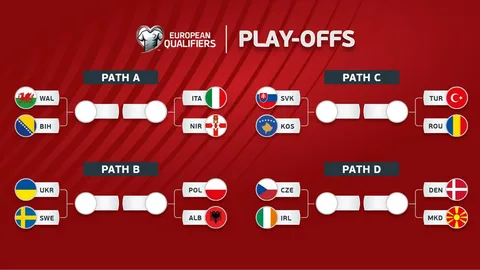
UEFA World Cup 2026 playoffs are the final gateway through which European nations that did not automatically qualify through their qualifying group campaigns will compete for the remaining UEFA berths at the 2026 FIFA World Cup in the United States Canada and Mexico — with the expanded 48-team tournament format giving UEFA a significantly increased allocation of 16 guaranteed places plus the potential for a 17th through the inter-confederation playoff.
UEFA World Cup 2026 playoffs involve nations that finished in playoff qualifying positions in their qualifying groups — with the specific teams format and seeding for the UEFA World Cup 2026 playoffs having been determined by UEFA’s qualifying campaign structure that ran through 2024 and 2025. The UEFA World Cup 2026 playoffs groups draw has assigned the playoff nations into specific paths — with each path producing 1 World Cup qualifier through a sequence of single-leg or two-leg knockout ties.
World cup qualifiers playoffs 2026 European dimension is among the most competitive in World Cup qualifying history — with the depth of European football meaning that nations of genuine World Cup calibre including some with significant tournament pedigrees are competing in the UEFA World Cup 2026 playoffs for the final available European berths at a tournament whose expanded format has paradoxically made competition for qualifying places more rather than less intense given how many strong European nations exist.
Background: How UEFA Qualifies for World Cup 2026
UEFA’s World Cup 2026 Allocation
UEFA World Cup 2026 playoffs context begins with understanding how UEFA’s expanded allocation of 16 guaranteed World Cup places — up from 13 at the 2022 Qatar World Cup — has been distributed across the qualifying structure.
UEFA World Cup 2026 qualification allocated 16 direct qualifying places to Europe — with 12 group winners qualifying automatically and 4 additional places going through the UEFA World Cup 2026 playoffs structure. This represents a significant increase from previous World Cup cycles and reflects FIFA’s decision to expand the tournament from 32 to 48 teams to increase global football participation.
UEFA World Cup 2026 qualifying structure divided the 54 UEFA member associations into 12 qualifying groups — with groups of varying sizes ranging from 4 to 6 teams. Group winners secured automatic qualification while the runners-up and select third-placed finishers entered the UEFA World Cup 2026 playoffs to compete for the remaining 4 European places.
UEFA World Cup 2026 playoffs therefore represent the final competitive filter through which European football’s second-tier qualifying nations compete for the last remaining spots — bringing together nations whose qualifying campaigns fell just short of the automatic qualification threshold but who demonstrated sufficient quality to remain genuine contenders for World Cup participation.
The Expanded World Cup Format Impact
World cup qualifiers playoffs 2026 exist within the context of the most significant expansion of World Cup football since the tournament grew from 24 to 32 teams in 1998 — with the 48-team format creating additional participation opportunities across all confederations including UEFA.
World cup qualifiers playoffs 2026 European significance is amplified by the quality depth of European football — with UEFA’s expanded allocation meaning that European football can send 16 nations to the World Cup but with the playoff structure ensuring that every one of those berths is competed for rather than distributed through automatic seeding arrangements.
UEFA World Cup 2026 Playoffs — Which Nations Are Involved
Nations in UEFA World Cup 2026 Playoffs
UEFA World Cup 2026 playoffs nations include the qualifying group runners-up and select third-placed finishers whose campaign performances earned them playoff participation — representing a cross-section of European football from established powerhouses who underperformed in their qualifying groups to emerging nations whose development has brought them to the threshold of World Cup qualification.
UEFA World Cup 2026 playoffs typically involve 12 nations competing in 3 separate playoff paths — with each path consisting of 2 semi-finals and 1 final that together produce 1 World Cup qualifier from each path for a total of 3 additional European World Cup places from the playoffs. A fourth place may be decided through the inter-confederation playoff that gives one UEFA nation the opportunity to compete against qualifying nations from other confederations for an additional berth.
UEFA World Cup 2026 playoffs specific nations involved depend on the final qualifying campaign standings — with the runners-up from each of the 12 qualifying groups forming the primary pool of playoff participants. Nations seeded for the UEFA World Cup 2026 playoffs paths are determined by their UEFA Nations League performance — with Nations League results providing the seeding mechanism that ensures higher-ranked nations receive the more favourable playoff path assignments.
UEFA World Cup 2026 playoffs nations in the upper seeding tier — those receiving the most favourable path assignments based on Nations League performance — typically include nations from UEFA Nations League A whose qualifying campaigns fell short of automatic qualification despite their overall ranking strength. Nations seeded in the lower tier of UEFA World Cup 2026 playoffs are those whose Nations League performance places them in the B and C tiers regardless of their qualifying group finishing position.
UEFA World Cup 2026 Playoffs Groups
UEFA World Cup 2026 Playoffs Groups — Path Structure
UEFA World Cup 2026 playoffs groups are structured as 3 separate paths — Path A Path B and Path C — each containing 4 nations competing in 2 semi-finals and 1 final. Each UEFA World Cup 2026 playoffs group path produces exactly 1 World Cup qualifier — meaning that 3 of the 4 nations in each path end their World Cup journey in the playoffs.
UEFA World Cup 2026 playoffs groups Path A typically contains the highest-seeded playoff nations — those whose Nations League performance places them in the most prestigious tier. UEFA World Cup 2026 playoffs groups Path A semi-finals are played as single-leg ties at the higher-seeded nation’s home ground — giving home advantage to the better-ranked team in each tie and providing a meaningful reward for Nations League performance.
UEFA World Cup 2026 playoffs groups Path B and Path C follow the same structural format — with seeded nations receiving home advantage in semi-final ties and the path final being played at the venue of whichever nation has the higher seeding between the 2 semi-final winners.
UEFA World Cup 2026 playoffs groups draw conducted by UEFA determines which specific nations are placed in which path and which semi-final pairings are created — with the draw procedure using the Nations League seeding bands to ensure that the highest-ranked nations in each path are on opposite sides of the semi-final draw and cannot meet until the path final.
UEFA World Cup 2026 Playoffs Format
UEFA World Cup 2026 Playoffs Format — How It Works
UEFA World Cup 2026 playoffs format uses single-leg knockout ties throughout — with no away goals rule and extra time and penalties used to decide ties that are level at the end of 90 minutes. This UEFA World Cup 2026 playoffs format provides decisive outcomes from each fixture without requiring return legs that would extend the playoff window beyond the available international calendar space.
UEFA World Cup 2026 playoffs format semi-finals are played at the home ground of the higher-seeded nation — providing home advantage as the reward for better Nations League performance and creating home atmosphere that meaningfully advantages the seeded team while giving the lower-seeded team the challenge of qualifying on the road.
UEFA World Cup 2026 playoffs format finals are played at the home ground of the higher-seeded nation remaining in each path — meaning that the path seedings influence not just the semi-final pairings but also the potential final venue depending on which teams advance from the semi-finals.
UEFA World Cup 2026 playoffs format extra time provisions apply when ties are level after 90 minutes — with 2 additional 15-minute periods played before a penalty shootout if the tie remains level after extra time. The UEFA World Cup 2026 playoffs format therefore guarantees a decisive result from each fixture without the scheduled return leg that two-legged tie formats require.
World Cup Qualifiers Playoffs 2026 — Seeding Explained
World cup qualifiers playoffs 2026 seeding uses UEFA Nations League performance as the primary ranking criterion — with nations ranked according to their Nations League tier division and finishing position within their division to create the seeding bands that determine path assignments and home advantage allocations.
World cup qualifiers playoffs 2026 seeding advantage is meaningful in practical terms — with home advantage in both the semi-final and potentially the final giving the higher-seeded nation a significant statistical edge given that international football results are heavily influenced by home venue factors including crowd support travel fatigue and pitch familiarity.
World cup qualifiers playoffs 2026 seeding system has been designed to give Nations League participation a tangible competitive reward — incentivising nations to take Nations League fixtures seriously rather than treating them as secondary competitions. Nations that performed well in the Nations League — winning their groups or finishing in promotion positions — receive better seedings in the world cup qualifiers playoffs 2026 than nations of similar qualifying group ranking but lower Nations League performance.
World Cup Qualifiers Playoffs 2026 — Dates and Schedule
When Are the UEFA World Cup 2026 Playoffs
World cup qualifiers playoffs 2026 UEFA playoff window falls within the FIFA international calendar’s designated playoff dates — with the semi-finals and finals of the UEFA World Cup 2026 playoffs scheduled across 2 international windows in the 2025 to 2026 period that follows the conclusion of the qualifying group stage.
World cup qualifiers playoffs 2026 semi-finals are scheduled for the March 2026 international window — with the 6 semi-final ties across the 3 playoff paths being played over a concentrated 4-day period to maximise broadcast scheduling and minimise the disruption to club football that extended international windows create.
World cup qualifiers playoffs 2026 finals are scheduled for the same March 2026 international window — with the 3 path finals being played in the days following the semi-finals to keep the entire UEFA World Cup 2026 playoffs within the single international calendar window and to announce all 3 European playoff qualifiers simultaneously before the World Cup squad preparation cycle begins.
World cup qualifiers playoffs 2026 timing relative to the World Cup itself gives the qualifying nations approximately 3 months between securing their places through the UEFA World Cup 2026 playoffs and the tournament’s opening in June 2026 — enough time for squad preparation but limited enough that playoff qualification followed by the immediate demands of World Cup preparation creates its own unique pressure.
Key Matches and Nations to Watch
High-Profile UEFA World Cup 2026 Playoffs Ties
UEFA World Cup 2026 playoffs high-profile potential ties include several matches between nations with significant World Cup pedigrees — with the playoff format’s single-leg knockout structure creating the possibility of established nations being eliminated in a single match that does not allow for the correction of below-par performances that two-legged formats permit.
UEFA World Cup 2026 playoffs nations of particular interest include those whose absence from the World Cup would represent a significant footballing story — either because of their historical World Cup participation records or because their recent form suggests they are capable of performing well at the tournament itself.
UEFA World Cup 2026 playoffs best fight potential ties combine nations with historical rivalry dimensions competitive quality differentials that make outcomes genuinely unpredictable and the specific pressure of single-leg knockout football that eliminates the margin for error that two-legged formats provide.
UEFA World Cup 2026 playoffs best penalties potential exists across multiple ties — with the single-leg format and the availability of extra time and penalties creating the conditions for the high-pressure shootout drama that is simultaneously the most stressful and most compelling form of international football conclusion.
Quotes on UEFA World Cup 2026 Playoffs
UEFA President Aleksander Ceferin stated that the UEFA World Cup 2026 playoffs represented European football’s ultimate qualifying test — adding that the playoff format rewarded Nations League performance while ensuring that every European World Cup place was competed for in meaningful knockout football that the global audience deserved.
FIFA President Gianni Infantino described the expanded World Cup format and the UEFA World Cup 2026 playoffs as part of football’s commitment to making the World Cup more representative of global football’s full diversity — while preserving the competitive qualification pathways that ensure the tournament’s quality.
A veteran football analyst from Opta stated that the UEFA World Cup 2026 playoffs format created some of the most statistically unpredictable outcomes in international football — with single-leg knockout ties at this level producing upset results at significantly higher rates than two-legged aggregate ties because a single bad performance or piece of misfortune cannot be compensated for by a return fixture.
UEFA Nations League winner’s manager — speaking ahead of his nation’s potential playoff involvement — stated that his preparation for the UEFA World Cup 2026 playoffs focused as much on the psychological demands of single-leg knockout football as on the tactical preparation for specific opponents — adding that the margin for error in a playoff semi-final or final was essentially zero and that mental clarity under pressure was the defining factor at this level.
Impact: What UEFA World Cup 2026 Playoffs Mean
For European Football
UEFA World Cup 2026 playoffs significance for European football extends beyond the individual nations competing — with the playoff results shaping the European contingent at the World Cup and determining which national team stories the tournament’s most closely followed group of footballing nations will tell in the summer of 2026.
UEFA World Cup 2026 playoffs elimination of established nations — should it occur as it has in previous playoff cycles — would create the kind of major-nation World Cup absence narrative that resonates through the tournament itself. The potential for significant footballing nations to miss the World Cup through the playoff format is one of European football’s most compelling recurring storylines.
For Host Nations United States Canada Mexico
World cup qualifiers playoffs 2026 European outcomes have commercial significance for the host nations — with the participation of high-profile European nations including their fanbases and commercial partners driving the tournament’s broadcast rights values merchandise sales and the broader economic activity that World Cup hosting generates.
World cup qualifiers playoffs 2026 producing the expected strong European contingent at the expanded 48-team tournament is therefore not merely a football story but a commercial one — with the identity of the European nations at the World Cup affecting the tournament’s global audience profile in ways that FIFA’s broadcast and sponsorship partners monitor closely.
Frequently Asked Questions
How Do the World Cup 2026 Play-Offs Work?
World cup qualifiers playoffs 2026 for UEFA work through a 3-path system in which 12 nations compete for 3 additional World Cup places. The 12 playoff nations are divided into 3 paths of 4 teams each — with seedings determined by Nations League performance. Within each path 2 semi-finals are played as single-leg ties at the higher-seeded team’s home ground. The 2 semi-final winners from each path then meet in a path final — also played as a single leg at the higher-seeded finalist’s home ground. The path final winner secures World Cup qualification. Extra time and penalties decide any tie level at 90 minutes — meaning each playoff fixture is guaranteed to produce a decisive result. The entire UEFA World Cup 2026 playoffs process produces 3 European World Cup qualifiers — in addition to the 12 nations that qualified automatically by winning their qualifying groups. A fourth additional European place is available through the inter-confederation playoff that a European nation enters as UEFA’s representative.
How Do the UEFA World Cup Qualifying Playoffs Work?
UEFA World Cup qualifying playoffs work by taking the nations that finished as group runners-up in the qualifying campaign — plus select third-placed finishers from larger groups — and placing them into the playoff structure for the final available European World Cup places. The UEFA World Cup 2026 playoffs format uses Nations League performance to seed the playoff nations — with higher Nations League performers receiving home advantage in their semi-final and potentially their path final. Single-leg knockout ties are used throughout the UEFA World Cup 2026 playoffs — with no second-leg opportunity for nations who perform below expectations in their semi-final or final. The UEFA World Cup 2026 playoffs groups of 4 nations in 3 separate paths each produce 1 qualified nation — giving UEFA exactly 3 additional World Cup places through the playoff structure on top of the 12 automatic group-winner qualifications. Nations eliminated in the semi-finals or finals of the UEFA World Cup 2026 playoffs do not progress to any further qualification opportunity — making each playoff fixture a true winner-takes-all contest.
How Does the New Playoff Format Work?
The new playoff format for the UEFA World Cup 2026 playoffs represents an evolution from previous World Cup qualifying playoff structures — with the Nations League seeding integration being the most significant innovation. Previously UEFA World Cup playoffs used FIFA ranking or qualifying campaign performance alone to determine seedings and pairings. The new format integrates Nations League tier and division finishing position as the primary seeding criterion — giving nations that performed well in the Nations League concrete competitive rewards beyond the promotion and relegation consequences of the Nations League itself. The single-leg format throughout the UEFA World Cup 2026 playoffs is also a departure from the two-legged home-and-away ties used in some previous World Cup qualifying playoff structures — with the single-leg format creating more concentrated drama and decisive moments while also increasing the element of chance that single high-stakes fixtures inherently contain relative to two-legged aggregate formats that provide more opportunity for overall quality to determine outcomes.
Conclusion
UEFA World Cup 2026 playoffs represent the final chapter of European football’s World Cup qualification story — a concentrated period of high-stakes single-leg knockout football that will determine which 3 additional European nations join the 12 automatic qualifiers at the most expanded World Cup in football history.
UEFA World Cup 2026 playoffs groups format and world cup qualifiers playoffs 2026 seeding system together create a structure that rewards Nations League performance while ensuring that every playoff berth is earned through competitive football rather than administrative distribution.
The nations competing in the UEFA World Cup 2026 playoffs are fighting for the opportunity to be part of football history — the first 48-team World Cup co-hosted across 3 nations in the most commercially and competitively significant tournament expansion in the sport’s modern era. For the nations that succeed through the UEFA World Cup 2026 playoffs that opportunity will have been earned in the most demanding possible way — single-leg knockout football with no margin for error and no second chance.