
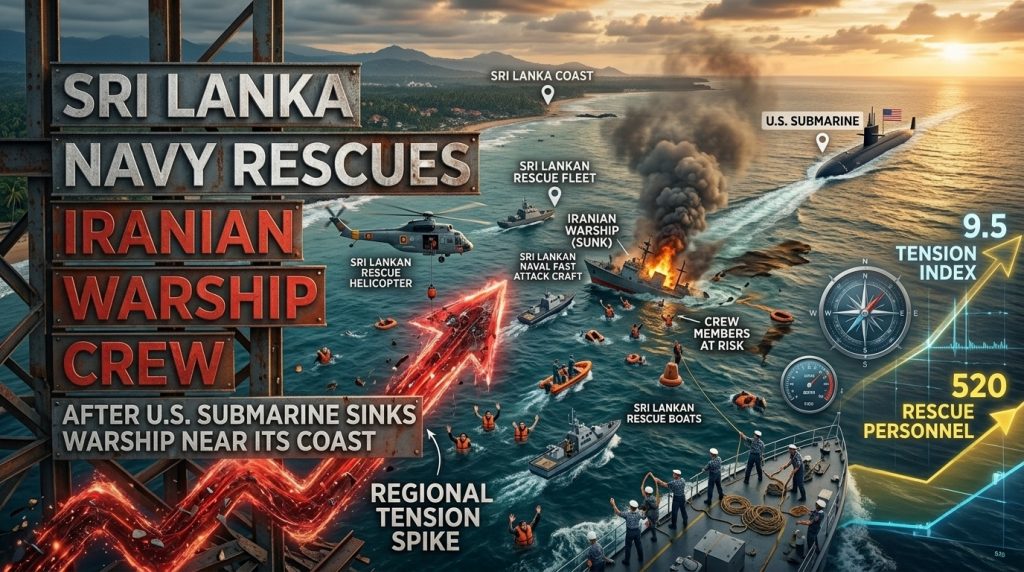
Sri Lanka has evacuated more than 200 Iranian naval crew members from a second warship off its coast. This came just one day after a US submarine sank the Iranian frigate IRIS Dena in international waters near Sri Lanka. The incident has thrust the island nation into the center of a widening military conflict between the United States and Iran.
Background
The crisis began on March 5, 2026, when a dramatic sequence of events unfolded in the Indian Ocean near Sri Lanka. A US submarine sank the Iranian frigate IRIS Dena, leaving 87 sailors dead, while Sri Lankan coastguards received a distress call from the vessel early that morning.The IRIS Dena had been sailing home after taking part in a major multinational naval exercise in the Bay of Bengal involving ships from 74 countries when it was struck.The sinking sent shockwaves across the region and placed Sri Lanka at the center of an unfolding geopolitical crisis.
Why Was an Iranian Warship in Sri Lanka?
Many people have been searching: Why was an Iranian warship in Sri Lanka? The answer lies in a peacetime naval exercise.
The IRIS Dena was returning from a naval exercise hosted by India when the US submarine torpedoed it marking the first time a US submarine has sunk an enemy warship by torpedo since World War II.
The second vessel, IRIS Bushehr, was a fleet supply ship accompanying the IRIS Dena. The IRIS Bushehr docked at the port of Colombo on March 5, carrying 208 naval personnel including 53 officers and 84 officer cadets, with the official reason cited as an engine technical malfunction.
Sri Lanka Evacuates Iranian Crew Full Details
Once IRIS Bushehr arrived in Sri Lankan waters, authorities moved quickly. Sri Lanka took control of the Iranian naval vessel after its captain surrendered the ship within Sri Lankan territorial waters, in what appears to be the first internment of a warship by a neutral nation since World War II.
Sri Lankan President Anura Kumara Dissanayake announced that his navy would take custody of the second ship and move it to the northeastern port of Trincomalee for safekeeping, amid fears it could be targeted.He confirmed that his government held discussions with both Iranian officials and the captain of the ship before proceeding.
The Sri Lanka evacuates Iranian crew captain story took a more dramatic turn when reports revealed deeper reasons behind the surrender. A former Sri Lankan navy official said the ship’s request for humanitarian assistance was in fact a cover for a mass escape by the crew, driven by a deep collapse of trust in the Islamic Republic amid the ongoing war.
Iranian Ship Sri Lanka Video and Eyewitness Accounts
Videos circulating online showed Iranian sailors arriving at hospitals and ports in Sri Lanka. Thirty-two survivors all seriously injured were taken to Galle National Hospital, while 87 bodies were recovered from the sea.
One Iranian sailor who died had called his father shortly before the strike, saying American forces had issued two warnings for the crew to abandon the vessel. The ship’s commander reportedly refused to allow evacuation, and the 32 survivors were mainly sailors who managed to escape on lifeboats.
Quotes from Officials
Sri Lankan Foreign Minister Vijitha Herath confirmed the human toll. He stated that 87 bodies were recovered from the sea and that more than 10 sailors remain missing.
Iranian Foreign Minister Abbas Araghchi called the strike “an atrocity at sea, 2,000 miles from Iran’s shores,” noting the ship had been a guest of India’s navy when struck without warning.
US War Secretary Pete Hegseth described the operation as “quiet death,”confirming the US role in the torpedo attack.
Iran Sri Lanka Relations
Iran and Sri Lanka have historically maintained diplomatic and trade ties. Sri Lanka imports oil from Iran and has maintained cordial relations through various administrations. However, this incident has tested that relationship and Sri Lanka’s position as a neutral state.
Sri Lanka found itself caught in the middle of the conflict, hoping its decision to let an Iranian navy ship dock in one of its ports would not anger the US and Israel.
Sri Lanka declared neutrality in the conflict and called for restraint. The island nation now finds itself hosting the human wreckage from a war being fought on its doorstep.
Sri Lanka to Iran The Geographic Context
The Sri Lanka to Iran map shows just how far from home these Iranian sailors were. The distance from Sri Lanka to Iran by sea is approximately 3,500 to 4,000 kilometers, passing through the Arabian Sea. The IRIS Dena was on its return journey when it was attacked just 19 nautical miles from the southern Sri Lankan port of Galle shockingly close to shore.
International maritime law allows warships from a belligerent state to enter the waters of a neutral country for up to 24 hours without being subject to attack. Under those frameworks, neutral governments must either expel or intern such vessels to maintain their neutrality.
Iran Ship India The Naval Exercise Connection
The Iran ship India connection is central to this story. The IRIS Dena was part of a multinational naval exercise hosted by India in the Bay of Bengal. The exercise involved ships from 74 countries, and Iran’s vessels were returning home when they were attacked.
India has not publicly commented on the sinking of the Iranian ship that had just participated in its hosted exercise a silence that carries its own diplomatic weight in the region.
Regional and Global Impact
The impact of this event extends well beyond Sri Lanka and Iran.
The Israeli-US attacks have killed more than 1,000 people in Iran and displaced more than 100,000 from Tehran, according to the UN.The sinking of IRIS Dena was part of a broader pattern it was one of more than 20 Iranian navy vessels destroyed since the United States and Israel launched coordinated strikes on Iran on February 28.Questions about international law have also risen sharply. Concerns have been raised about the legality of the attack in international waters, and legal experts globally are debating whether the torpedoing of a ship in neutral-adjacent waters sets a dangerous precedent.
Conclusion
The Sri Lanka evacuates Iranian crew episode marks a turning point for the island nation’s foreign policy. Sri Lanka has tried to remain neutral but now holds Iranian sailors, an interned warship, and the attention of major world powers. As the US-Iran conflict continues, Sri Lanka’s next steps how it handles the crew, the ship, and diplomatic pressure will be closely watched. Further developments are expected in the coming weeks as international legal reviews of the IRIS Dena sinking proceed.
FAQs
Is India an underrepresented country?
India is the world’s most populous democracy, yet it remains underrepresented in key global institutions such as the UN Security Council, the IMF, and the World Bank. Despite its economic and strategic weight, India does not hold a permanent seat on the UN Security Council, which many analysts argue makes it politically underrepresented at the highest levels of global governance.
What is the delimitation issue in India?
Delimitation in India refers to the redrawing of parliamentary and assembly constituency boundaries based on population data. The current freeze on delimitation, in place since 1976 and extended to 2026, was intended to prevent states with lower population growth from losing seats. The planned delimitation exercise based on post-2026 census data has stirred controversy, particularly in southern states that fear losing political representation to more populous northern states.
Why is women’s political representation so low in India at present?
Despite the Women’s Reservation Bill passed in 2023, which reserves 33% of seats for women in Parliament and state legislatures, implementation is linked to the completion of delimitation and a fresh census. Until those processes conclude, the bill will not take effect. Currently, women hold less than 15% of Lok Sabha seats, reflecting barriers including patriarchal political party structures, lack of campaign financing, and deeply rooted social norms that discourage women from entering public life.