
Bangladesh has gone through one of the most dramatic political transformations in its modern history. From a deadly student uprising in 2024 to a landmark election in 2026, the Bangladesh crisis today stands as a turning point for South Asia’s third-largest democracy.
Background: What Sparked the Bangladesh Political Crisis 2024?
The roots of the Bangladesh political crisis 2024 trace back to a single legal decision. In early June 2024, the Supreme Court of Bangladesh invalidated the government’s 2018 circular on job quotas in the public sector, reviving a quota system that reserved a significant share of civil service positions for certain groups.
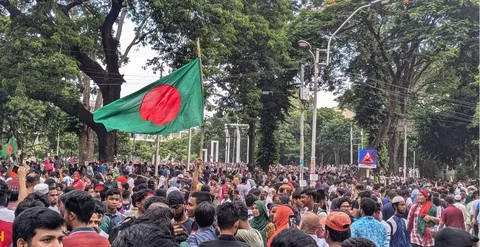
Students across the country took to the streets in protest. What started as a quota reform movement quickly turned deadly. The government carried out mass killings of protesters — known as the July Massacre — by late July. The crackdown only fueled public anger.
Following the violent crackdown by security forces, the protests escalated into a nationwide movement. With growing public support, the protests forced then-Prime Minister Sheikh Hasina to flee to India and led to the resignation of her government after 15 years in power.
Sheikh Hasina’s Fall: August 5, 2024
The ruling Awami League, which had consolidated its control by harassing political opponents and co-opting state institutions during its 15 years in power, was overthrown in a student-led uprising in August 2024.
With the backing of the military and student protesters, an interim government led by Nobel Laureate Muhammad Yunus took power. The Bangladesh crisis 2024 had reached its peak and a new chapter had begun.
This moment also triggered a constitutional vacuum. A constitutional crisis emerged in Bangladesh on 5 August 2024, after the prime minister resigned and fled to India as protesters stormed her residence and office in Dhaka.
Why Did Gen Z Protest in Bangladesh?
The Gen Z protest in Bangladesh was driven by more than just quota reform. Young people who had grown up under a single dominant government were tired of corruption, limited job opportunities, and state repression.
Young people make up 44 percent of voters in Bangladesh. They ousted Hasina, but had never seen a competitive election until now. For this generation, the Bangladesh political crisis was not just about one law. It was about reclaiming the future of their country.
The Interim Government: Yunus Takes the Helm
Nobel Peace Prize laureate Muhammad Yunus was tasked with leading Bangladesh through its most unstable transition in decades. The current political situation in Bangladesh 2025 was defined largely by how his administration managed this fragile moment.
The respect that Yunus commanded both at home and abroad was crucial in establishing the interim government’s legitimacy, mobilising support for ambitious political reforms, and maintaining consensus among key political players.
But the honeymoon did not last long. Popular pressure mounted on the government to start delivering not just on the promised reforms, but also on improvements to day-to-day governance. A burning issue was the scheduling of fresh national elections.
During the first five months of the interim government’s tenure, it reopened political and civic space and began to reform state institutions, but violence and political retribution remained problems.
Violence and Unrest: Bangladesh Crisis Today (2025)
The Bangladesh crisis today did not end with Hasina’s departure. New waves of instability followed throughout 2025.
Between 18 and 20 December 2025, a series of riots, arson attacks, and political unrest occurred across Bangladesh following the assassination of Osman Hadi, the spokesperson of Inqilab Moncho. Targets included media offices, political party headquarters, and even foreign diplomatic missions.
The broader period of post-resignation violence, spanning from August 2024 onwards, resulted in 44 policemen killed as of August 18, 2024, with over 18,000 arrested and nearly 1,500 monuments and sculptures damaged.
The Bangladesh crisis 2025 was a reminder that democratic transitions are rarely smooth especially after 15 years of authoritarian rule.
Road to Elections: Bangladesh Crisis 2026 Begins to Ease
Despite the turmoil, the Yunus government moved forward with its most important task: holding a free and fair election.
In a televised address in December 2025, the Chief Election Commissioner AMM Nasir Uddin confirmed that Bangladesh would hold a parliamentary election on February 12, and that a national referendum on political reforms would also be held on the same day.
Yunus framed the election schedule as a turning point, saying the country had moved closer to reclaiming democratic norms. “Bangladesh’s democratic journey has crossed an important milestone, strengthening the new path the nation has taken after the historic mass uprising,” he said.The Bangladesh crisis 2026 was entering its most hopeful phase yet.
February 12, 2026: Bangladesh Votes
On February 12, 2026, Bangladesh held its first general election since the 2024 uprising — and the scale was historic.
Over 127 million people were eligible to vote across the nation of some 170 million people, with 2,028 candidates contesting parliamentary seats nationwide.
European Union observers described the upcoming vote as the “biggest democratic process in 2026, anywhere.”
With the Awami League barred from political activity by the interim Yunus government, the election turned into a battle between two rival coalitions one led by the Bangladesh Nationalist Party (BNP), and the other by Jamaat-e-Islami.
BNP Wins in a Landslide
The results were decisive. The Bangladesh Nationalist Party won a landslide parliamentary election, securing a resounding mandate in a pivotal vote expected to restore political stability in the South Asian nation.
According to official results released by the Election Commission for 297 seats, the BNP won 209 seats on its own, comfortably crossing the 151-seat threshold required to form a government in the 300-member Parliament.
In the elections, the BNP won 209 parliamentary seats, while Jamaat-e-Islami secured 68 seats.
The Election Commission said voter turnout in the parliamentary election and simultaneous referendum was 59.44 percent.
Tarique Rahman Sworn In as Prime Minister
On February 17, 2026, the BNP established its Parliamentary Party and conducted its inaugural meeting, chaired by Tarique Rahman, after its 208 MPs took their oaths at the Jatiya Sangsad Bhaban. The Parliamentary Party elected BNP Chairman Tarique as its leader and the only candidate for prime minister.
BNP Chairman Tarique Rahman’s Press Secretary confirmed that MPs would take the oath at 10 AM at the Jatiya Sangsad Bhaban, with President Mohammed Shahabuddin swearing in the new cabinet members at the South Plaza of Parliament in the afternoon.This formally brought the Bangladesh political crisis paragraph to a close at least in its most acute phase.
Quotes from Key Figures
Muhammad Yunus (Chief Adviser, Interim Government): “Bangladesh’s democratic journey has crossed an important milestone, strengthening the new path the nation has taken after the historic mass uprising.”
Mirza Fakhrul Islam Alamgir (BNP Secretary General): He described the result as both joyful and emotional, noting that former chairperson Khaleda Zia did not live to witness the party’s return to power. He identified restoring the economy, maintaining law and order, curbing corruption, and ensuring justice as key challenges for the next government.
EU Chief Observer: The EU chief observer hailed the Bangladesh polls as a “big day” for democracy.
Constitutional Reforms: A Parallel Vote
Alongside the general election, Bangladesh also held a referendum on sweeping constitutional changes. The referendum covered establishing a neutral interim government for election periods, restructuring parliament into a bicameral legislature, increasing women’s representation, strengthening judicial independence, and introducing a two-term limit for the prime minister.The referendum recorded over 60 percent turnout, with the “yes” vote securing a majority.
Bangladesh Crisis 1971: Historical Roots
No analysis of the Bangladesh crisis is complete without acknowledging its deeper roots. Bangladesh was born through one of the bloodiest liberation wars in modern history. In 1971, East Pakistan fought for and won independence from West Pakistan, at the cost of millions of lives. The scars of that struggle, including debates over who collaborated with Pakistan and who fought for freedom, have continued to shape Bangladesh’s political identity and its cycles of conflict for over five decades. The Bangladesh crisis today is, in many ways, a long echo of those founding tensions.
Regional and Global Impact
The Bangladesh political crisis had significant consequences beyond its borders.An estimated 70,000 Rohingya refugees had already fled into Bangladesh over the last year, and more could join them if there is further violence in Myanmar’s Rakhine State. This adds a humanitarian burden to an already stretched state.
Bangladesh is also the world’s second-largest garment exporter, and the instability hit its economy hard. A clear election outcome had been seen as crucial for stability in the Muslim-majority country of 175 million after months of deadly anti-Hasina unrest disrupted everyday life and hit major industries, including the apparel sector.
India’s relationship with Bangladesh also shifted. With Hasina who had close ties with New Delhi gone, many voters are focused on restoring democratic rule, reviving the vital garment-export industry, and recalibrating ties with India, which soured after Hasina fled there following the upheaval.
Is Bangladesh Politically Stable Now?
The short answer: cautiously optimistic. In February, voters in Bangladesh’s first free and fair election in almost two decades delivered a clear majority to the Bangladesh Nationalist Party. The new government will need to pursue rapid reform if it is to keep public support. Job one is reinvigorating the economy.
The BNP’s two-thirds majority gives it the power to govern effectively but also the responsibility to avoid repeating the authoritarian patterns of the past. Jamaat-e-Islami and its 11-party alliance alleged irregularities in vote counting and result announcements, warning of mass mobilisation if complaints are not addressed.
The current political situation in Bangladesh 2025 has now evolved into a post-election transition fragile, but far more hopeful than it was a year ago.
Conclusion: What Comes Next?
Bangladesh has survived its political crisis but the road ahead is steep. The new BNP-led government must rebuild public trust, restore economic growth, and prove that it will not slide back into the authoritarian practices that defined the Awami League era.
For a generation of young Bangladeshis who risked their lives to reclaim democracy, the real test is just beginning. The Bangladesh crisis 2026 may be easing but the work of building a stable, just, and democratic Bangladesh has only just started.
FAQs
What is the reason for Bangladesh’s conflict?
The Bangladesh political crisis stems from decades of authoritarian rule, political rivalry between the Awami League and BNP, economic grievances, and institutional corruption. The immediate trigger in 2024 was the reinstatement of a controversial civil service quota system, which sparked massive student-led protests that eventually overthrew Prime Minister Sheikh Hasina’s government.
Why did Gen Z protest in Bangladesh?
Gen Z protesters in Bangladesh were driven by anger over a quota system that they felt blocked merit-based access to government jobs. The protests grew into a broader uprising against 15 years of Awami League rule, which was marked by repression, corruption, and political manipulation. Young people making up 44% of the electorate wanted democratic change and economic opportunity.
Is Bangladesh politically stable now?
Bangladesh is more stable in 2026 than it was during the peak of the crisis, following the February 12 election that gave BNP a two-thirds parliamentary majority. However, full stability depends on whether the new government delivers on economic recovery, justice, and institutional reform. Opposition parties have raised concerns about irregularities, and the transition remains a work in progress.