

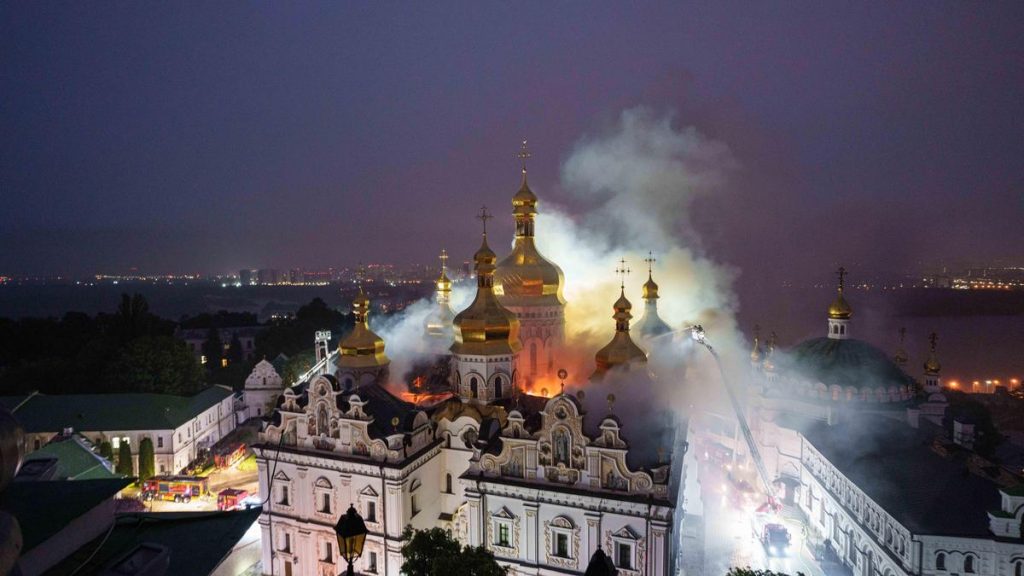
Kyiv-Pechersk Lavra has been a place of continuous religious life for nearly a thousand years. The Russia-Ukraine war has not destroyed it, but it has changed what it means to be there air raid sirens replacing pilgrimage bells, security protocols replacing open gatherings, and a persistent background anxiety about what a stray missile or shock wave could do to structures that have already survived one destruction and been rebuilt.
The Dormition Cathedral Kyiv, the centerpiece of the complex, stands intact. That it is still standing is something. Whether it stays that way depends on factors that have nothing to do with its historical importance.
Background: Kyiv-Pechersk Lavra and Its Historical Importance
Kyiv-Pechersk Lavra the Monastery of the Caves was founded in 1051. It predates almost every institution in Eastern Europe that still functions. UNESCO designated it a World Heritage site in 1990, recognizing what generations of monks, architects, and worshippers had built across ten centuries.
The Dormition Cathedral of Kyiv Pechersk Lavra is the most recognizable structure within the complex. The original was destroyed in 1941 blown up during the German occupation, though both sides blamed each other for decades. The version standing today was reconstructed and completed in 2000. It is a rebuilding of something lost, which gives it a particular resonance in a war where loss is again the dominant experience.
Before the escalation of the Russia-Ukraine conflict, Kyiv-Pechersk Lavra drew over three million visitors a year. Pilgrims, tourists, and the simply curious moved through the same underground cave churches that monks inhabited in the eleventh century. That life has been significantly curtailed.
Current Situation of Kyiv-Pechersk Lavra
Ukrainian authorities have increased security and monitoring around Kyiv-Pechersk Lavra since the war intensified. The complex has not been directly struck. But Kyiv has been struck repeatedly missiles, drones, and debris from intercepted projectiles have damaged buildings across the capital, and the Lavra’s location puts it within that risk perimeter.
The concern cultural experts raise is not only about a direct hit. Repeated shockwaves from nearby explosions cause cumulative stress to old masonry, foundations, and the fragile painted surfaces of underground cave churches. These are materials and structures that cannot simply be swapped out after damage. Some of what exists inside Kyiv-Pechersk Lavra cannot be replicated.
The Dormition Cathedral Kyiv continues to function, but in a reduced capacity. High-alert periods mean limited public gatherings. Religious life continues under conditions that the people who practice it did not choose.
Cultural and Religious Significance
Kyiv-Pechersk Lavra is a different kind of landmark from a museum or a government building. It is a living religious community, not a preserved artifact. Monks live there. Liturgies are conducted there. For Orthodox Christians in Ukraine, it is one of the holiest places on the continent.
Its political dimension has become more complicated since the war began. The Russian Orthodox Church maintained control of the monastery for years, and the Ukrainian government’s move to transfer administration to the Ukrainian Orthodox Church was part of a broader assertion of cultural and religious independence from Moscow. That dispute about who rightfully administers one of Christianity’s oldest monastic sites sits within the larger conflict about Ukrainian sovereignty.
The Dormition Cathedral of Kyiv Pechersk Lavra is therefore not simply an architectural or historical question. It is a statement about identity, about which traditions Ukraine claims as its own, and about the relationship between Russian and Ukrainian Orthodox Christianity that the war has made irreconcilable for the foreseeable future.
Impact of War on Kyiv Religious Sites
The war’s effect on religious sites in Kyiv is felt most immediately in the disruption to normal practice. Air raid alerts can come at any hour. Services are interrupted, curtailed, or moved underground. The cave churches that are part of Kyiv-Pechersk Lavra’s identity have an accidental practical advantage here they were underground before air raids were a consideration.
Dormition Cathedral Kyiv operates under security protocols that would have been unimaginable as recently as 2021. Access is managed. Large gatherings are limited during high-risk periods. The religious calendar continues, but around the edges of a security situation that takes priority.
UNESCO has been vocal about the risks to Ukrainian cultural heritage sites generally. Kyiv-Pechersk Lavra is specifically listed in international discussions about monuments at risk, which creates pressure on both military forces to exercise care and on the international community to provide support for preservation.
Expert Views and Cultural Commentary
Cultural historians working on Ukrainian heritage use language that is careful about what the war has already cost and what it could still cost. The Kyiv monastery complex is not replaceable. The cave system, the relics, the frescoes, the archaeological layers these accumulated over centuries and cannot be reconstructed if lost.
Security analysts note that cultural sites occupy a complicated position in modern warfare. They are not supposed to be military targets under international law. They do become symbolic sometimes as propaganda, sometimes as deliberate statements about cultural erasure. There is no confirmed evidence that Kyiv-Pechersk Lavra is being deliberately targeted. The risk it faces is primarily the risk of being in a city at war: proximity, collateral damage, cumulative stress.
Religious leaders across denominations have called for protection of places of worship. That call is consistent and largely ignored by the operational realities of the conflict. It matters nonetheless as a statement of principle.
Global Reaction
International attention to Kyiv-Pechersk Lavra reflects a broader concern about what the Russia-Ukraine war is doing to the material record of European civilization. Ukraine’s cultural losses since 2022 — documented by UNESCO, by the Smithsonian, by independent researchers are substantial and growing.
The Dormition Cathedral of Kyiv Pechersk Lavra appears in international heritage discussions not because it is the most damaged site in Ukraine but because of what it represents. The destruction of the original in 1941, the decades of Soviet neglect and restriction, the reconstruction in 2000, and now this the site has absorbed the weight of twentieth and twenty-first century European history in concentrated form.
Human rights organizations and cultural preservation groups have called on both sides to respect the protections international law extends to religious and historical monuments. Whether those calls have operational effect is a different question from whether they matter.
Why Kyiv-Pechersk Lavra Matters Today
Part of what makes Kyiv-Pechersk Lavra significant during this war is that it predates the categories we use to argue about the war. It was there before modern Ukraine and before modern Russia. The monks in the caves in 1051 were not defining nationality in twentieth-century terms. The site exists outside the conflict that now surrounds it, which is part of why its survival carries meaning beyond either side’s political claims.
The Dormition Cathedral Kyiv functions as that kind of symbol something that has outlasted previous catastrophes and that people are determined to keep outlasting this one. That determination is genuine and it is not nothing.
Future Outlook
How Kyiv-Pechersk Lavra emerges from this war depends first on the war itself, and then on the decisions made in its aftermath. If the complex survives without major structural damage, restoration and reopening to full public access will be a priority in whatever reconstruction period follows.
International funding for cultural heritage restoration in Ukraine is already being discussed in anticipation of that phase. The Dormition Cathedral of Kyiv Pechersk Lavra would be near the top of any list of sites warranting attention, given its UNESCO status, its religious significance, and its symbolic weight in Ukraine’s national identity.Until then, the site exists in the condition that most of Kyiv exists in: intact so far, under threat, and waiting.
Conclusion
Kyiv-Pechersk Lavra is still standing. The Dormition Cathedral Kyiv still holds services. The underground cave churches still contain what they have contained for centuries. None of this is guaranteed to still be true tomorrow, or next month, or whenever the next missile targeting Kyiv falls slightly differently than the last one.
Cultural preservation in a war zone is not a policy problem. It is a daily condition of uncertainty managed by people trying to maintain something worth preserving. The fact that the complex is still there is not an accident it is the result of decisions, preparations, and luck, in proportions that no one can fully calculate.
FAQs
Why did Russia’s attack on Kyiv fail?
Russia’s initial push toward Kyiv in February and March 2022 stalled for several interconnected reasons. Ukrainian resistance was better organized and more effective than Russian military planners anticipated. Logistical failures — fuel shortages, broken supply chains, vehicles that could not sustain the advance — compounded the tactical problems. Urban terrain favored the defenders. International weapons deliveries, particularly anti-tank systems, arrived quickly enough to matter in the early weeks. Russia withdrew from the Kyiv region in late March 2022, framing it as a goodwill gesture toward negotiations while military analysts described it as a recognition that the operation had failed on its own terms.
Why did Russia attack Ukraine now?
The conflict’s roots run through decades of post-Soviet geopolitics: disputes over Ukraine’s orientation toward Europe and NATO, the 2014 Maidan uprising and subsequent annexation of Crimea, eight years of war in the Donbas, and a broader Russian strategic calculation that NATO expansion represented an unacceptable security threat. The specific timing of the February 2022 full-scale invasion reflected Russia’s assessment of a window a Ukrainian military that had not yet received the Western weapons systems it would later receive, a US focus on domestic issues, and a moment where the operation might be concluded quickly. That calculation turned out to be wrong on most of its assumptions.
What missile did Russia hit Ukraine with?
Russia has used a range of weapons systems against Ukrainian targets since 2022, including Kalibr cruise missiles launched from naval platforms, Iskander ballistic missiles, Kh-101 and Kh-55 air-launched cruise missiles, Iranian-designed Shahed drones, and S-300 surface-to-air missile systems repurposed for ground attack. Kyiv has been targeted with various combinations of these systems, often in mixed-weapon salvos designed to saturate Ukrainian air defenses. The specific weapon used in any given strike is typically confirmed by Ukrainian defense authorities after debris analysis.