
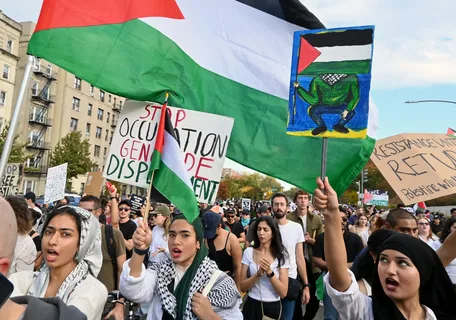
The phrase “Pro Palestine protest meaning” has become one of the most searched topics in recent years as demonstrations supporting Palestinian rights have taken place across cities, universities, and public spaces worldwide. These protests have drawn millions of participants and sparked debates about human rights, foreign policy, freedom of expression, and the future of the Israeli-Palestinian conflict.
Understanding what these demonstrations represent requires examining their goals, origins, and how the movement has evolved since the escalation of violence in the Middle East. From large marches to Pro Palestine encampments on university campuses, the movement has become a major force in global political discourse.
Background
To understand the Pro Palestine protest meaning, it is important to look at the broader Israeli-Palestinian conflict. The conflict has roots stretching back more than a century and involves disputes over territory, sovereignty, security, and national identity.
Many people participating in demonstrations describe their activism as support for Palestinian human rights, self-determination, and protection of civilians affected by conflict. Others focus on humanitarian concerns, including access to food, healthcare, education, and basic infrastructure in Palestinian territories.
The movement gained significant global attention following the escalation of violence after October 2023. Since then, protests have expanded across Europe, North America, Asia, Africa, and the Middle East.
What Are Pro Palestine Protests About?
One of the most common questions online is: “What are Pro Palestine protests about?”
The answer varies depending on the organizers and participants involved. However, several themes frequently appear across demonstrations:
- Calls for a ceasefire in conflict zones
- Support for Palestinian civilian rights
- Advocacy for humanitarian aid
- Opposition to military actions causing civilian casualties
- Support for diplomatic solutions to the conflict
- Calls for accountability under international law
While different groups may emphasize different issues, the majority of demonstrations focus on humanitarian and political concerns related to Palestinians.
As a result, searches for “Pro Palestine protest wiki” have increased as people seek background information about the movement and its goals.
October 7 Palestine Protest Discussions
The events of October 2023 transformed international discussion surrounding the conflict. Since then, the phrase “October 7 Palestine protest” has frequently appeared in news coverage and online searches.
Many demonstrations held after October 7 focused on responses to the violence, civilian casualties, and humanitarian concerns. Some rallies were organized immediately after events unfolded, while others developed as broader international campaigns advocating for ceasefire agreements and diplomatic solutions.
The scale of public engagement demonstrated how deeply the conflict resonates with communities around the world.
October 8 Palestine Protest and Early Mobilization
Another frequently searched term is “October 8 Palestine protest.” This refers to demonstrations that emerged immediately after the initial escalation of violence.
Activists, students, religious organizations, labor groups, and community leaders organized rallies in numerous countries. The speed with which these events were organized reflected the strong public interest surrounding developments in the region.
These early demonstrations laid the foundation for a larger international movement that continued throughout 2024, 2025, and 2026.
Rise of Pro Palestine Encampments
One of the most visible developments has been the emergence of Pro Palestine encampments on university campuses.
These encampments became a prominent form of protest, particularly in North America and Europe. Students established temporary camps to draw attention to the conflict and encourage universities to review investment policies, partnerships, and institutional positions.
The encampments generated significant public debate. Supporters argued that they represented peaceful activism and student engagement. Critics raised concerns regarding campus disruptions, safety issues, and policy disagreements.
Despite differing views, the encampments became one of the defining symbols of the broader movement.
Palestine Protest Numbers Reach Millions
Palestine protest numbers have reached remarkable levels across multiple continents. Major cities including London, New York, Paris, Istanbul, Jakarta, and many others have witnessed large demonstrations.
While exact attendance figures often vary depending on organizers and authorities, experts generally agree that the movement has become one of the largest international protest campaigns in recent history.
Large gatherings have repeatedly drawn hundreds of thousands of participants, while smaller events continue to take place in towns, universities, and community centers worldwide.
These Palestine protest numbers illustrate the global reach of the issue and its significance for many different communities.
Pro Palestine Israelis and Internal Debate
An important aspect of the movement is the presence of Pro Palestine Israelis.
Not all Israelis share identical views regarding the conflict. Some Israeli activists, academics, human rights advocates, and former officials have publicly supported Palestinian rights and called for diplomatic solutions.
Pro Palestine Israelis often participate in peace initiatives, coexistence projects, and campaigns aimed at reducing violence. Their involvement demonstrates the diversity of opinion that exists within Israeli society.
The presence of Pro Palestine Israelis also challenges the assumption that support for Palestinian rights exists only outside Israel.
Political and Social Impact
The movement has influenced political discussions in many countries. Governments, opposition parties, universities, businesses, and civil society organizations have all faced pressure to respond to public concerns.
The debate extends beyond foreign policy and touches on issues such as freedom of speech, protest rights, academic freedom, and international humanitarian law.
Politicians across different ideological backgrounds have expressed a range of opinions regarding the demonstrations. Some support the movement’s goals, while others criticize certain protest tactics or policy demands.
This diversity of viewpoints has contributed to ongoing public discussion and political engagement.
Media Coverage and Public Awareness
Media organizations around the world have extensively covered demonstrations, encampments, and political debates connected to the movement.
The rise of social media has further amplified public awareness. Videos, photographs, interviews, and livestreams have enabled people to follow events in real time.
As a result, understanding the Pro Palestine protest meaning has become increasingly important for readers seeking context about one of the most significant global protest movements of recent years.
Future of the Movement
The future direction of the movement remains uncertain. Much will depend on developments in the Israeli-Palestinian conflict, diplomatic negotiations, humanitarian conditions, and political responses from governments around the world.
Many organizers indicate that they plan to continue advocacy efforts regardless of immediate political outcomes. Others are focusing on educational initiatives, humanitarian campaigns, and long-term policy engagement.
What is clear is that public interest in the issue remains strong, and discussions surrounding Palestinian rights will likely continue to influence global politics.
Conclusion
The Pro Palestine protest meaning extends beyond a single slogan or demonstration. It represents a broad international movement focused on Palestinian rights, humanitarian concerns, political advocacy, and public engagement with one of the world’s most enduring conflicts.
From October 7 Palestine protest discussions to Pro Palestine encampments and growing Palestine protest numbers, the movement has become a major force in contemporary global activism. As events continue to unfold, the conversation surrounding Palestinian rights and regional peace is likely to remain at the center of international attention.
FAQs
Are the UK supporting Palestine?
The United Kingdom officially supports a negotiated two-state solution and provides humanitarian assistance to Palestinians. However, political opinions within the UK vary significantly. Different political parties, lawmakers, advocacy groups, and members of the public hold differing views regarding the conflict and the best path toward peace.
Which UK party is pro-Palestine?
There is no single major UK party that can be universally described as exclusively pro-Palestine. Individual politicians and party factions often express varying levels of support for Palestinian rights, humanitarian assistance, ceasefire efforts, and diplomatic initiatives. Positions can differ significantly even within the same political party.
Are girls allowed to go to school in Palestine?
Yes. Girls attend schools throughout Palestinian territories and female education is widely supported by Palestinian families and educational institutions. Like many regions affected by conflict, access to education can sometimes be disrupted by security conditions, infrastructure challenges, or humanitarian crises, but girls’ education remains an important part of Palestinian society.